



India’s shipbuilding and maritime capex cycle is booming, supported by government policies and a strong execution pipeline. This aligns with the government’s ambition to position India among the top five shipbuilding nations and a global ship-repair hub over the next decade.
This ambition is anchored by the Indian Navy’s force-level roadmap, which targets a fleet of 175–200 warships by 2035, up from the current strength of about 132 vessels. The near-to-medium-term order visibility is already meaningful. According to Krishna Defence, the Indian Navy currently has 68 warships and vessels on order, valued at around ₹2 lakh crore.
This ongoing build-out, combined with future fleet additions, ensures sustained demand not just for shipyards but across the wider maritime ecosystem. In parallel, port-led development and coastal infrastructure spending continue to support dredging, marine services, and specialised maritime construction.
Against this backdrop, proxy plays become more important. Companies supplying defence components and building complex maritime structures are directly linked to the same capex cycle. Previously, we examined 3 companies to benefit from the shipbuilding and defence capex cycle, without being shipyards themselves. However, the opportunity set does not stop there.
The welding segment and the global metallic hose market are also expected to benefit. The welding industry is a cornerstone of the manufacturing sector, which itself accounts for 17% of GDP and is expected to rise to 21% over the next 6-7 years, per Ador Welding. High-growth sectors such as energy, automotive, defence, shipbuilding, and aerospace will drive the demand.
Opportunity also lies in metallic, flexible flow solutions that carry fluids or gases while allowing movement. The segment is expected to double to $288 million by 2035, up from $137 million in 2024, as per Aeroflex Industries. Data Centers, Electric Mobility, Aerospace, and shipbuilding are expected to drive the demand.
Similarly, in this story, let’s look at three such beneficiaries…
#1 Ador Welding: The high-end robotics pivot
Ador Welding is a leading player in the Indian welding industry. The company provides a comprehensive range of welding consumables, equipment, and automation solutions, serving as a vital partner for national infrastructure and industrial development.
Ador divides its business into three main reportable segments. These include the Products division, which offers welding consumables (electrodes, wire, and flux) and a wide range of equipment, including power sources and accessories. Then comes the Services division, which provides customized solutions.
Robotics and cobots: Ador’s shift to high-end fabrication
The Maintenance and Reclamation Division focuses on the life enhancement of industrial components through surfacing, spraying, and fusion solutions. The company is also aggressively expanding its Welding Automation Division, moving towards robotic solutions, cobots, and high-end CNC cutting and drilling software like King Cut and King Drill.
The naval monopoly
It identifies several core sectors for aggressive growth, including defence, shipbuilding, and nuclear energy. Because the company specializes in shaping and joining metals, its products and services are fundamental to the construction of vessels. In the shipbuilding sector, Ador possesses the technology to meet 90% to 95% of all welding requirements.
This coverage extends to general consumption welding for both large-scale commercial shipping and complex defence-related naval projects. Ador maintains active working relationships with the largest Indian shipyards, mainly Public Sector Undertakings.
Aligning with 11 global manufacturing value chains
Beyond defence, Ador also targets renewable energy and recently launched submerged-arc wire and fluxes specifically for wind tower fabrication. The company is pursuing long-term growth through ongoing approvals for nuclear-grade applications and thermal space. Further, it aligns its growth with 11 manufacturing value chains identified by McKinsey, like pharmaceuticals, semiconductors, and aerospace.
The EBITDA recovery
From a financial perspective, Ador’s standalone revenue declined 1% year-on-year to ₹531 crore in the first half of FY26. Steel price fluctuations, flat consumption, and export headwinds from US tariffs impacted growth. EBITDA (earnings before interest, tax, depreciation, and amortisation) fell 35.4% to ₹31 crore, while margins declined by 320 bps to 5.8%.
Margins fell due to one-time onerous costs and liquidated damages. Management expects volumes to improve in the second half. The company expects to show growth over the second half of the previous year.
#2 KMEW: Monopolising the ‘green’ blue economy
Knowledge Marine & Engineering Works (KNEW) is India’s only listed pure-play marine engineering company, specialising in dredging, port ancillary services, and shipbuilding. Dredging is the company’s anchor segment, contributing over 96% of its revenue in FY25. As of 30 September, shipbuilding accounted for 11% of its ₹1,749 crore order book.
Within dredging, it handles both capital and maintenance dredging for ports, rivers, and fishing harbors. The segment uses a diverse fleet, including Trailing Suction Hopper Dredgers and Cutter Suction Dredgers. The company also operates port ancillary crafts and shipbuilding and repair segments.
Shipbuilding Expertise
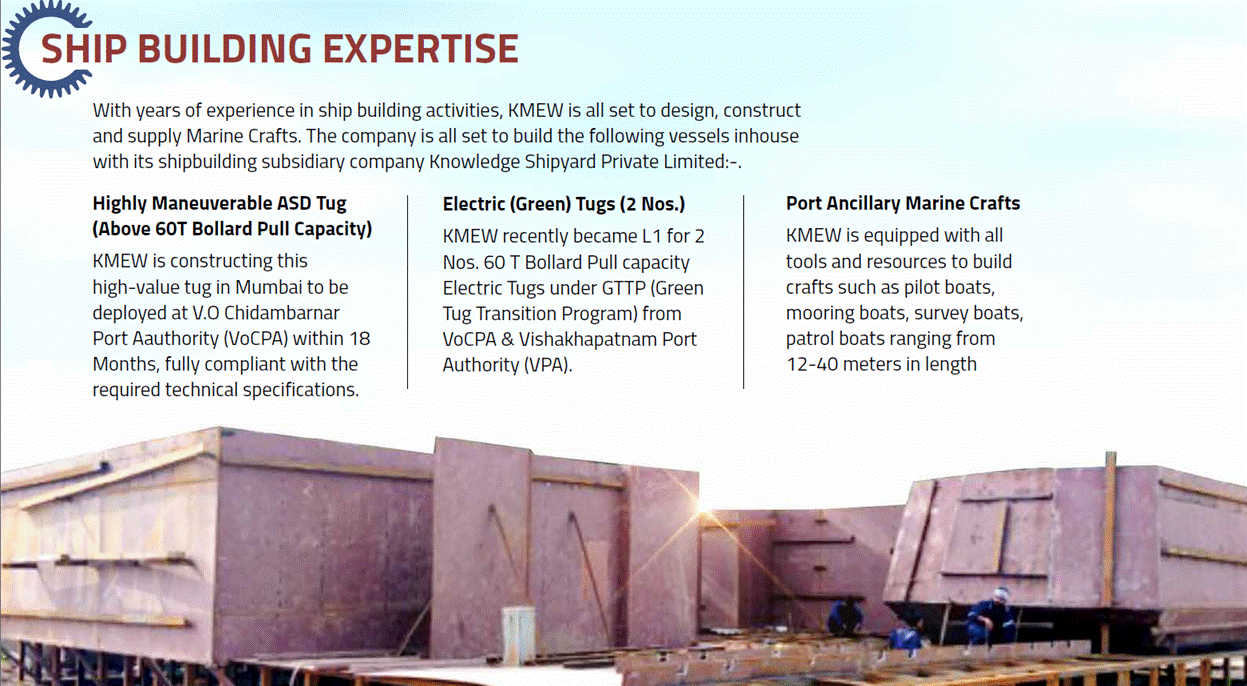
Source: KMEW Investor Presentation
KMEW’s involvement with the naval and defense sectors is multifaceted.
With the acquisition of Kamal Marine & Engineering Works, KMEW has vertically integrated its operations to design, construct, and refit specialized vessels. The company’s facilities build and refit fast patrol boats, pilot launches, and mooring boats, specifically securing contracts from defence agencies.
The decarbonization dividend: Leading India’s green tug transition
It currently has orders to construct 24 marine crafts for the Inland Waterways Authority of India, valued at approximately ₹195 crore. In addition, KMEW is positioning itself as a leader in India’s Green Tug Transition Program. It has secured two high-value 15-year contracts at VOC Port (₹327 crore) and Visakhapatnam Port (₹326 crore) for electric tugs.
Navigating the Narmada and global luxury tourism
The company expects this segment to eventually emerge as a standalone business vertical. It is also expanding into the luxury cruise sector, through a project with the Madhya Pradesh Tourism Board. The project involves operating a vessel on the Narmada River, which is projected to offer revenue visibility of up to ₹800 Crores over 20 years.
A significant portion of India’s dredging demand stems from the need to maintain naval bases and military ports, which are essential to national security. Here, KMEW provides maintenance for key naval projects and works with the Director General Naval Projects in Visakhapatnam, the South Naval Command in Kochi, and the Western Naval Command in Mumbai.
The Indian maritime industry as a whole is currently witnessing a surge in defense and public-sector orders for harbor, river, and support vessels. This demand is the main driver of the domestic shipbuilding market, which is projected to grow from $1.12 billion in 2024 to $8 billion by 2033 (around ₹72,000 crore).
KMEW is positioned to capitalize on this growth by participating in tenders and aligning with the government’s Atmanirbhar Bharat guidelines. As part of its long-term strategy, KMEW is expanding its fleet and geographic reach to support India’s Blue Economy and Maritime Amrit Kaal Vision 2047.
Future Growth Enablers
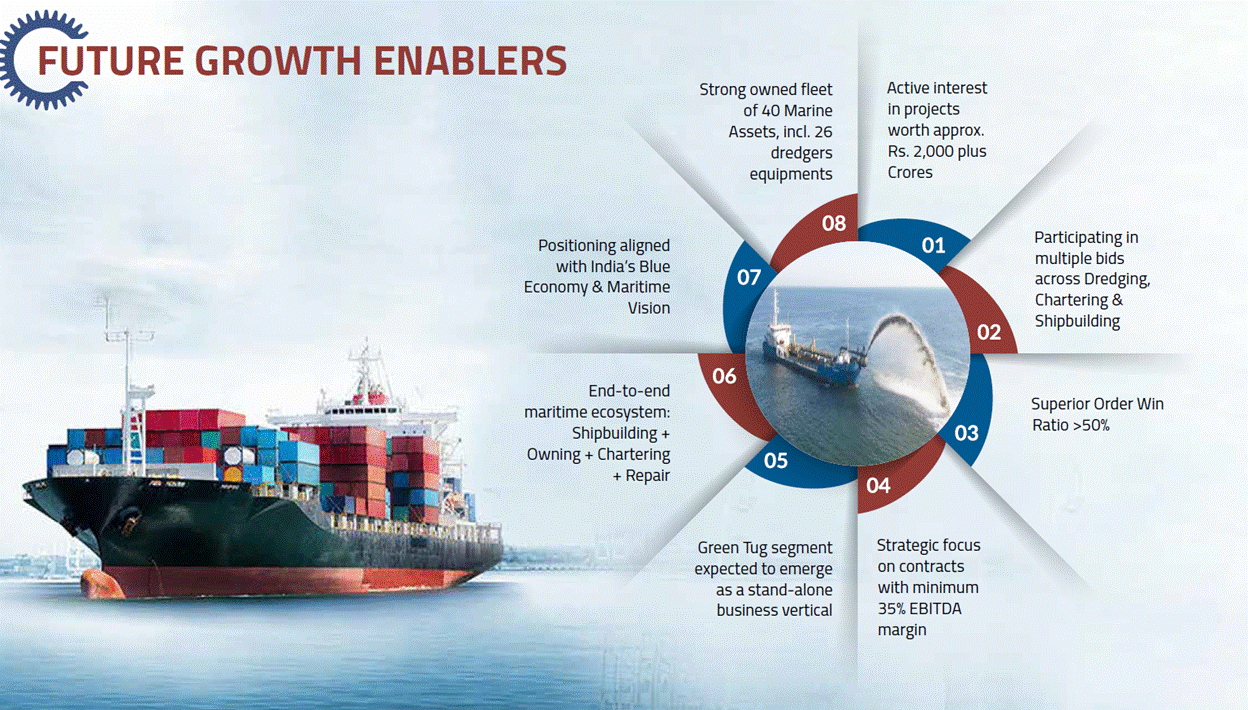
This includes expansion of patrol fleets. The company currently has 25-knot speed patrol boats and VIP security launches under construction to enhance coastal capabilities. KMEW aims to enter the large trailing suction hopper dredger market, enabling it to execute mega-scale dredging projects for deep-channel naval and commercial ports.
Infrastructure Scaling: Managing a ₹1,749 crore strategic backlog
From a financial perspective, revenue increased by 3% year-on-year to ₹98.6 crore in the first half of FY26. However, EBITDA fell by 7.6% to ₹36.9 crore, while margins declined by 190 bps to 38.6%. Net profit declined slightly by 2% to ₹23 crore. KNEW ₹1,749 crore order book provides revenue visibility for more than 5 years.
#3 Aeroflex: Engineering the metallurgy of Deep-sea pressure
Aeroflex Industries is a leading global provider of metallic flexible flow solutions. The company manufactures precision-engineered products used for the controlled flow of solids, liquids, and gases across a vast range of industries. Its products are used in new-age industries, including data centers, semiconductors, robotics, and hydrogen.
The metallurgy of movement
Metallic flexible flow solutions carry fluids or gases while allowing movement and absorbing vibration without compromising strength or safety. As naval and ship-based equipment operate in highly corrosive, high-pressure environments, it requires specific technical attributes in flow solutions. This is where Aeroflex’s metallic, flexible flow solutions come in handy.
They are chemically compatible, temperature-resistant, and abrasion-resistant. These products are durable substitutes for rubber and polymers. They are capable of absorbing high pressure and maintaining integrity in the extreme environments found at sea.
The Hyd-air integration
A primary driver for Aeroflex’s presence in the maritime industry is its subsidiary, Hyd-Air Engineering. The company specialises in hydraulic products, which Aeroflex leverages to provide comprehensive flow solutions, including hydraulic fittings, fluid connectors, and flanges.
This acquisition strategically strengthened Aeroflex’s integrated manufacturing capabilities. It helped broaden its influence in the shipbuilding and heavy industry markets. Through this subsidiary, Aeroflex got access to a top client base, including Mazagon Dock Shipbuilders, BHEL, and Tata Steel.
Hyd-Air revenue contribution is small. Hyd-Air’s revenue for H1FY26 reached ₹15 crores, up 5X from ₹3 crores in H1 FY25. The subsidiary turned profitable in Q2FY26 after recording a loss in Q1. Management is planning further capacity expansion at Hyd-Air to meet rising demand.
Aeroflex sees strong demand from the marine, aerospace, and defence sectors for its ongoing industrial expansion. The company is also seeing stronger sales traction in domestic segments supporting naval operations, particularly ports and terminals.
Beyond Hoses: The data centre and hydrogen growth levers
To capitalise on the demand, the company is increasing its annual production capacity for SS flexible hoses from 16.5 million meters to 20 million meters by March 2026. The company expects a revenue potential of around ₹650 crore at peak utilisation. It is also scaling its metal bellows production to 300,000 pieces annually to meet rising demand in high-dynamic industrial applications.
From a financial perspective, revenue increased by 5.7% year-on-year to ₹195 crore in the first half of FY26. Most of the revenue (73%) comes from exports, while domestic sales accounted for 27%. EBITDA increased by 3.9% to ₹41.9 crore, while margins declined slightly by 21 bps to 21.4%. However, net profit declined by 17.9% to ₹21.4 crore, due to weak quarter one.
Valuation guardrail: Is growth already priced in?
Knowledge Marine’s valuation is too high, even relative to the median and industry valuations, leaving little margin of safety. However, it boasts a strong Return on Capital Employed (RoCE) and Return on Equity (RoE). Aeroflex is trading near its median valuation but above the industry median. Aeroflex RoCE is high, indicating strong capital utilisation, but RoE is moderate.
| Valuation Assessment (X) | |||||
| Company | P/E | 5Y Median P/E | Industry P/E | RoCE (%) | RoE (%) |
| Ador Welding | 32.3 | 30.0 | 29.7 | 20.3 | 13.9 |
| Knowledge Marine | 87.8 | 29.4 | 100.0 | 24.7 | 25.8 |
| Aeroflex | 54.1 | 50 (2Y) | 22.1 | 22.3 | 16.6 |
Ador Welding is valued at both the median and industry multiples. Its return ratios, particularly RoCE, are strong, but RoE is weak. As India’s naval ambitions move toward a 200-ship fleet, these niche companies point the way to a multi-year capex super-cycle. However, how this is accomplished remains to be seen.
Disclaimer
Note: Throughout this article, we have relied on data from http://www.Screener.in and the company’s investor presentation. Only in cases where the data were unavailable have we used an alternate, widely accepted, and widely used source of information.
The purpose of this article is only to share interesting charts, data points, and thought-provoking opinions. It is NOT a recommendation. If you wish to consider an investment, you are strongly advised to consult your advisor. This article is strictly for educational purposes only.
About the Author: Madhvendra has been deeply immersed in the equity markets for over seven years, combining his passion for investing with his expertise in financial writing. With a knack for simplifying complex concepts, he enjoys sharing his honest perspectives on startups, listed Indian companies, and macroeconomic trends.
A dedicated reader and storyteller, Madhvendra thrives on uncovering insights that inspire his audience to deepen their understanding of the financial world.
Disclosure: The writer and his dependents do not hold the stocks discussed in this article.
The website managers, its employee(s), and contributors/writers/authors of articles have or may have an outstanding buy or sell position or holding in the securities, options on securities or other related investments of issuers and/or companies discussed therein. The articles’ content and data interpretation are solely the personal views of the contributors/ writers/authors. Investors must make their own investment decisions based on their specific objectives, resources, and only after consulting such independent advisors as may be necessary.