




The Indian government is reportedly considering an incentive package of up to ₹23,000 crore in the upcoming Budget 2026. The goal is to accelerate domestic manufacturing of capital goods and promote Make in India products, reducing dependence on imports. (Note: Financial Express could not independently verify these reports.)
The construction equipment sector could receive incentives worth approximately ₹16,000 crore, while the automobile sector is targeted for ₹7,000 crore to build global value chains. Support for construction equipment followed China’s restrictions on tunnel boring machine exports, which disrupted infrastructure projects in India previously. However, they were lifted last year.
Support for the auto sector will target advanced automotive components such as Advanced Driver Assistance Systems, 360-degree cameras, sensors, and other high-technology parts, with a provision to promote at least 50% domestic value addition. In this article, we have highlighted three stocks that could benefit from the construction sector incentive…
#1 ACE: Dominating the crane market with a strategic defence pivot
Action Construction Equipment (ACE) is a diversified construction Equipment Manufacturer. It manufactures construction equipment, including cranes and material handling equipment. ACE serves sectors including infrastructure, Manufacturing, Logistics, and the agri-sector. It has a presence in both domestic and global markets, exporting to over 37 countries.
The 63% crane dominance
In fact, ACE is the world’s largest pick & carry Crane manufacturer and holds over 63% market share in Mobile and tower cranes. In the backhoe loader segment, a significant focus area, ACE aims to increase its market share from roughly 2.5% to double digits. In the heavy crane segment, ACE aims to achieve 50% market share within the next 3–4 years.
ACE Financial Performance
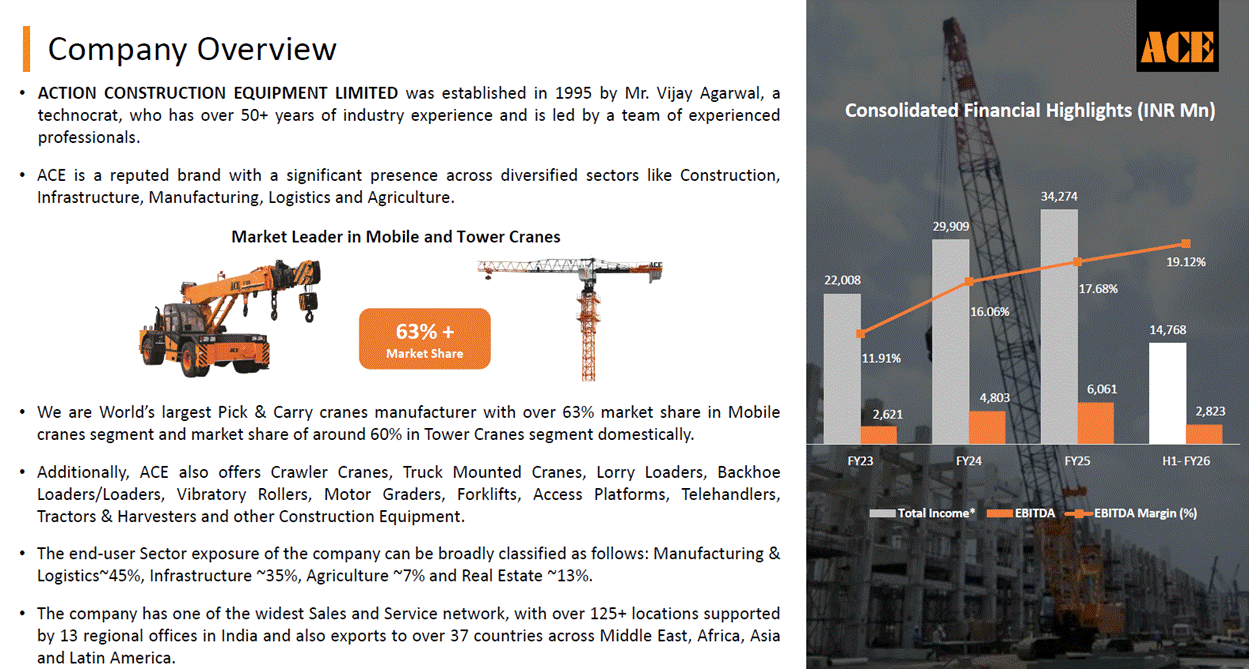
Among end-user sectors, manufacturing and logistics (45%), infrastructure (35%), real estate (13%), and agriculture (7%) contributed the most. With such diverse exposure, ACE could be a major beneficiary. A notable strategic development for ACE is its expanding presence in the Defence sector.
The ₹420 crore defence breakthrough
ACE received its first-ever order (₹420 crore) from the Ministry of Defence for 1,121 rough-terrain forklifts. It is awaiting a No Objection Certificate to begin executing the order book. It expects execution to begin in Q4 and continue into FY27. ACE aims to increase export revenue share to 8-10% and defence share to 5-8% in the medium to long term.
ACE’s roadmap to a ₹6,000 crore revenue target
The company targets revenue of ₹4,000 crore (lower end) by the end of FY27 and ₹6,000 crore by FY29-30, from ₹3,327 crore in FY25. Growth will be supported by the transition to BS-V emission norms, which has led to a 15-20% increase in realizations. On a blended basis, the company expects an 8-9% price increase due to technology upgrades.
Countering the China factor
The government’s recommendation to impose anti-dumping duties on Chinese crawler and truck cranes (ranging from 26% to 52%) could be a major tailwind. This is expected to curb aggressive pricing by Chinese players and enable ACE to compete more effectively in the heavy crane market. With these duties, ACE estimates an incremental revenue of ₹500-1,000 crore over the next 3-5 years.
To support its growth targets, ACE is undergoing expansion, including the acquisition of 86 acres of land. Its current production capacity can support revenues of over ₹5,000 crore. Additionally, ACE is focusing on premiumization. It is also finalizing a joint venture with Kato Works, a five-decade-old Japanese company.
The Kato works alliance
This partnership will provide access to advanced Japanese technology. The company hopes to sell at a premium and use the proceeds to establish leadership in the heavy-lifting segment. ACE states that continued government capex on logistics modernisation, infrastructure provides a positive multi-year demand outlook.
ACE’s total income declined 4.9% year over year to ₹1,477 crore in H1FY26, due to a high base from last year, driven by strong pre-buying ahead of the emission norm shift. The cranes, material handling, and construction equipment segment continued to dominate, contributing 94% of total revenue.
However, despite the revenue dip, the company’s profitability improved. EBITDA (earnings before interest, tax, depreciation, and amortisation) increased 5% to ₹282 crore, while margins expanded by 180 basis points (bps) to 19.12%. Margins expanded by favourable product mix, operating leverage, and cost efficiencies. As a result, PAT increased by 4.9% to ₹187.8 crore.
#2 BEML: Transitioning from mining to high-margin rail & metro
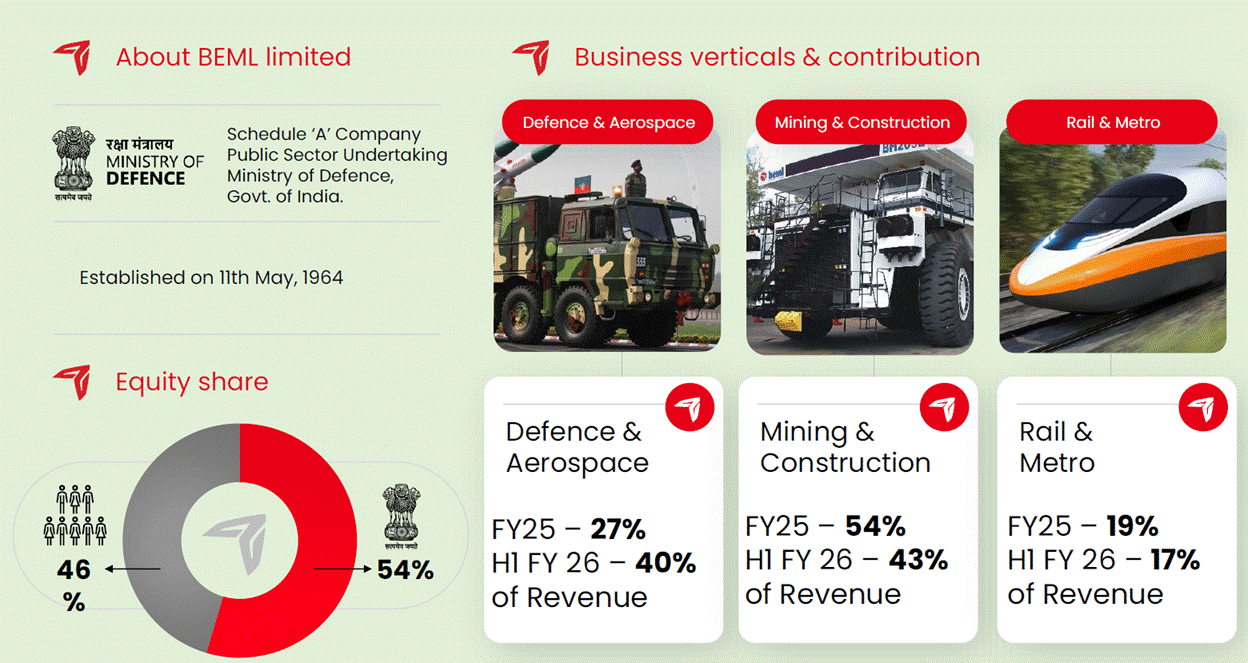
BEML is a Public Sector Undertaking operating under the Ministry of Defence. It manufactures heavy earthmoving equipment for the mining and construction industries, defence vehicles, and coaches for the metro and Indian Railways.
Mining and Construction accounts for the highest (43% of sales), followed by defence and aerospace (40%) and rail and metro (17%). The Mining and Construction vertical specialises in manufacturing heavy-duty earth-moving equipment for surface and underground mining. Key products include Dump Trucks, Dozers, Rope Shovels, and Motor Graders.
BEML Revenue-Mix
BEML’s shift toward 60% revenue share from defence and rail
The Mining and Construction sector contribution is expected to fall to about 40% in FY26. At the same time, the Defence, Rail, and Metro sectors are projected to rise to 60%. It’s because the Defence, Rail, and Metro sectors are poised for expansion due to the Government of India’s strong emphasis on reducing import dependency.
BEML is actively diversifying its portfolio to reduce its over-dependence on traditional sectors such as the coal industry. A new Strategic Business Unit has been created to focus on complex defence systems rather than just vehicle platforms. This includes Mechanical Minefield Marking Equipment and Self-Propelled Mine Barriers.
In defence, BEML has partnered with Bharat Forge and Data Patterns in a consortium for the Advanced Medium Combat Aircraft program, focusing on its core strength in aerostructures. BEML expects defence revenue to grow by 70% to 80% in the near term.
The diversification into the ₹4,000 crore port market
The company is entering the maritime market, targeting Goliath cranes for shipbuilding and ship-to-shore cranes for port operations. Management believes this line will generate revenues of over ₹4,000 crore in the next four to five years.
The metro upside
In the rail and metro sector, the company expects to manufacture 53 trains for the Bangalore Metro. Revenue from 63 trains for Mumbai Metro is expected to begin in FY27, and prototype rollouts for Chennai Metro are scheduled for FY27.
The ₹16,342 crore order book
From a financial perspective, the company’s revenue remained flat in H1 FY26 at ₹1,473 crore, compared with ₹ 1,494 crore last quarter. It reduced its losses to ₹16 crore from ₹ 19 crore in the same period last year. BEML has set an aspirational growth target of at least 20% in FY26. The order book stood at ₹16,342 crore, providing revenue visibility of about 4 years.
#3 Ajax Engineering: Market leader in self-loading concrete mixers
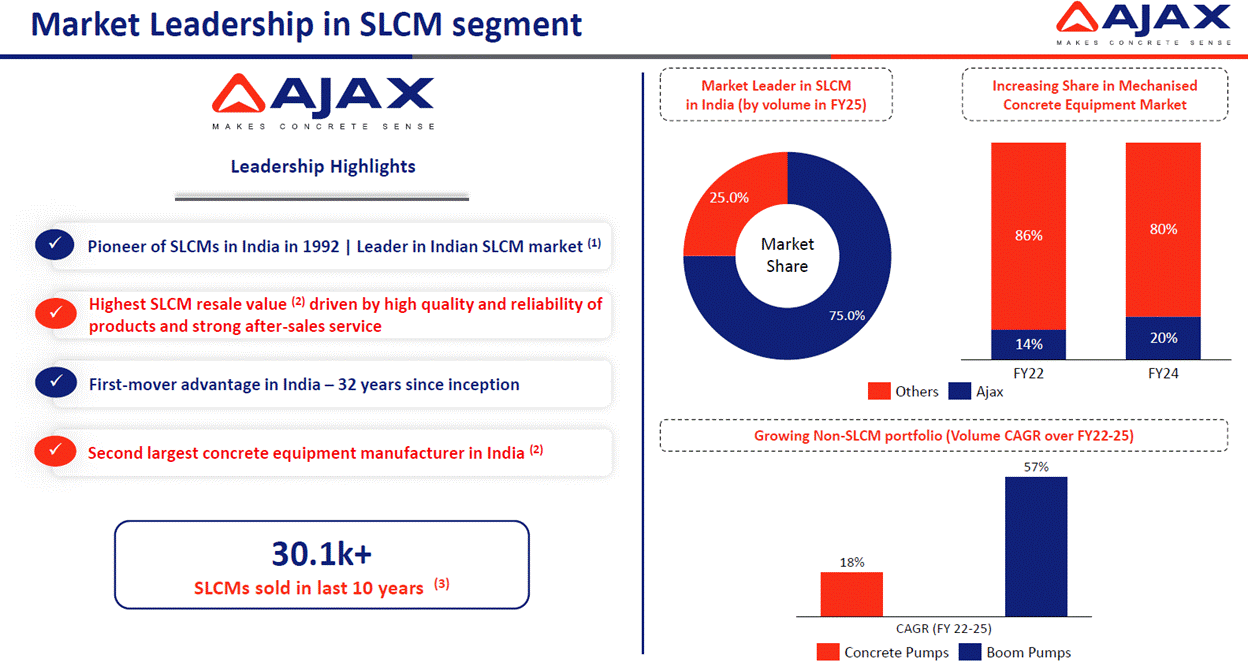
Ajax Engineering manufactures concrete equipment for the entire concrete application value chain, including engineering, production, transportation, placement, paving, and printing. It is the leader in self-loading concrete mixers (SLCM) in India, with a 75% market share by volume. It is also India’s second-largest manufacturer of concrete equipment.
Market Leadership in the SLCM Segment
The non-SLCM pivot
AJAX intends to maintain its dominant position in the Self-Loading Concrete Mixer (SLCM) segment. A major strategic goal is building strong capabilities in the non-SLCM space, including concrete pumps, batching plants, and transit mixers. The company is pursuing several strategic growth drivers.
The company’s fourth manufacturing facility is expected to become operational in H2FY26, providing fungible capabilities to assemble various concrete equipment. Ajax is also expanding its pan-India dealer network with a new B2B channel focused on the top eight metro cities to target larger buyers directly.
Soft H1 performance as sector activity slows
Ajax faced headwinds in H1FY26 due to changes in emission norms and a slower pace of project execution. Revenue increased by 18.4% year-on-year to ₹912 crore in H1 FY26. However, EBITDA declined 10.6% to ₹106.6 crore, while margin fell 380 bps to 11.7%. As a result, PAT declined by 9% to ₹91.9 crore.
The industry typically sees a 40-60% split between H1 and H2 of the year. Therefore, volume growth is expected to accelerate in H2 FY26. With performance improvement, the company expects operating leverage and continued cost optimization to support its margin profile.
The valuation gap: Are these stocks overpriced?
ACE and Ajax have the industry-leading return ratios: Return on Capital Employed (RoCE) and Return on Equity (RoE). However, BEML lags behind with below-average metrics and a relatively higher valuation multiple compared to the industry. ACE and Ajax are both trading at below the industry valuation.
| Peer Comparison (X) | ||||
| Company | P/E | 5Y Median P/E | RoCE (%) | RoE (%) |
| BEML | 50.0 | 50.2 | 15.6 | 10.5 |
| ACE | 25.4 | 32.2 | 40.1 | 28.7 |
| Ajax | 27.2 | NA | 33.6 | 25.1 |
| Industry Median | 33.9 | 25.4 | 23.4 | |
If the proposed ₹23,000 crore incentive framework materialises, it strengthens the investment case for construction equipment manufacturers aligned with localisation.
ACE and Ajax stand out for strong market positions, high return ratios, and favourable valuation, offering a cleaner risk–reward profile. BEML while strategically placed across defence, rail, and mining. Ultimately, incentive clarity and timely implementation will decide earnings translation.
Disclaimer
Note: Throughout this article, we have relied on data from http://www.Screener.in and the company’s investor presentation. Only in cases where the data were unavailable have we used an alternate, widely accepted, and widely used source of information.
The purpose of this article is only to share interesting charts, data points, and thought-provoking opinions. It is NOT a recommendation. If you wish to consider an investment, you are strongly advised to consult your advisor. This article is strictly for educational purposes only.
About the Author: Madhvendra has been deeply immersed in the equity markets for over seven years, combining his passion for investing with his expertise in financial writing. With a knack for simplifying complex concepts, he enjoys sharing his honest perspectives on startups, listed Indian companies, and macroeconomic trends.
A dedicated reader and storyteller, Madhvendra thrives on uncovering insights that inspire his audience to deepen their understanding of the financial world.
Disclosure: The writer and his dependents do not hold the stocks discussed in this article. The website managers, its employee(s), and contributors/writers/authors of articles have or may have an outstanding buy or sell position or holding in the securities, options on securities or other related investments of issuers and/or companies discussed therein. The articles’ content and data interpretation are solely the personal views of the contributors/ writers/authors. Investors must make their own investment decisions based on their specific objectives, resources, and only after consulting such independent advisors as may be necessary.