



Investors often put companies into neat little boxes. Once a label sticks, it can take years for the market to notice that the business has changed. Mayur Uniquoters is one such company.
Long seen as a manufacturer of synthetic leather, it is increasingly becoming a play on exports, particularly global automobile Original Equipment Manufacturers (OEMs). The latest numbers suggest that this shift is no longer just a story. It is beginning to show up in the financials.
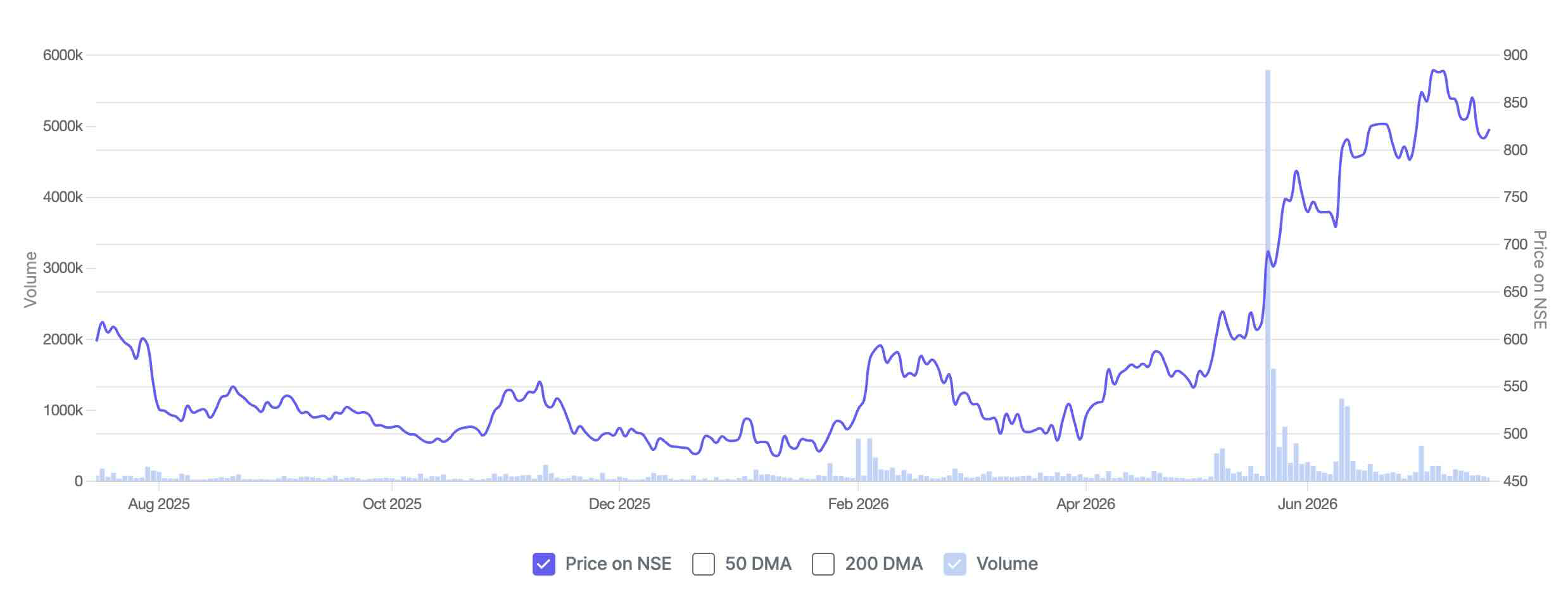
Mayur Uniquoters 1-Year Share Price Chart
For years, the company built its reputation on consistency rather than excitement. It generated healthy cash flows, maintained a strong balance sheet and delivered respectable returns, but revenue growth rarely gave investors a reason to believe the business was entering a different league.
However, now, that appears to be changing. Exports are becoming a larger part of the revenue mix. Profitability is also improving and fresh investments are being planned to support the next phase of growth.
The obvious question is whether this is simply a strong year or the beginning of a longer-term transformation.
The business is the same. The customer mix is changing.
Mayur Uniquoters manufactures Polyvinyl Chloride (PVC) synthetic leather and Polyurethane (PU) products. These are used across automobiles, footwear, furnishings and fashion accessories.
Automobiles contribute around 65% of revenue, with the balance coming from footwear, furnishings and other industrial applications.
On the surface, very little has changed. The company continues to manufacture synthetic leather, just as it has done for decades.
The difference lies in who is buying these products. Over the last few years, Mayur has steadily increased its presence among global automobile OEMs. These customers typically demand higher quality standards, but they also offer better pricing and longer business relationships. As their contribution increases, the economics of the business begin to improve.
That trend is now visible in the numbers.
For Financial Year 2026 (FY26), consolidated revenue increased 10% to Rs 967 crore from Rs 880 crore in the previous year. Operating profit grew 23%, while net profit rose 29%. Operating Profit Margin improved to 24.3% from 21.7%, indicating that profits are growing much faster than revenue.
The March quarter was even stronger. Standalone revenue increased 22% year on year and profit after tax increased 73%. According to management, the improvement came from a better product mix, higher exports, stronger productivity and tighter cost control rather than any extraordinary gain.
Why exports matter more than revenue growth
Revenue growth, by itself, tells only part of the story. A company can increase sales simply by selling more products, but that does not necessarily make it significantly more profitable. What matters is the kind of products being sold and the customers buying them.
That is where Mayur’s export strategy becomes important.
Automobiles account for around 65% of Mayur’s revenue, while exports contribute about 42.5%. As overseas automotive programmes become a larger part of this mix, the company’s earnings profile is beginning to change. Export products generate higher realizations than many domestic businesses, particularly those supplied to global automotive customers. As exports become a larger share of sales, profitability improves even if overall revenue growth remains moderate.
FY26 offers a good example of this. Overall value growth stood at 15%. Exports grew around 35%, while domestic revenue increased only about 4%. Sales volumes rose by roughly 5% to around 31 million metres, indicating that much of the earnings improvement came from selling better products rather than simply selling larger quantities.
Management also highlighted that business from existing export customers continues to expand. Volumes supplied to Ford have started increasing after additional vehicle platforms were added, and recently secured export programmes are expected to contribute over the next two to three years.
While automotive exports remain the primary growth driver, management also sees another opportunity. It believes the India-EU Free Trade Agreement could improve the competitiveness of its non-automotive products, such as furnishings, marine applications and other industrial uses. Unlike automotive OEM contracts, where customer qualification matters more than tariffs, these businesses could benefit more directly from lower import duties over time.
Why profitability is improving
A manufacturing company can improve profitability in two ways. It can become more efficient or it can sell products that earn better margins. Mayur appears to be benefiting from both.
The biggest driver is exports. Management said export orders, especially from global automobile Original Equipment Manufacturers (OEMs), generate better realisations than much of its domestic business. As exports account for a larger share of revenue, the company’s earnings naturally improve even if overall revenue growth remains moderate. That partly explains why operating profit has grown much faster than sales over the past year.
The March quarter also benefited from stronger factory utilisation. When order books remain healthy, manufacturing becomes more efficient because fixed costs are spread over higher production. Management said productivity improved during the quarter, while freight, maintenance and other operating costs remained under control, giving Operating Profit Margin an additional lift.
There were other tailwinds as well. A favourable foreign exchange supported profitability during the year. At the same time, management dismissed suggestions that the sharp improvement was driven by inventory gains, explaining that the company largely manufactures against confirmed customer orders and values inventory conservatively. Price increases have also started flowing through, although the automotive business typically takes one to two months to approve revised pricing.
The more important takeaway is management’s guidance for the future. It believes margin can remain in the 25% to 30% range if exports continue to grow as expected. That guidance is deliberately broad because raw material prices remain linked to petroleum and global conditions can change quickly. Even so, it indicates that management does not see the March quarter as an isolated spike in profitability.
The company is not chasing growth at any cost
One encouraging aspect of Mayur’s strategy is that management is not trying to accelerate growth by making aggressive promises.
For FY27, it continues to guide for domestic revenue growth of 8% to 10% and export growth of 15% to 20% on a value basis. The company expects this growth to come not only from new customers but also from deeper relationships with existing automobile manufacturers and additional vehicle platforms.
The automotive business remains the biggest opportunity, but management also sees scope for growth in other sectors. These includes marine applications, furnishings and other export markets where Indian manufacturers are becoming increasingly competitive.
The PU business, however, continues to lag. Although Mayur has secured vendor approvals from some large customers and remains in discussions with several global brands, commercial volumes are yet to build meaningfully. The business generated revenue of about Rs 27 crore during FY26, making it a relatively small contributor to overall earnings.
Growth is easier when the balance sheet is strong
Manufacturing businesses often need substantial capital before they can grow. That usually means taking on debt.
But Mayur is in a much more comfortable position.
The company has decided to install a new coating line at its existing manufacturing facility after identifying additional space, instead of setting up a new plant in South India. This significantly reduces capital expenditure while still increasing production capacity. Management expects domestic capital expenditure of around Rs 50 crore, and believes the new line can support additional annual revenue of roughly Rs 120 crore to Rs 150 crore once fully utilised.
| Financial Strength | FY26 |
| Debt/Equity | 0.01x |
| ROCE | 24.7% |
| ROE | 18.4% |
| Domestic Capex (FY27) | Rs 50 crore |
| Potential Overseas Capex | Rs 300 crore |
The company is also evaluating an overseas manufacturing facility with an estimated investment of around Rs 300 crore. While Mexico remains one of the options, management said the final location has not yet been decided.
One of Mayur’s biggest advantages is that growth does not depend on borrowing heavily.
The company remains virtually debt free.
That financial discipline has also translated into healthy shareholder returns. Return on Capital Employed (ROCE) stands at 24.7%, while Return on Equity (ROE) is 18.4%. These are healthy return ratios for a manufacturing business that has achieved them without relying on meaningful financial leverage.
Valuation now reflects higher expectations
The market has begun recognising that Mayur’s earnings profile is changing.
At the current share price of around Rs 822, the company trades at around 18.6 times earnings. This is close to its median PE of 19.2 times.
These valuations suggest investors are increasingly treating Mayur as a specialised export-oriented manufacturer instead of a steady domestic supplier. That also means expectations have moved higher, leaving less room for disappointment if growth slows.
Risks
The biggest risk is that exports fail to maintain their current momentum. A slowdown in global automobile demand, delays in customer programmes or prolonged weakness in overseas markets could affect both revenue growth and profitability.
Raw material costs remain another variable because key inputs are linked to crude oil prices. While management expects higher costs to be passed on over time, there is usually a lag before revised prices are accepted by customers. The proposed overseas manufacturing facility also remains at the evaluation stage, making its timing and eventual benefits uncertain.
The market often takes time to recognise when a company’s economics begin to change. Mayur Uniquoters appears to be going through such a phase. It is still the same synthetic leather manufacturer that investors have known for years, but the business is gradually becoming more export-oriented, more profitable and better positioned for long-term growth. Whether that transition continues will depend largely on its ability to keep winning global automotive business, but the latest numbers suggest that the shift is already underway.
Disclaimer:
Note: We have relied on data from www.Screener.in throughout this article. Only in cases where the data was not available, have we used an alternate, but widely used and accepted source of information.
The purpose of this article is only to share interesting charts, data points and thought-provoking opinions. It is NOT a recommendation. If you wish to consider an investment, you are strongly advised to consult your advisor. This article is strictly for educative purposes only.
Manvi Aggarwal has been tracking the stock markets for nearly two decades. She spent about eight years as a financial analyst at a value-style fund, managing money for international investors. That’s where she honed her expertise in deep-dive research, looking beyond the obvious to spot value where others didn’t. Now, she brings that same sharp eye to uncovering overlooked and misunderstood investment opportunities in Indian equities. As a columnist for LiveMint and Equitymaster, she breaks down complex financial trends into actionable insights for investors.
Disclosure: The writer and her dependents do not hold the stocks discussed in this article. The website managers, its employee(s) and contributors/writers/authors of articles have or may have an outstanding buy or sell position or holding in the securities, options on securities or other related investments of issuers and/or companies discussed therein. The content of the articles and the interpretation of data are solely the personal views of the contributors/ writers/authors. Investors must make their own investment decisions based on their specific objectives, resources and only after consulting such independent advisors as may be necessary.