



The global and Indian defence and aerospace sectors are undergoing a shift, driven by escalating geopolitical tensions, evolving warfare technologies, and national policies focusing on self-reliance. In line with that, India’s budget 2026 announced total outlay of ₹7.8 lakh crore. Of this, ₹2.2 lakh crore has been earmarked for capital acquisition.
Around 75% of the capital acquisition budget is reserved for domestic defence industries in FY27. The Defence Research and Development Organisation (DRDO) also received ₹29,100 crore for bolstering indigenous technology. On similar lines, this article discusses two companies that are not only DRDO partners but are also focusing on indigenous defense products.
Let’s take a look at them.
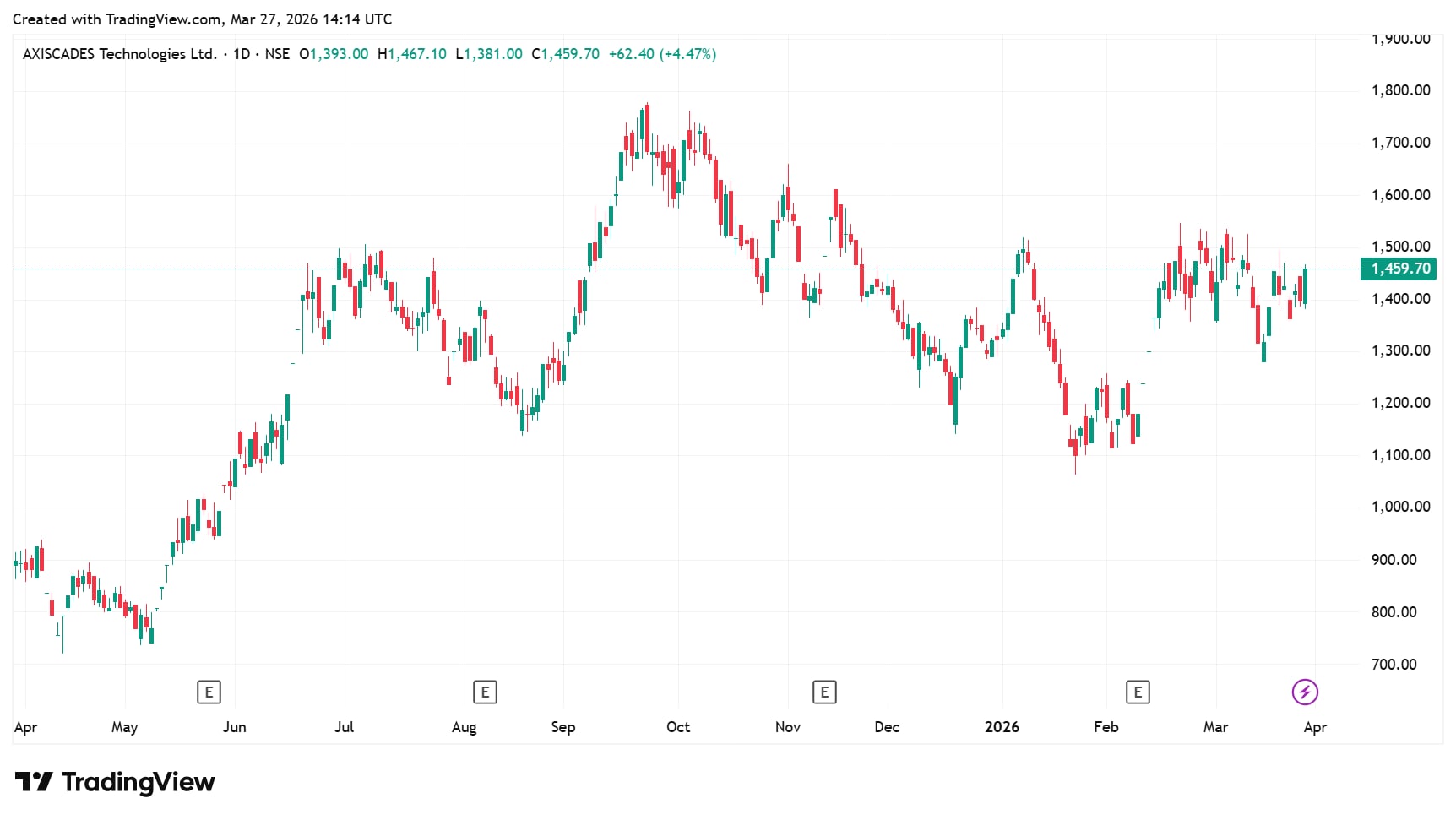
#1 Axiscades Technologies
Axiscades provides end-to-end product engineering, manufacturing, and lifecycle support to global original equipment manufacturers (OEMs) and Tier-1 suppliers. It works in three core domains, which together account for the vast majority of its revenue: Aerospace, Defence, and ESAI (Electronics, Semiconductor, and Artificial Intelligence).
The company has a partnership with Spain’s leading defence company (Indra), European defence majors (Thales), Airbus, DRDO, Hindustan Aeronautics Limited, and BEL. AXISCADES is DRDO’s long-term engineering and electronics design partner for core R&D and production programs.
In the aerospace industry, AXISCADES provides support to aircraft manufacturers throughout the entire product lifecycle, from initial conceptual design to after-sales maintenance. Primarily, it offers engineering and design, avionics and systems, manufacturing support, and after-sales and maintenance services.
Strategic Pillars: Engineering Excellence in Global Aerospace
Within the defence industry, it delivers mission-critical R&D, engineering, electronics, and systems integration across air, land, sea, and missile platforms. Its defense capabilities include aero defence & unmanned aerial vehicles, radar and electronic warfare, naval and land systems, and missiles.
In the ESAI domain, AXISCADES operates as a deep-tech innovation partner, offering end-to-end embedded solutions from pre-silicon validation to post-silicon product deployment. This vertical is becoming a massive growth engine for the company. It actively collaborates with global tech companies, including Apple, Amazon, Texas Instruments, Qualcomm, NXP, Intel, and NVIDIA.
Axiscades: 9M EBITDA Surpasses Full-Year FY25 Levels
AXISCADES has reported record financials in 9MFY26. Revenue grew 16.2% year-on-year to ₹886 crore, with 39% growth in defence vertical revenue to ₹311 crore. EBITDA (Earnings Before Interest, Tax, Depreciation and Amortization) rose 37.1% to ₹144 crore, surpassing even its FY25 EBITDA. Its adjusted net profit (excluding a one-time labor code charge) surged 81.5% to ₹79.5 crore.
The company’s business mix is changing. Product and solution revenues now account for 39% of the business, up from 33% in FY25. With this, AXISCADES is on track toward its long-term goal of an 80% product-driven revenue mix.
Vision 2030: The US$1 Billion Revenue Roadmap
AXISCADES is driving a multi-year transformation under its “Power 930” vision, which aims to drive the company’s revenue to over US$1 billion (₹9,000 crore) by FY30. It also aims to sustain EBITDA margins above 20% by then. A shift toward a non-linear, IP-led, and product-driven growth model will drive this growth.
To achieve these targets, the company anticipates 40-50% year-on-year growth in profitability in both FY26 and FY27. Its goal is to derive over 80% of its revenues from manufacturing-driven products and solutions by FY28.
Portfolio Optimization: Divesting Legacy for Strategic Focus
To protect and expand its profit margins, AXISCADES is actively resetting and divesting its legacy, low-margin non-core businesses (Heavy Engineering and Automotive). It plans to concentrate all financial resources on its three primary growth engines: Aerospace, Defence, and ESAI.
To support this shift, it is expanding around highly strategic tech and aviation hubs. It is building the Devanahalli Atmanirbhar Complex near Bangalore Airport. It will focus on co-development for global OEMs, housing radar hangars (expected by Q3FY27), aerospace manufacturing, and advanced testing facilities.
Infrastructure Expansion: Building India’s Private Defense Capacity
The company recently acquired 8 acres in Hyderabad’s Aerospace Park to build one of India’s largest private-sector missile component manufacturing facilities. This site, in partnership with a leading global missile manufacturer, will focus on indigenous and foreign missile electronics, data links, and cold assembly integration.
The company’s expansion strategy is uniquely tailored to its three core verticals. The defense segment is poised to become the biggest engine of the company’s growth, backed by an order pipeline of approximately ₹14,000 crore over the next four years.
Indigenous Innovation: Advancing India’s Missile Programs
The company is evolving from a build-to-print service provider into a design-to-manufacture leader. Key growth avenues include developing indigenous missile programs such as BrahMos and Kusha, which are currently under trials and certification.
AXISCADES is making progress on its indigenous RF seekers for major missiles like the BrahMos and Kusha. The RF functionalities completed trials in February 2026. It expects to complete mechanical housing and integration by March 2026, with full qualification expected by Q2FY27, positioning it as a first-of-its-kind qualified seeker in India.
ESAI Scaling: Powering Semiconductor and Hyperscaler Needs
The ESAI vertical is on track to outpace the company’s overall growth, with targets to become a ₹500-crore business by FY27. This expansion is driven by scaling up box-build manufacturing (moving from silicon design to fully packaged products) for global semiconductor OEMs and U.S. hyperscalers.
The company is currently executing pilot programs for major U.S. hyperscalers, manufacturing test kits and sensor fusions (like millimeter-wave radars and laser/IR sensors) for automation lines, which have the potential to scale by 50x to 100x once fully certified.
Aerospace Pivot: Capturing the High-Margin Aftermarket
With new commercial aircraft platform development declining globally, AXISCADES is pivoting its aerospace expansion toward the high-margin aftermarket. It is building India’s most advanced (Maintenance, Repair and Overhaul) MRO hub. It expects growth to be driven by passenger-to-freighter aircraft conversions, interior retrofitting, and tooling manufacturing.
#2 Apollo Micro Systems
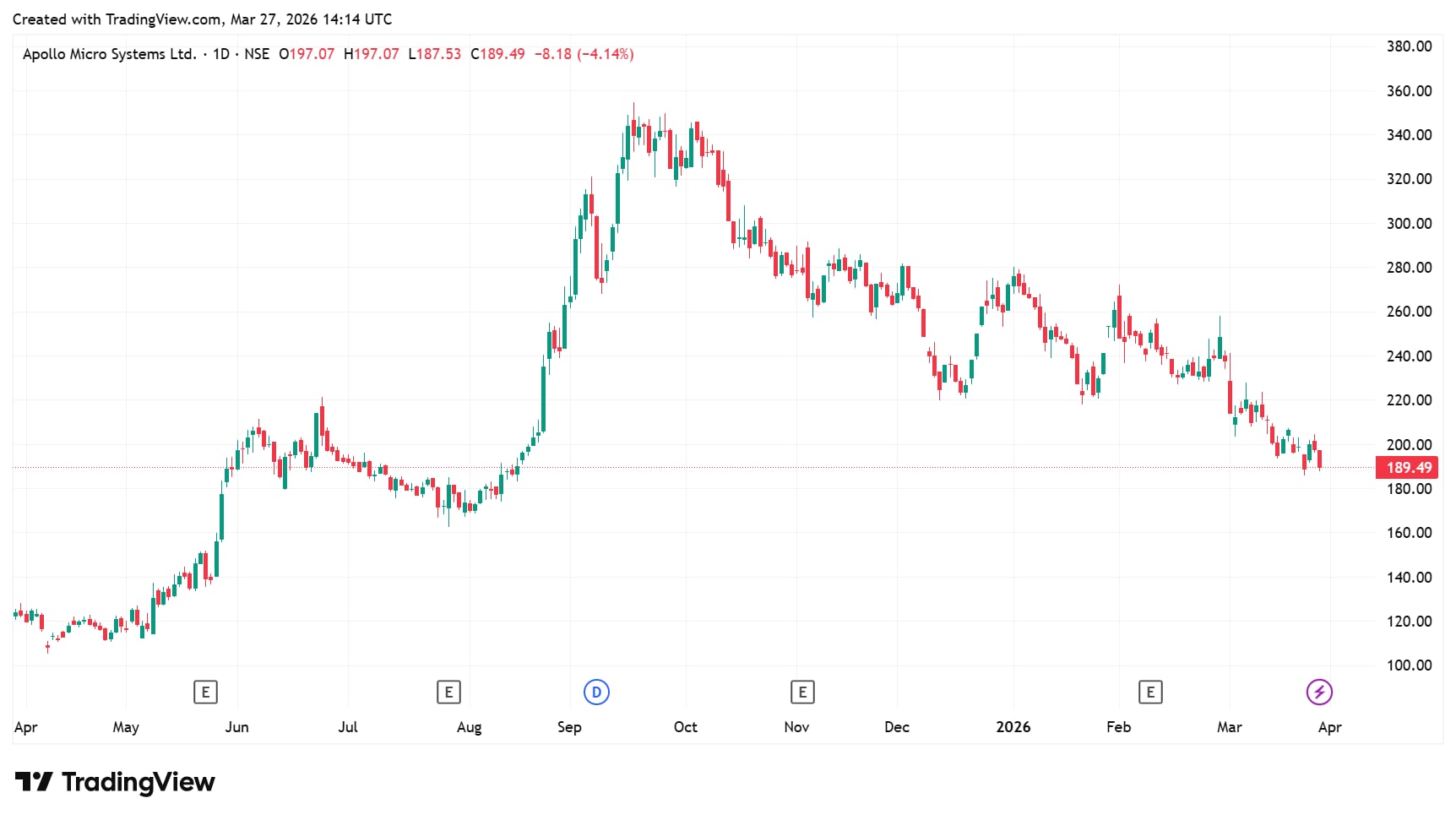
Apollo Micro (AMS) designs, develops, and manufactures electronic, electro-mechanical, and weapon systems. It is currently transitioning from being a niche subsystem supplier to a fully integrated Tier-1 defence OEM capable of supplying complete weapon platforms.
Its core offerings include missile defence, naval defence, ground defence, avionics and aerospace, and munitions. AMS’s strength lies in its capability to keep R&D, design, assembly, manufacturing, and testing – all within a single umbrella.
Tier-1 Pivot: Transitioning to Weapon System Integration
AMS is currently involved in over 150 active indigenous defence programmes and collaborate extensively with DRDO, Bharat Dynamics, and Bharat Electronics to co-develop platforms and technologies.
AMS aims to become a “system-of-systems integrator,” supplying complete weapon platforms, precision munitions, and smart explosives to both Indian and international markets. To support this, the company is undertaking major infrastructure developments.
Its flagship project is the upcoming Unit-3 facility at Hardware Park-II in Hyderabad, which will entail a CapEx of ₹250 crore. This facility will feature cleanrooms, high-throughput assembly lines, and automated testing bays; it will serve as a scalable hub for advanced manufacturing and help AMS significantly reduce its external dependencies.
AMS aims to undertake vertical integration, combining warhead and fuze manufacturing with electronic engineering to deliver complete munitions and end-to-end guided weaponry. AMS is also actively pursuing inorganic growth. It currently has three companies in the pipeline and expects to finalise at least one acquisition soon.
The 45-50% Revenue CAGR Target
The company projects to grow its revenue at 45-50% CAGR over the next two to three years. Notably, this growth will solely come from core business and excludes the incremental revenue contributions from their recent acquisition of IDL Explosives. It expects improvements in operating margins and a fall in working capital cycle by 100 to 120 days starting FY27.
AMS outlook is supported by several high-value defence programs transitioning into bulk production. AMS is a major contributor to the QRSAM and Akash NG missile programs, both of which are entering large-scale production phases.
The Expected ₹2,500 Crore Order
In the naval sector, AMS has completed limited series production for heavyweight torpedoes and are anticipating massive bulk production orders. Furthermore, the company is awaiting final clearances for a highly lucrative MOORED Mine project, worth around ₹2,500 crore.
Financial Performance: Revenue Visibility and Order Book Strength
From a financial perspective, revenue grew by 53% year-on-year to ₹611 crore in 9MFY26. EBITDA surged by 61% to ₹150.5 crore, while margin expanded by 134 bps to 24.6%. Net profit jumped 67% to ₹70.6 crore. Its order book stood at ₹1,305 crore, providing revenue visibility of over 2-years.
The Valuation Gap
Return ratios (Return on Capital Employed and Return on Equity) of both the companies are moderate. However, following the recent correction, valuations have moderated. AXISCADES is trading in line with the industry multiples and at premium to historical valuation. Whereas AMS continues to trade at a premium to both historical and industry multiples.
| Valuation Comparison (X) | |||||
| Company | P/E | 5Y Median P/E | Industry P/E | RoCE (%) | RoE (%) |
| Axiscades | 56.9 | 39.1 | 52.2 | 13.8 | 12.7 |
| Apollo Micro | 75.8 | 60.7 | 52.2 | 14.0 | 10.0 |
| source: screener.in | |||||
India’s defence outlay of ₹7.8 lakh crore, with ₹2.2 lakh crore in capital allocation and 75% reserved for domestic players, sets a strong base.
Against this backdrop, Axiscades and Apollo Micro are aligning with indigenous opportunity. But execution, margins, and valuations will ultimately decide how much of this tailwind converts into shareholder returns. It’s worth keeping them in your watchlist.
Disclaimer:
Note: Throughout this article, we have relied on data from http://www.Screener.in and the company’s investor presentation. Only in cases where the data were unavailable have we used an alternate, widely accepted, and widely used source of information.
The purpose of this article is only to share interesting charts, data points, and thought-provoking opinions. It is NOT a recommendation. If you wish to consider an investment, you are strongly advised to consult your advisor. This article is strictly for educational purposes only.
About the Author: Madhvendra has been deeply immersed in the equity markets for over seven years, combining his passion for investing with his expertise in financial writing. With a knack for simplifying complex concepts, he enjoys sharing his honest perspectives on startups, listed Indian companies, and macroeconomic trends.
A dedicated reader and storyteller, Madhvendra thrives on uncovering insights that inspire his audience to deepen their understanding of the financial world.
Disclosure: The writer and his dependents do not hold the stocks discussed in this article.
The website managers, their employees (s), and contributors/writers/authors of articles have or may have an outstanding buy or sell position or holding in the securities, options on securities, or other related investments of issuers and/or companies discussed therein. The articles’ content and data interpretation are solely the personal views of the contributors/ writers/authors. Investors must make their own investment decisions based on their specific objectives, resources, and only after consulting such independent advisors as may be necessary.