



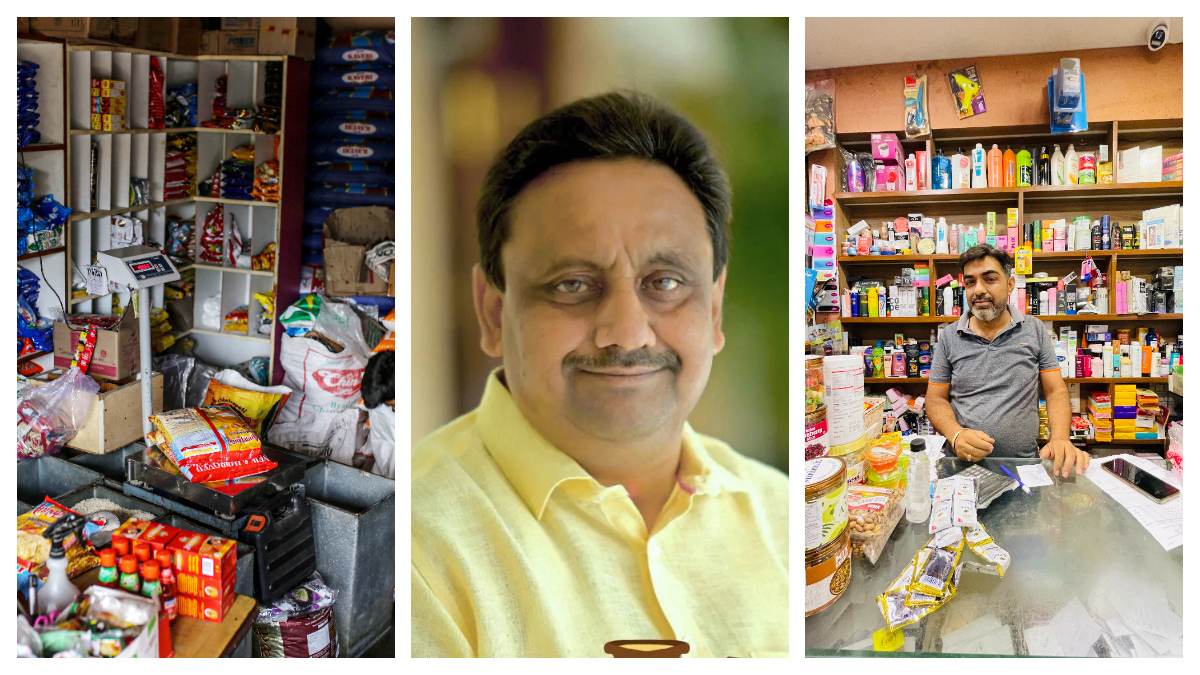
In the narrow lanes of Jaipur House in Agra, where conversations often last longer than transactions, stands Lovely Traders—a modest kirana shop that has served its neighbourhood for over two decades. Behind the counter is 42-year-old Gulshan Gudeja, the shop owner, who has witnessed a dramatic shift in the rhythm of his business—one he never anticipated.
There was a time, not long ago, when his store drew steady footfall and familiar faces. “If I was selling about Rs 50,000 worth of goods per week two years ago, it could have easily grown to over a lakh by now,” he recalls. But that expected growth never materialised. Instead, his business has slipped into a quiet decline. “We are not able to grow,” he says. “There is no profit, only more expenditure.”
The rapid rise of quick-commerce platforms like Blinkit, Instamart and Zepto has transformed how people shop. But in the process, says Gudeja, customers are missing out on a very important aspect of everyday life—the human connection. “We know their buying habits, understand their unspoken needs. They will never get this online.”
Across India, kirana stores now find themselves at a crossroads. While some struggle to keep pace with the speed and pricing of e-commerce or quick-commerce platforms, others are experimenting with new ways to stay relevant. Yet the broader trend is concerning.
Structural shift
Ramesh Jain (name changed on request) has been running his kirana store in the Kalkaji area of south Delhi for nearly 15 years. Tucked between a tailor and a shuttered photocopy shop, his establishment had once been a dependable stop for families, fulfilling every need, big or small, from rice to oil, atta to soaps. They trusted him enough to jot purchases on a worn notebook when cash ran short. But things have slowed down after q-commerce. “I see delivery riders zip past my shop,” shares the 50-year-old shop owner.
Their insulated bags are brighter than his fading signboard. Sometimes a regular would still come, apologetically saying, “We found this cheaper on the app today.”
Even though he tried to adapt, adding a phone number for orders, asking his nephew to help him list items online, the process felt unfamiliar and intimidating. Margins were tighter too; he couldn’t match the discounts flashing on mobile screens. Still, every morning he lifts the shutter with the same determination hoping a few customers remain loyal.
Apart from Jain and Gudeja, a supermarket-like shop—selling everything from vegetables and fruits to premium ingredients—in Samachar market of Mayur Vihar in east Delhi shut down after orders dwindled because of the quick commerce tide. A snack shop owner in the same complex, whose goods usually were spread out much beyond the shop premises, now runs a much curtailed operation. He laments: “Online has destroyed our business. I am sitting idle on a weekend evening, whereas I had my hands full a couple years ago.”
A small shop owned by an old man and his son has given way to a bank ATM, while in Vasundhara Enclave in east Delhi, all local kirana shops have shut down after the advent of q-comm.
Clearly, the rapid expansion of e-commerce poses a structural challenge to India’s traditional retail ecosystem, as per Praveen Khandelwal, a Member of Parliament from Delhi’s Chandni Chowk and secretary general of the Confederation of All India Traders (CAIT), representing more than 9 crore traders in India.
“With nearly 1.5 crore kirana stores supporting millions of livelihoods, the shift carries significant economic consequences. Consumer behaviour has fundamentally changed—from need-based purchases at local shops to instant, app-driven consumption. While kiranas still maintain a strong presence, signs of decline are evident in reduced footfall, falling sales, and rising financial stress,” adds Khandelwal.
A major concern is the uneven playing field. Khandelwal explains that e-commerce, despite incurring heavy losses, are resorting to deep discounting and cashbacks to capture market share, while kirana traders operate on thin margins and cannot sustain such aggressive pricing practices. This is not just competition but also a behavioural disruption.
“Kiranas cannot match due to very thin margins ranges from 7 to 15% only, while quick commerce operates warehouses with optimised inventory and data misuse which leads to footfall collapse in kirana stores,” says Khandelwal, adding how such imbalances lead to large-scale displacement of small traders, increased market concentration among a few dominant players, and long-term adverse effects on both consumers and the broader economy.
Numbing numbers
India’s retail landscape is undergoing a consequential shift. According to the Federation of Retailer Associations of India (Dec 2024-2025 report), over 2 lakh kirana stores shut down, coinciding with the rapid rise of quick commerce platforms like Blinkit, Zepto, and Instamart.
A 2024 dipstick study by JP Morgan on 50 offline grocery stores in Mumbai shows that 60% have seen a decline in their sales volume, and most attributed it to qcommerce through their dark stores.
However, this disruption shows a structural change in how India shops. As per Karan Taurani, executive vice president at Elara Capital, “In metro markets, kirana stores are facing structural challenges as consumer behaviour shifts toward convenience-driven solutions offered by q-commerce platforms.”
Despite online grocery penetration still being under 5%, Taurani notes that the trajectory is decisively upward, fuelled by sustained investments and the expansion of players like Amazon and Flipkart into faster delivery formats.
“Modern trade (such as supermarkets and hypermarkets) are less affected as consumers rely on them for bulk purchases, typically made once or twice a month, where pricing advantages are key. In contrast, kirana stores rely heavily on convenience and immediate availability—an advantage now being eroded by q-commerce platforms that deliver products quickly to consumers’ homes. This competitive pressure is expected to intensify further with the entry and expansion of major players,” says Taurani.
The implications go beyond retail—they touch the backbone of the economy. India has ~13 million kirana stores, forming a critical part of the MSME ecosystem. The MSME sector itself contributes nearly one-third of India’s GDP and accounted for ~46% of exports in 2023–24, states a joint report by JPMorganChase and eB2B commerce platform Udaan.
According to Nikhil Sethi, partner and national head, consumer goods, KPMG India, kirana stores are shutting for a combination of structural and generational reasons. “Many are losing portfolio relevance as consumer baskets evolve and competition from organised retail, ecomm and q-comm intensifies. In several affluent neighbourhoods, consumers are buying products that traditional kiranas simply don’t stock anymore, which compresses earnings and creates a vicious cycle of lower throughput and lower reinvestment. Also, the next generation is unwilling to take over these businesses, accelerating exits that are as much about changing aspirations as about competition,” says Sethi.
On the demand side, consumer behaviour is also evolving rapidly. RedSeer data shows monthly transacting users on quick commerce platforms grew ~12% by October 2025, reflecting a clear shift toward habit-driven, instant consumption. Quick commerce is winning on three fronts—speed and reliability, behavioural stickiness and expanding categories . This positions quick commerce not just as an alternative but as the default layer for everyday consumption.
Daily retail driver
Despite the ground reality, kirana stores continue to dominate India’s ~$600billion grocery market, holding over 91% share in 2025 and projected to retain a strong ~86% by 2030, as per a 2026 Redseer report. While modern retail and quick commerce are expanding rapidly, their impact remains concentrated in metros and Tier-1 cities, influencing top-up and convenience-driven purchases rather than core, high-frequency consumption.
India’s grocery ecosystem is shaped by three primary formats—kiranas, modern trade (big-box retail), and online commerce—each serving distinct consumer needs. Online platforms deliver convenience, and large-format retail offers value and assortment. However, kiranas remain the most critical touchpoint for the majority of Indian households.
This dominance is rooted in India’s income distribution. The market is anchored by over 230 million low-to-middle income households, whose consumption patterns are defined by low average order values (AOVs), high purchase frequency, and tight cash flows. Kirana stores are uniquely optimised for this demand.
Operating largely out of owned or low-rent spaces and run by families, kiranas thrive on lean cost structures and rapid inventory cycles. Their typical AOV of Rs 100-Rs 200 reflects daily or weekly ‘survival buying’, a segment that remains structurally unviable for scale-heavy formats like e-commerce or big-box retail.
In contrast, higher AOV missions—Rs 1,500+ baskets—are associated with planned, bulk purchases in hypermarkets or B2B procurement channels. This divergence creates what Redseer terms the ‘AOV trap’—while quick commerce captures frequent, small-ticket orders, its path to profitability is challenged by low basket sizes. Meanwhile, large-format retail depends on less frequent, high-value transactions.
This split reinforces a multi-format retail landscape. As incomes rise, higher-income consumers diversify across channels—supermarkets, quick commerce, and e-commerce—yet kiranas remain indispensable for routine consumption across the mass market.
Together, these formats make up a grocery market valued at ~Rs 55.9 trillion ($658 billion) in 2025, projected to grow at ~9% CAGR to ~Rs 84.3 trillion ($992 billion) by 2030. Despite this expansion, kiranas will continue to be the primary driver of daily grocery consumption, supported by their unmatched neighbourhood reach, personalised service, localised assortments, and informal credit systems.
Kushal Bhatnagar, associate partner at Redseer, says, “Quick commerce is expanding, but largely within a specific, mid-high income segment. For the vast majority of Indian households—where grocery spend is frequent, low-ticket, and cash-flow driven—kiranas continue to be the most efficient and resilient channel.”
Survival strategies
As organised retail and q-commerce platforms expand rapidly, India’s kirana stores are evolving to remain competitive while preserving their core strengths. Khandelwal notes that kirana stores have adopted several pragmatic survival strategies, particularly through digital transformation. “Many now promote WhatsApp-based ordering, accept UPI payments, and offer hyperlocal delivery within 30–60 minutes. They are also leveraging local B2B and B2C supply platforms to improve sourcing efficiency,” he says.
Kiranas are also reinforcing their traditional advantages—personal relationships, informal credit facilities, and customisation—which continue to differentiate them from large-scale digital platforms.
On the policy front, the government has introduced measures to curb predatory pricing and irrational discounting by e-commerce and quick commerce players. These include regulatory oversight, support for digital empowerment, and financial assistance schemes aimed at small traders. Such interventions are designed to create a level-playing field and ensure fair competition across the retail ecosystem.
Looking ahead, long-term survival will depend on how effectively kiranas sharpen their relevance. As Sethi of KPMG India, emphasises: “Kirana survival isn’t about scale, it’s about sharpening relevance. They need to get much smarter on local assortment, working closely with FMCG companies—who remain intrinsically invested in the kirana channel—to reflect neighbourhood-specific buying patterns. Upgrading the quality of loose staples like dal and atta is another under leveraged moat, as trust in fresh, unpackaged goods is where kiranas genuinely win. Finally, using simple communication and ordering platforms like WhatsApp or ONDC can meaningfully enhance convenience.”
Insights from the 2026 Grant Thornton Bharat report reveal that kirana stores have faced intense competition from q-commerce platforms, which benefit from advanced technology, efficient supply chains, superior inventory management, and deep discounting capabilities. Convenience has emerged as the primary driver of retail choices in India, with over 70% of consumers stating they would continue using q-commerce platforms even if discounts were reduced. The report highlights a structural shift in consumer priorities, where speed and accessibility are outweighing price considerations in everyday purchases.
According to the report, quick commerce is being used for mission-led purchases rather than fully displacing conventional retail formats. Around 45% of consumers turn to quick commerce for last-minute or urgent orders, while 24% rely on these platforms for daily top-ups such as milk and bread. Another 19% use rapid-delivery services for impulse buys, including snacks and beverages.
The report drew insights based on a nationwide survey of over 1,600 consumers and over 1,000 kirana retailers across metropolitan, Tier II, and Tier III markets.
This shift in shopping habits is impacting traditional neighbourhood stores. The survey found that 51% of consumers reported a reduced reliance on kirana stores over the past year.
However, 27% noted no significant change in their dependence on kiranas, and 13% indicated that they now use these local stores more frequently.
Facing margin constraints and shifting consumer expectations, traditional retailers are showing a willingness to adapt. The report found that 40% of kirana retailers expressed interest in partnering with quick commerce platforms. Another 32% said they were interested but unsure how such partnerships would work in practice, while 20% indicated they would participate if provided with operational or technology support.
“The relevance of kiranas will increasingly depend on how effectively they embrace technology, strengthen digital integrations, and tap into premiumisation trends to meet evolving consumer expectations. The next phase of retail will be driven by connected, purpose-led ecosystems where physical and digital retail work in tandem to deliver greater value, convenience, and choice,” says Naveen Malpani, partner and consumer industry leader, Grant Thornton Bharat.