



In the summer of 1974, some 17 lakh Indian railway workers walked off the job for 20 days, in what remains the largest recorded industrial action in the world.
Trains fell silent, goods rotted at sidings, coal did not reach the power stations, and a nation that ran on rails was halted.
Indira Gandhi’s government did not bow but answered with brute force. There were mass arrests, thousands of dismissals, and families were forced out of their railway quarters with their belongings on the platform.
The strike was crushed. In the short term, it had failed.
But the cost was not forgotten. George Fernandes, the firebrand who led them, won a Lok Sabha seat in 1977. It was the year Indira Gandhi herself was swept from power.
By 1979, the Charan Singh government granted the very bonus the strikers had demanded five years earlier. The protest had lost the battle and won the war, for one reason only: it had made itself too expensive to ignore.
That is the hidden arithmetic of protest, a stark reality to keep in mind as Sonam Wangchuk enters the fourth week of a hunger strike from a hospital bed. He has the nation’s solidarity as he seeks the government’s attention to his demand for Education Minister Dharmendra Pradhan’s resignation, but passion alone may not guarantee him victory.
History of the rise and fall of protest power
For centuries, protest has been the language of the powerless to the powerful, and during most of the twentieth century, its peaceful form worked; India’s own freedom struggle is the greatest proof of that.
Harvard’s Erica Chenoweth studied 323 campaigns between 1900 and 2006 and found that non-violent movements succeeded 53% of the time. They were more than double the 26% success rate of violent ones. That finding became the intellectual backbone of modern activism, and the quiet faith beneath every march.
But has that statistic stopped being true?
Chenoweth’s later work shows the success rate of peaceful movements has fallen sharply since 2010, even though the 2010s were, by their count, the most protest-filled decade in 120 years.
In India and across the world in Belarus, Hong Kong, Myanmar, the second wave of the Arab uprisings, the global climate marches, crowds gathered and dispersed with almost nothing to show for it.
“We are now basically at pre-Gandhi levels of the success of unarmed collective action,” Chenoweth told an audience at Bates College. More people are marching than ever before, and it is working less than at any time in a century.
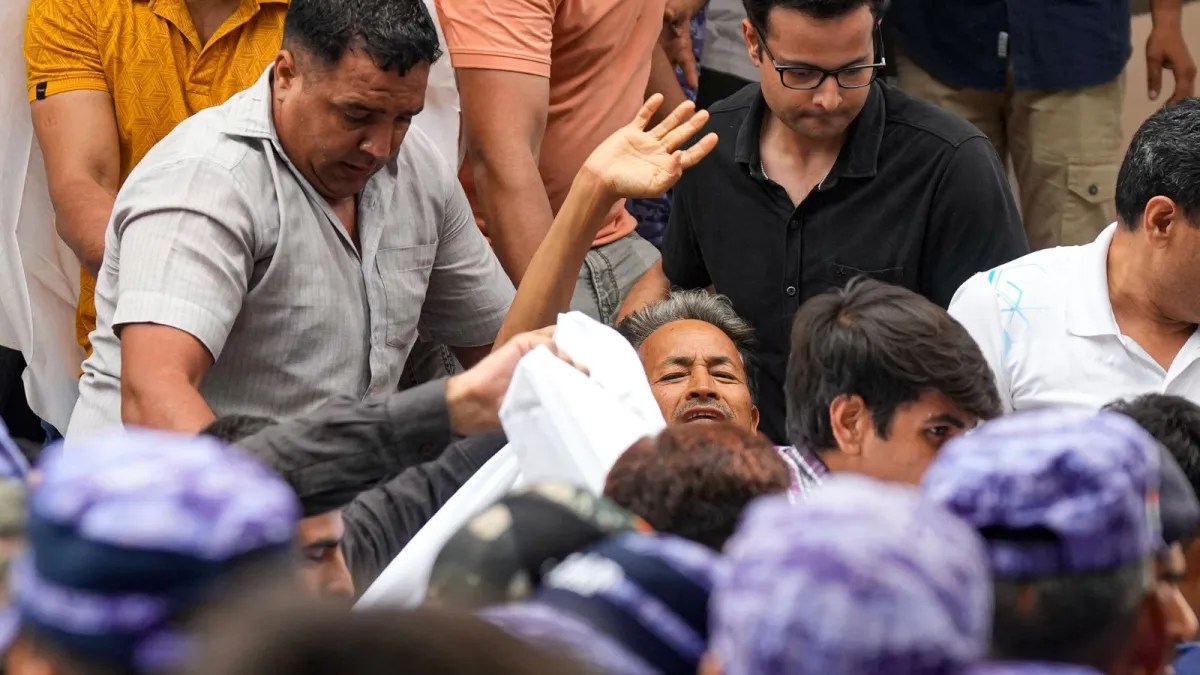
The reasons cut straight to the odds facing Sonam Wangchuk, who was photographed on a stretcher, with a pale hand waving to the crowds and a smile full of hope as plainclothes policemen forcefully removed him from Jantar Mantar after 20 days of hunger strike.
After a close reading of the research on protest, three findings explain why Wangchuk and the Cockroach Janata Party face such long odds and where a narrow path to success might still run.
1. Protest is a war of attrition, and the state has deeper pockets
Size matters most. The movements that win are the ones that draw in a large, diverse cross-section of society. A study by Erica Chenoweth found that no campaign mobilising more than 3.5% of a population had ever failed.
Economists have a blunter name – a war of attrition. The idea comes from the evolutionary biologist John Maynard Smith, who pictured two animals locked over a single prize, both take blows, both bleed, and the winner is simply the one who can bear the pain longer.
Later economists borrowed the model for politics, and its lesson is that the state, with its treasury, its police and its grip on the narrative, can almost always outlast the crowd.
Occupy Wall Street in 2011 is that sad ending. The movement blazed across hundreds of cities on the cry of “the 1%,” then simply guttered out once the government refused to blink. Once the encampments were cleared in November, the high-cost participants were gone, and the protest failed.
The same is being witnessed in Jantar Mantar. Wangchuk’s removal, two days ahead of the parliament session, appeared to let the air out of the movement, disperse the crowds and end the story. But the act has only galvanised it.
2. One hashtag cannot force the powerful to capitulate
A movement that never grows beyond the people who started it never becomes costly enough to matter. It must include participants that matter to the authorities.
The economist Ruben Enikolopov and colleagues explain why people show up at all. They want to showcase that we are socially-minded, and protest is a way to signal who we are to the people whose opinion we care about. But are they willing to march, strike, risk arrest?
This is exactly where the modern, hashtag-powered protest breaks down. Many silent observers would engage with a narrative but won’t step out to support it.
The sociologist Zeynep Tufekci, in Twitter and Tear Gas, argues that digital tools can conjure an enormous crowd overnight but fail to provide the consistent dedication. India’s freedom movement was forged with patient decades-long mass mobilisation, so that by the time people reached the streets they had the spine to endure.
Today’s giant protest flares with a hashtag and dies with the day’s trend. It runs on likes and shares rather than on people willing to upend their own lives for more than a day or two.
The Cockroach Janata Party is a perfect case study of this. It was born an internet joke and grew into something sincere and moving. Its perseverance to survive the cruelty of time and challenges of political force will decide its future.
3. Governments bow only to an economic cost they cannot absorb
The economic weapon is the sharpest.
If you read India’s history, a pattern emerges – governments conceded not out of conscience but out of self-interest.
It was when strikes severed supply chains, boycotts emptied tills, trains stopped, and factories went dark for weeks that the mighty acted. India’s freedom struggle with the Swadeshi boycott and the Dandi March understood this best of all.
The 2020–21 farmer protests, called the largest in recorded human history, cost the affected states an estimated Rs 3,500 crore a day at their peak, by ASSOCHAM’s estimates, and roughly Rs 70,000 crore in a single quarter, as per PHD Chamber. Paired with a farmer voter base that could swing state elections, that price was one the government could not swallow, and all three farm laws were repealed.
Beyond the numbers, the needle moves based on the weight of the trade-off: is the government willing to absorb a temporary blow to its public image, or will the material and electoral costs prove too ruinous to sustain?
Where the cost is moral rather than material, the state yields only when the shame grows unbearable. Potti Sriramulu’s 56-day fast-unto-death in 1952 ended in his death, set off riots, and moved Nehru to create Andhra State within days — a life laid down, and a promise finally kept.
The Nirbhaya protests of 2012–13 forced fast-tracked criminal-law reform on a tide of grief and fury no government dared defy. Anna Hazare’s 2011 fasts pushed a reluctant establishment to pass the Lokpal law.
And when none of those costs land, the state simply waits. Irom Sharmila fasted against the Armed Forces (Special Powers) Act for sixteen years, the longest hunger strike in the world, and the state arrested her, fed her through a tube against her will, and outlasted her sorrow.
Darshan Singh Pheruman died on the 74th day of a fast for Chandigarh, his demand unmet. The anti-CAA protests of 2019–20, among the largest in a generation, did not move a comma of the law.
And yet the protest power has not diminished. It can still move the immovable but only when it can make standing still cost more than surrender. That has always been the whole of it.