



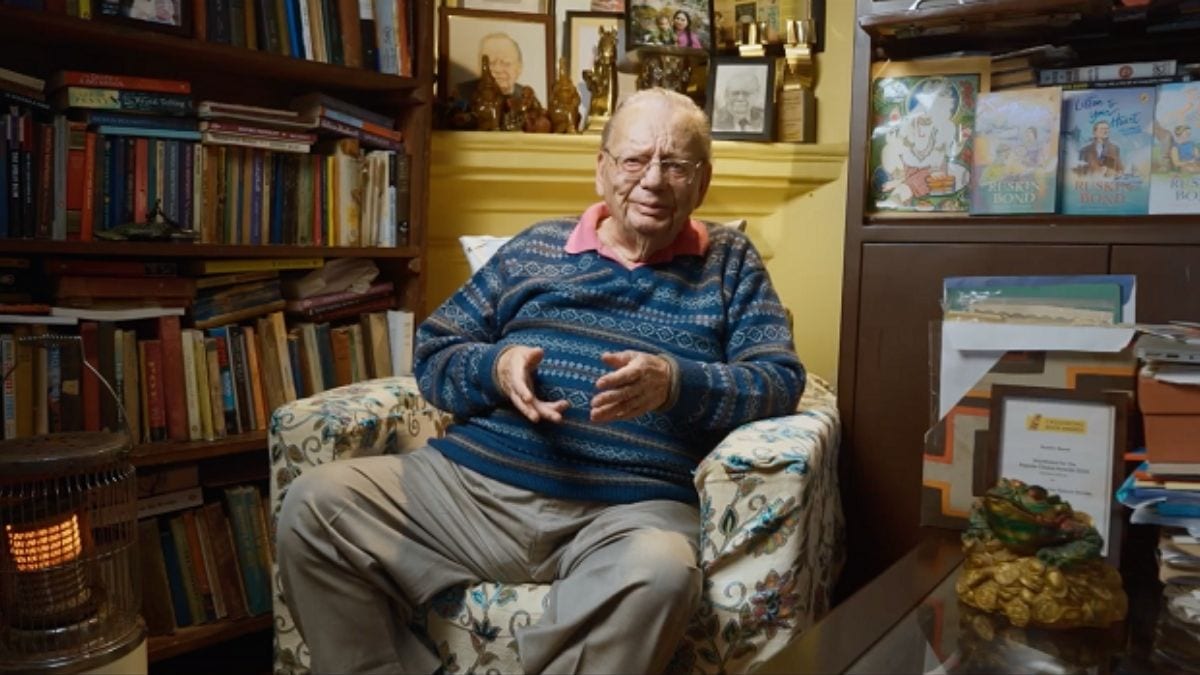
Ruskin Bond, whose writings are synonymous with Indian childhoods, his words indelibly etched into the minds of 10-year-olds and 70-year-olds alike, turned 92 this month. Surrounded by his family, his cat Mimi, dog Coco and several ardent lovers of his work, Bond celebrated his birthday, as well as the first iteration of The Ruskin Bond Literature Festival at Lekhak Gaon, Dehradun. A bust of the author was also inaugurated at Lekhak Gaon at the event, organised by StoneX Global.
Bond is full of anecdotes, jokes and always ready to entertain a chat despite the physical strain it causes him. Lately, the author dictates his words to his granddaughter, who writes for him, now that the tremors in his hands don’t allow him the liberty. On this night, the ageless writer laid back on the bed set up at his Dehradun residence for home care, appearing bright and eager nonetheless, and spoke with FE, looking back on his life’s work, his disdain for deadlines, his brief stint on screen, and his ability to endlessly innovate for his readers. Edited excerpts:
You have been living in Landour for nearly 45 years, and almost 20 years in Mussoorie before that. What is it about the place and your way of life that continues to provide for new inspiration to write?
When one spends most of one’s life in the hills, the mountains slowly begin to feel like companions. Landour has given me silence, birdsong, old trees, drifting mist, and the gentle rhythm of everyday life—all the little things that quietly nourish a writer’s heart. Even now, as I watch the deodars disappear into the mist, I often feel there is always another story waiting to be told. Inspiration rarely comes from grand adventures; more often, it arrives softly —in a child’s laughter, a passing memory, or some small moment of everyday life. The hills have taught me to notice these things quietly, and perhaps that is why I continue to write.
Although I am very lazy, I try to write about two or three pages every morning. But deadlines scare me, like if a publisher tells me that they want the book ready by so and so date or month. But if no deadline hangs over me, I can write quite fast, a few pages every day.
In an early interview in the 1990s, you said the world was very competitive and not everyone can be a writer. Do you still feel the same?
I still believe writing demands patience and perseverance. However, not everyone who wishes to write will become a writer overnight. I think today there are many more opportunities for young people to express themselves than there were in my youth. The important thing is not fame or competition, but sincerity. A good writer must first learn to observe, to listen, and to feel deeply. If one writes honestly and regularly, then one gradually finds one’s voice. Perhaps I have softened a little with age! I would encourage young people to write—but also to read widely and live fully before expecting instant success.
Among your latest works is a children’s picture book. But children today have changed immensely, and are exposed much more to the world than ever before via the internet. How has this changed your writings for children?
Children today certainly know much more about the world than children of my generation did. They grow up with the internet, mobile phones and constant information. But in some ways, children remain wonderfully unchanged. They still enjoy adventure, friendship, humour, mystery, animals, and stories that comfort them. So while I may occasionally acknowledge the modern world and adult themes in my stories, I still try to preserve a sense of wonder and simplicity. I think children also appreciate moments of quietness now, perhaps even more than before. A story can give them a little escape from noisy lives.
What is your opinion about children’s books and authors today—on themes that are no longer simplistic, on themes that range from divorce, mental health, death and disease— which no one broached upon in kids’ literature a few decades back?
I think it is good that children’s literature today is willing to address subjects that were once avoided. Children are often far more aware of sorrow, loneliness, or difficulty than adults imagine. Books can help them understand life gently and honestly. Of course, one must handle such themes with sensitivity and hope. Childhood should not lose its innocence entirely. But literature has always helped people face the world, and children deserve truthful stories too. The best children’s books, whether old or new, are those that offer warmth, courage, and compassion.
Apart from your written work, your stories have been adapted for the screen, your home has become a part of literary history, a literature festival and a short film is being created around you now. How do you feel about being so prolifically eternalised in a country’s literary culture?
I have been fortunate that my stories that have been filmed have been made by good directors. Shyam Benegal made Junoon, which was based on A Flight of Pigeons, and Vishal Bharadwaj made The Blue Umbrella, and Saat Khoon Maaf (based on Susanna’s Seven Husbands). I actually wrote the original script for Saat Khoon Maaf, but it was changed a lot. It came out differently. But I was happy with The Blue Umbrella and Junoon.
Saat Khoon Maaf had some wonderful acting by Priyanka Chopra. I also ended up working in it, because the director gave me a small role. I had to give Priyanka a fatherly peck on the cheek, and I did my best, but the director said, “Ruskin that was a bit clumsy, can you do it again!” So I gave her another peck on the cheek, but it took six or seven takes to finalise the scene. The director jokingly said: “Ruskin Bond I think you are doing this deliberately!” But Priyanka was very sporting about it.
I never imagined, when I was a struggling writer, that my stories would travel so far or that people would take such interest in my little home in Landour. I have always lived very simply and quietly. But I feel grateful that readers continue to find comfort in my work. If my stories have encouraged young readers to love books, then I think it is reward enough.
You have published novels, short stories, poetry. Which style speaks to you the most, and which is the most challenging for you?
I prefer, as a medium, the short story. When I was quite young, I realised that I was better at the short story or the novella. When I would sit down to write a long novel, I would lose interest after a while. So, I decided I’ll stick to the shorter version, and I made a living out of it. There were always hard times—of the 75 years I have been writing, let’s say one-third was a struggle, and two-thirds was a gentler journey. It’s never been easy, but it’s easier now than it was before.
The short story has always been closest to my heart, perhaps because life itself is made up of fleeting moments, small encounters, and passing emotions. Poetry, too, has given me great joy because it comes from mood and memory. Novels are probably the most demanding because they require one to sustain energy and structure over a long period. But each form teaches you something different. I think a writer should move freely between them, depending on what the story asks for.
On your 92nd birthday, how do you look back at your life, and if there could be anything you could change, what would it be? Would you say it has been a life well lived so far?
Ninety-two sounds rather alarming when one says it aloud! But when I look back, I feel fortunate. I have known loneliness and hardship at times, certainly, but I have also known friendship, love, nature, books, and loyal readers. I have spent my life doing the one thing I truly enjoyed—writing. Not everyone is lucky enough to say that. Of course, there are small things one might wish to change—perhaps lost friendships, moments when one could have been kinder or wiser. But regrets are part of being human. Overall, I think it has been a gentle and satisfying journey. And as long as there are stories left to tell and readers willing to listen, life continues to feel meaningful.