



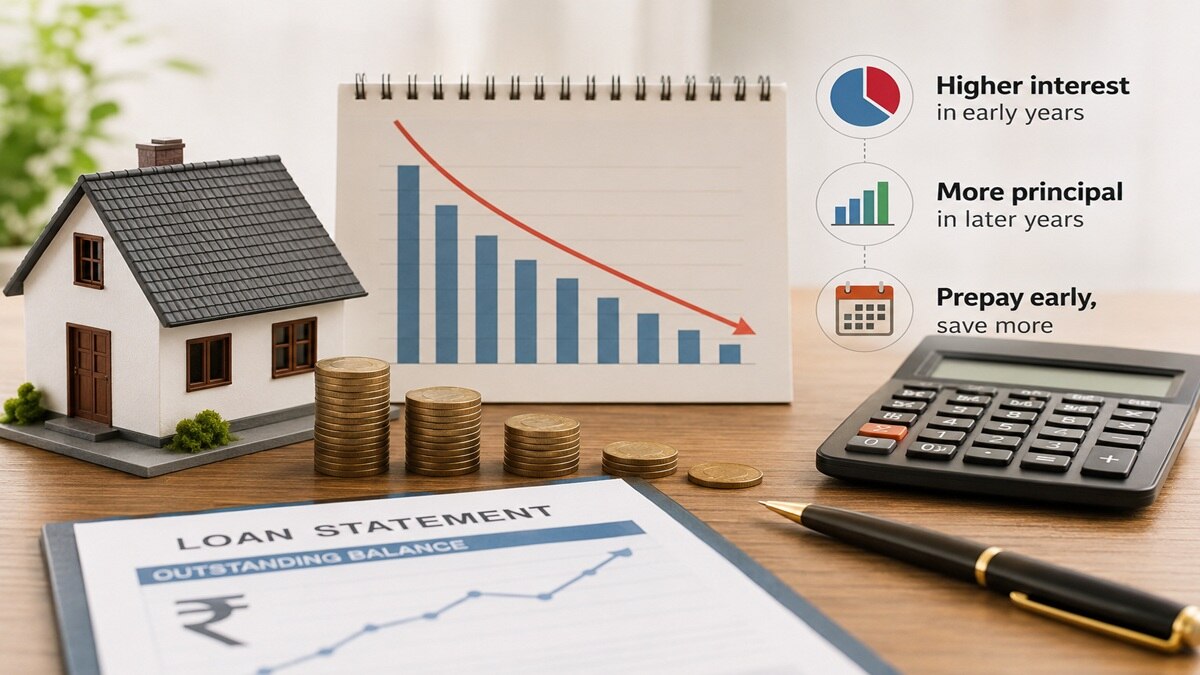
You’ve been paying your home loan EMI every month without fail. Five years have gone by and you’ve already paid nearly ₹50 lakh to the bank. Yet when you check your loan statement, the outstanding loan doesn’t seem to have reduced by much.
If you’ve ever wondered why this happens, you’re not alone.
Most homebuyers assume that every EMI steadily reduces the loan. But that’s not how a home loan works. In the initial years, a much larger part of every EMI goes towards paying interest, while only a small portion reduces the principal. It is only later in the loan tenure that this equation starts changing.
Let’s understand this with a simple example.
Assume you take a ₹1 crore home loan at an interest rate of 8% for 20 years. The monthly EMI works out to around ₹83,644. While the EMI remains the same throughout the loan tenure, the split between interest and principal keeps changing every month.
Why does your loan reduce so slowly?
“Many borrowers assume that paying their EMI steadily reduces the loan balance, but home loans work differently,” says Ankit Bagadia, Director – Business, BankBazaar.
He explains that interest is calculated every month on the outstanding loan amount, which is highest at the beginning of the loan. That means the interest portion of the EMI is also the highest initially.
For example, on a ₹1 crore loan at 8%, the first month’s interest is about ₹66,667. Out of an EMI of around ₹83,644, only about ₹16,977 goes towards reducing the principal. The remaining amount is used to service the interest. As the loan balance gradually comes down, the interest component also falls, allowing a larger share of each EMI to reduce the principal.
Table 1: Where does your EMI actually go?
Loan assumptions
Loan amount: ₹1 crore
Interest rate: 8%
Tenure: 20 years
EMI: ₹83,644 per month
| Year | Principal paid during year (₹) | Interest paid during year (₹) | Loan balance at year-end (₹) |
| 1 | 2,11,367 | 7,92,362 | 97,88,633 |
| 2 | 2,28,910 | 7,74,819 | 95,59,724 |
| 3 | 2,47,909 | 7,55,819 | 93,11,814 |
| 4 | 2,68,486 | 7,35,243 | 90,43,329 |
| 5 | 2,90,770 | 7,12,959 | 87,52,559 |
| 6 | 3,14,904 | 6,88,825 | 84,37,655 |
| 7 | 3,41,040 | 6,62,688 | 80,96,615 |
| 8 | 3,69,347 | 6,34,382 | 77,27,268 |
| 9 | 4,00,002 | 6,03,726 | 73,27,266 |
| 10 | 4,33,202 | 5,70,526 | 68,94,064 |
| 11 | 4,69,158 | 5,34,571 | 64,24,906 |
| 12 | 5,08,098 | 4,95,631 | 59,16,808 |
| 13 | 5,50,270 | 4,53,459 | 53,66,539 |
| 14 | 5,95,942 | 4,07,787 | 47,70,597 |
| 15 | 6,45,405 | 3,58,324 | 41,25,192 |
| 16 | 6,98,973 | 3,04,755 | 34,26,219 |
| 17 | 7,56,987 | 2,46,741 | 26,69,232 |
| 18 | 8,19,817 | 1,83,911 | 18,49,415 |
| 19 | 8,87,861 | 1,15,867 | 9,61,554 |
| 20 | 9,61,554 | 42,175 | 0 |
Source: BankBazaar. Illustrative calculations.
The table clearly shows why many borrowers feel their loan is barely moving in the early years. During the first five to six years, a much larger portion of the EMI goes towards interest than principal. The principal repayment rises only gradually, while the interest component steadily falls.
According to Bagadia, the biggest change comes roughly in the middle of the loan tenure.
“The amortisation table shows that the composition of an EMI changes gradually over the life of the loan, with the most noticeable shift occurring roughly between Years 10 and 13. As the loan balance reduces, the interest component declines and a larger share of each EMI starts repaying the principal. This is why the outstanding loan begins reducing more quickly in the second half of the tenure, even though the EMI remains unchanged throughout,” he says.
Can you speed up principal repayment?
Yes.
One of the most effective ways is to make small but regular part-prepayments while keeping the EMI unchanged.
Let’s assume the borrower pays an additional ₹1 lakh every year from the sixth year to the tenth year.
Table 2: What happens if you prepay ₹1 lakh every year?
| Particulars | Value |
| Total prepayments | ₹5,00,000 |
| Total interest paid | ₹92,34,491 |
| Interest saved | ₹8,40,077 |
| Original tenure | 20 years |
| Revised tenure | 18 years 8 months |
| Loan tenure reduced | 1 year 4 months |
Source: BankBazaar. Illustrative calculations.
The numbers are revealing. By making total prepayments of ₹5 lakh over five years, the borrower saves around ₹8.4 lakh in interest and becomes debt-free 16 months earlier, without increasing the monthly EMI.
The reason is simple. Every prepayment directly reduces the outstanding principal. Once the principal falls, future interest is calculated on a smaller amount, allowing a larger portion of every subsequent EMI to go towards reducing the loan.
This effect becomes even clearer when you look at the outstanding balance after each annual prepayment.
Table 3: Outstanding loan balance after annual prepayments
| Year | Extra prepayment (₹) | Loan balance at year-end (₹) |
| 1 | — | 97,88,633 |
| 2 | — | 95,59,724 |
| 3 | — | 93,11,814 |
| 4 | — | 90,43,329 |
| 5 | — | 87,52,559 |
| 6 | 1,00,000 | 83,30,073 |
| 7 | 1,00,000 | 78,72,520 |
| 8 | 1,00,000 | 73,76,991 |
| 9 | 1,00,000 | 68,40,333 |
| 10 | 1,00,000 | 62,59,133 |
| 11 | — | 57,37,276 |
| 12 | — | 51,72,105 |
| 13 | — | 45,60,026 |
| 14 | — | 38,97,144 |
| 15 | — | 31,79,243 |
| 16 | — | 24,01,757 |
| 17 | — | 15,59,739 |
| 18 | — | 6,47,835 |
| 19 | — | 0 |
Source: BankBazaar. Illustrative calculations.
Use bonuses wisely
Bagadia says annual bonuses or incentives can be an effective way to reduce the cost of a home loan, especially during the initial years.
“Since interest is calculated on the outstanding principal, reducing the loan balance early lowers the interest payable over the remaining tenure. Even relatively modest but regular prepayments can meaningfully reduce the overall borrowing cost and shorten the loan tenure,” he says.
However, he advises borrowers to first build an emergency fund and set aside money for near-term financial goals. Only surplus funds should be used for home loan prepayments.
Summing up….
A home loan EMI doesn’t work the way many borrowers assume. In the initial years, most of what you pay each month goes towards interest because the outstanding loan is still large. As that balance gradually falls, a bigger share of the EMI starts reducing the principal.
Understanding this repayment pattern can help borrowers make smarter decisions. Even relatively small prepayments made in the early years can reduce the total interest burden by several lakhs and help close the loan well ahead of schedule.
Every financial journey has a turning point. What’s yours?
Financial Express is launching a new series highlighting real experiences with money, investments, and the taxman. Did a sudden tax rule catch you off guard? Did a piece of financial advice change your life? Your story could provide invaluable, practical lessons for thousands of fellow taxpayers. Share your experience with us. We respect your privacy: no stories will be featured without a direct conversation and your full consent. Thank you.