



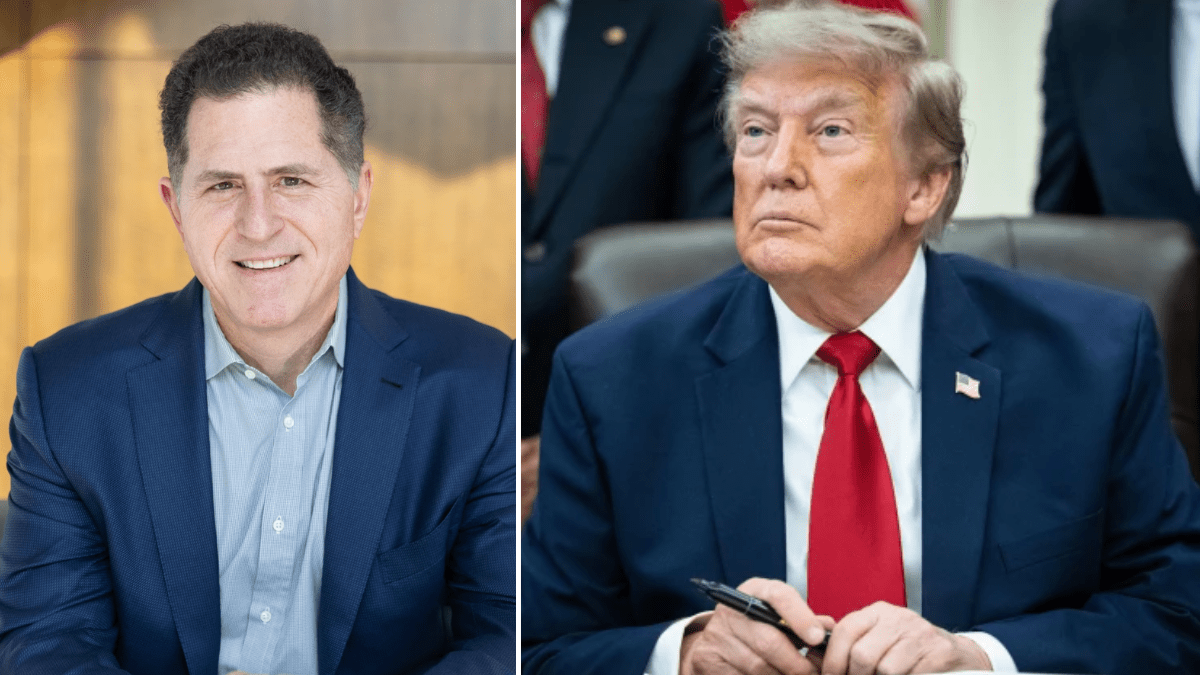
Michael Dell has become one of the biggest winners of 2026. The 61-year-old billionaire has added $83.5 billion to his fortune this year, taking his net worth to $223 billion and making him the world’s sixth-richest person. The company’s shares have climbed 240%, while demand for artificial intelligence infrastructure has powered rapid growth in a business that sells everything from GPUs and memory to networking, cooling and storage. Dell, who owns roughly 40% of the company, has benefited enormously from that rise.
But as his company rides the AI wave, another development has put the usually low-profile billionaire in an unfamiliar position that is close to the centre of Washington’s political light.
US President Donald Trump has repeatedly praised Dell, publicly encouraged Americans to buy his company’s computers and welcomed Michael and his wife, Susan Dell, to a growing number of White House events. For a businessman who rarely courts attention, Dell has suddenly become one of the more visible corporate figures around the president.
AI has transformed Dell’s fortunes
The strongest explanation for Dell’s wealth boom lies in the company’s business. Dell Technologies has positioned itself as a major supplier of the infrastructure needed for the AI revolution. Its Infrastructure Solutions Group provides GPUs, memory, networking, cooling, storage and related services.
According to Business Insider report, revenue from the division surged 181% year over year in the company’s first-quarter earnings report. In May, Dell posted its strongest quarterly earnings since returning to the public markets in 2018, with revenue reaching $43.8 billion.
The company has also been carrying out a major internal overhaul. It is modernising systems and programs across the business while cutting its workforce through layoffs and attrition.
Over the past three years, Dell has reduced its workforce by 36,000. As of January, the company employed around 97,000 people, according to its latest 10-K filing.
The combination of AI demand and rising investor confidence has sent the stock soaring and because Michael Dell owns around 40% of the company, much of that increase has flowed directly into his personal fortune. Then came an endorsement from the White House Dell’s strong year received another boost last week when Trump publicly promoted the company’s computers. ““Go out and buy a Dell computer,” Trump told reporters at the White House during the July 6 launch of Trump Accounts.
The president had made a similar recommendation in May
According to Business Insider, Dell shares rose in the days following Trump’s latest endorsement. Later on July 6, Michael and Susan Dell joined the president for lunch in the Rose Garden.
The public praise has become part of relationship between the billionaire and the president, one that is much more visible than it was during Trump’s first term.
Dell was involved with the first Trump administration. He joined the president’s American Manufacturing Council and attended an early meeting with business leaders. But his interactions with Trump were more limited.
This time, the relationship appears far more established.
Recent footage even showed the two men joking about Dell owning a “Dellicopter” instead of a helicopter.
A $6.25 billion commitment brought the Dells closer to Trump
The main reason behind the solid relationship is Trump Accounts, the new investment savings program for children.
Michael and Susan Dell contributed $6.25 billion to the program through their family foundation in December. Since then, the couple have appeared at several White House media events alongside the president.
Dell’s interest in the idea predates its current name and his closer relationship with Trump.
He attended the first “Invest America” roundtable in June 2025, before the initiative became Trump Accounts. Dell also told CNBC in December that he had become interested in the idea of seeding investment accounts for children around 2021.
The initiative is also closely aligned with the Dell Foundation’s existing philanthropic work, which has focused on children, education and economic opportunity.
The White House has strongly praised the couple’s contribution
“Michael and Susan Dell are patriots who are generously contributing billions of dollars of their fortune to the Trump Accounts of millions of kids from working-class families,” White House spokesman Kush Desai told Business Insider.
He added that Trump had “rightfully” praised Dell and other donors to the program.
The Dell Foundation and Dell did not respond to requests for comment from Business Insider.
The president has also invested in Dell
The relationship between Trump and Dell has another financial dimension.
Since the Dell Foundation announced its Trump Accounts contribution in December, the president has purchased more than $1 million worth of Dell stock.
In April, Trump sold at least $50,000 in Dell shares and possibly as much as $100,000.
Meanwhile, Dell Technologies has also secured a major government deal.
In February, the company landed a $10 billion contract renewal with the US Department of Defense. Navy Chief Information Officer Barry Tanner said the contract was awarded following a competitive evaluation process.
The sequence of events has placed Dell at the intersection of two powerful forces, the AI investment boom and a White House that has publicly embraced both the billionaire and his company.
A private billionaire becomes a familiar White House face
Dell’s increased political visibility is unusual for a businessman who has generally stayed away from the celebrity culture surrounding other technology billionaires.
He rarely gives interviews or attends high-profile “it-crowd” events. He was also absent from the group of technology moguls who attended Trump’s inauguration. In recent months, Dell has appeared at several important government events.
In March, he joined the President’s Council of Advisors on Science and Technology alongside Marc Andreessen, Jensen Huang and Mark Zuckerberg. Dell had previously served on the council during President George W. Bush’s administration.
He also attended a White House dinner for Saudi Crown Prince Mohammed bin Salman in May.
Douglas Schuler, a professor of Business and Public Policy at Rice Business School who specialises in corporate political activity, said the Dells have not traditionally been known as highly visible political supporters.
“They aren’t ‘out there’ as big backers of politicians like some of these other CEOs,” Schuler told Business Insider.
“They seem to make political contributions to both sides of the aisle and to members of Congress where they have significant operations or with jurisdiction over their business activities,” he added.
Corporate America is dealing with a different Trump presidency
Dell’s growing relationship with the president is also part of a wider change in corporate America.
During Trump’s first term, business leaders could face reputational risks for getting too close to him. In his second term, many executives have taken a different approach and are working more closely with the president.
Trump has exerted pressure on Big Law, media organisations, universities and, most recently, World Cup organisers.
That has created a new calculation for corporate leaders. Winning the president’s approval can be valuable, while becoming the target of his criticism can carry risks.
But even executives who try to maintain a working relationship with Trump cannot be certain that it will last.
JPMorgan CEO Jamie Dimon, for example, has combined criticism of some Trump policies with praise for others. Yet Trump sued Dimon and JPMorgan for $5 billion in January, alleging that the bank closed his accounts for political reasons after the January 6 attack. The bank said the lawsuit had no merit.
Elon Musk’s experience offers another example of how quickly the relationship between wealth and political influence can change.
After Musk criticised Trump’s “big beautiful bill,” his wealth fell by an estimated $34 billion in a single day as Tesla shares dropped 14%. A year later, however, Musk is worth nearly $900 billion.
Can political proximity translate into business gains?
Companies do not rely only on their products and market strategies to succeed. They also lobby governments, donate to charities and work with non-governmental organisations, Schuler said.
Some research suggests companies that combine these approaches can perform better financially. But establishing a direct link between political activity and financial success is much harder.
“Is it possible that they benefited personally or the company itself? Certainly,” Schuler said. “Is it easy to show? No.”
That question sits at the centre of Dell’s remarkable year.
The company has a clear business engine behind its rise: AI. Its infrastructure division is expanding rapidly, its revenue has hit new highs and its stock has soared.
At the same time, Michael Dell has moved closer to a president who has publicly told Americans to buy his computers, praised his family and welcomed him repeatedly to the White House.
There is no simple way to separate the value of political goodwill from the strength of the underlying business. But for now, Dell has both.
His company is riding one of the biggest technology investment waves in years, his personal fortune is growing at an extraordinary pace, and the president of the United States has become a very public fan.
Standing beside Michael and Susan Dell at the Trump Accounts launch last week, Trump summed up the warmth of the relationship. “They are truly incredible people,” the president said. “We’re going to get him that money back one way or another.”