



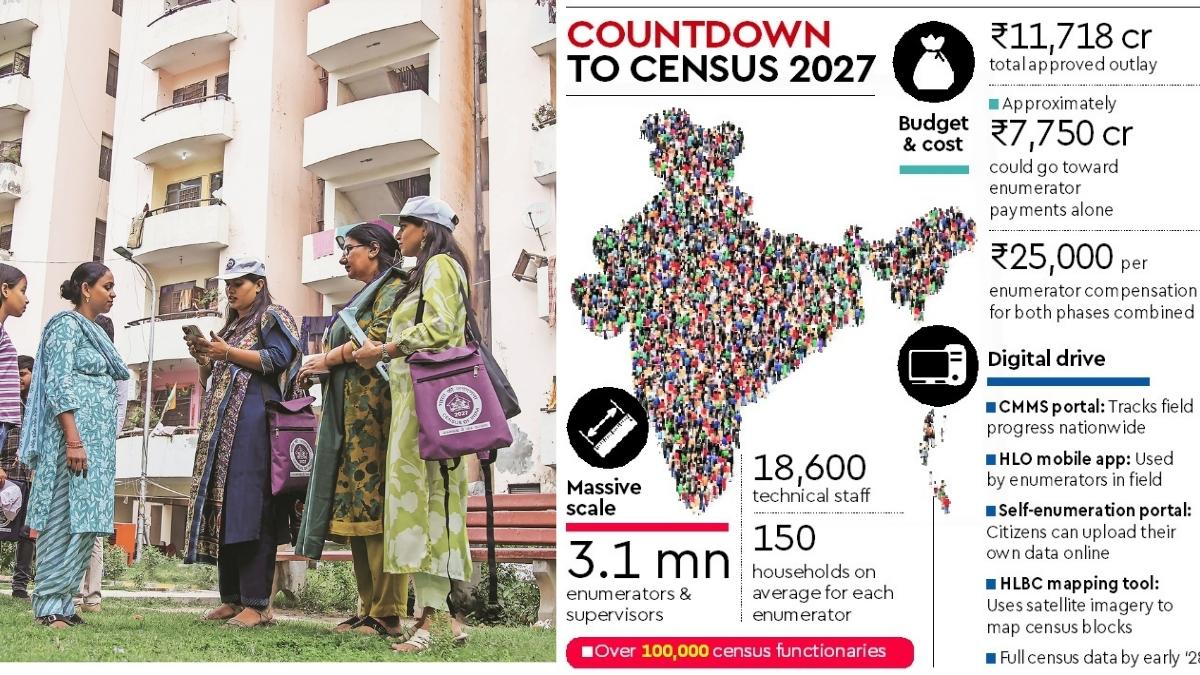
At 8 in the morning, Delhi already feels exhausted. The heat is full-on, flattening roads and emptying streets long before noon, and by the time I meet Yash Gupta outside a government boys’ school in Mehrauli’s Kishangarh area, the temperature is already hovering around 35 degrees Celsius. Gupta, a Class 8 science teacher, adjusts his white cap, checks his folder, and starts towards Vasant Kunj Sector D, the area assigned to him for Census 2027 work. India’s 16th Census, and the eighth since Independence, has officially begun.
It is being described by the government as the largest census exercise in the world, being overseen by Registrar General and Census Commissioner of India Mritunjay Kumar Narayan, and involving around 3.1 million enumerators and supervisors, more than 100,000 census functionaries, and approximately 18,600 technical personnel working over nearly 550 days. The Union Cabinet has approved a financial outlay of Rs 11,718 crore for the exercise. Nearly Rs 7,750 crore of that amount could go toward payments for enumerators and supervisors alone if each receives the promised Rs 25,000 honorarium for both phases combined.
This is also India’s first fully digital Census, introducing mobile-based data collection, self-enumeration portals, geo-referenced mapping tools, and near real-time monitoring through a centralised Census Management and Monitoring System (CMMS) portal developed with the Centre for Development of Advanced Computing (C-DAC). With the digital push and less paperwork, the government has aimed to publish the preliminary data within 6-9 months following the completion of enumeration, followed by detailed tables and reports in phases by early 2028.
But on ground, the Census still looks remarkably analogue. Gupta’s assigned Houselisting Block, or HLB, stretches across nearly four kilometres of Vasant Kunj’s farmhouse belt, where giant compounds sit behind tall iron gates and trimmed hedges. Some properties stretch across acres. Most look empty. Guards sit inside tiny cabins under rotating fans as stray dogs sleep across dusty roads. Human presence is sparse. “If a dog bites me here, I don’t know who will take me to the hospital,” Gupta laughs nervously as we walk through the deserted stretch.
Every structure has a census number (CN) painted in red outside the property. The number acts as a unique identifier for structures so that households are neither omitted nor double-counted. Each enumerator has been assigned roughly 150 such CN households on average. “One thing is very important,” Gupta says. “You cannot miss even one CN number.”
Phases & provisions
During Phase I, which is the ‘Houselisting and Housing Census’ currently underway across states from April to September, enumerators collect information on housing conditions, amenities, mobile numbers, internet access, cooking fuel, assets and caste. Phase II, scheduled for February next year, will collect demographic information including occupation, migration, religion, language, fertility and disability details. This Census is also the first since 1931 to include comprehensive caste data across all sections of the population. Before this, past censuses post-independence only enumerated Scheduled Castes (SC) and Scheduled Tribes (ST).
The government calls it a technologically advanced exercise. Enumerators now carry the HLO (house listing operations) mobile application, available in 16 regional languages, enabling direct field-to-server transmission without paperwork. Officers can track progress through dashboards on the CMMS portal. Satellite imagery is being used through the Houselisting Block Creator mapping application to digitally create enumeration blocks and avoid duplication. Citizens can also self-enumerate online through se.census.gov.in during a 15-day window before field visits begin.
And yet, by 8.30 am, Gupta and I are still standing outside locked gates trying to convince guards to answer basic questions. At one bungalow, the guard hesitates to call the owner because “maalik daatenge”. At another, the owner instructs the guard over the phone to first click a photograph of Gupta’s ID card and wait for his confirmation before speaking further. At a third property, nobody opens despite repeated ringing. A neighbouring guard eventually walks over and answers questions on their behalf.
How many people live there? “Pata nahi.” Do they have cable? He points vaguely toward wires crossing a tree branch. “Cable hi hoga.”
One guard identifies the owner as “Baid”. Gupta quietly writes “Vaidya” in the form. “Maybe it’s Vaidya,” he shrugs. “But there are so many spellings in India.”
India’s Census has always depended on temporary human infrastructure, mostly schoolteachers, to count itself. The reasoning is practical as teachers are spread across the country, literate, locally known and already embedded within communities.
“Do we have enough literate people out there on the field to collect the data accurately?” former chief statistician Pronab Sen tells me later. “Schoolteachers are easier to disperse and understand the work.”
But the system also rests on enormous assumptions that teachers can absorb this additional labour, that citizens will cooperate, that technology will work, and that trust can survive repeated visits by strangers asking sensitive questions.
The confusion becomes even sharper when enumerators begin dealing with migrant workers, guards and temporary tenants. “There is not much awareness about how counting actually works,” Sujit Dikshit, a 47-year-old Hindi teacher covering East Patel Nagar and Baljeet Nagar in Delhi, explains, as he returns from his enumeration duty on Bakrid, as “most people would be home”. He is happy that he could trace 7-8 households.
If a security guard lives inside a property with a separate room and cooks his own food there, he is counted as a separate household at that address even if his family lives in his native village. But if he eats with the employer’s family and lives within the same domestic arrangement, he may be counted as part of that household itself.
“People think if someone has a family back in the village, then they should only be counted there,” Dikshit says. “But the Census counts where and how people are actually living.”
The 2011 Census deployed around 2.7 million officials across more than 600,000 villages and nearly 8,000 towns, eventually recording India’s population at 1.21 billion. Though provisional totals were released within weeks, detailed socio-economic and demographic tables took nearly four years to fully publish.
The long gap between Census 2011 and Census 2027, prolonged further because of Covid-19, now means India has been making welfare, migration, urbanisation and education policy decisions using outdated population data for more than 15 years. “This is the only way to do it,” Sen says. “After Covid, it is essential because migration patterns have changed a lot.”
Relevance & reality
But a question repeatedly surfaces — why does India still need a massive physical Census at all in the age of Aadhaar, birth registrations and digital databases?
Bhaswati Das, associate professor at JNU’s Centre for Population Studies, believes India may eventually move toward a continuously updated population register model, similar to several European countries that now rely on linked administrative databases rather than once-in-a-decade physical enumeration.
“We already have Aadhaar, birth registrations, education databases and economic databases,” she says. “If eventually these can be linked through a common field, theoretically we may not need such large-scale Census exercises.”
But India, she argues, is still far from that reality. “Birth registration is incomplete in many areas. Death registration is weak. Migration data is still not captured properly. We are still evolving toward that system,” she adds.
That missing migration data matters enormously. India had around 456 million internal migrants during the 2011 Census, nearly one-third of the population. Since Covid-19, those migration patterns have changed dramatically.
“India’s challenge is that we do not yet have civil registration systems strong enough to substitute for or cross-check the Census in the way some countries, especially in the developed world, do,” says Poonam Muttreja, executive director of the Population Foundation of India. “The biggest risk is that the most vulnerable are also the easiest to miss. Migrants, homeless persons, domestic workers, temporary tenants, people in informal settlements — they can all fall through the cracks because they are mobile, poorly documented or fearful of institutions.”If they are missed, she says, “it affects everything from food security and housing to health services and political representation.”
The challenge becomes visible almost immediately once enumeration begins. By 9.30am, the roads in Vasant Kunj’s Sector D have emptied further. The temperature keeps rising. Guards can rarely provide complete information because owners are absent, travelling, or unwilling to answer calls. Some houses appear permanently vacant. “In my allotted area, 83 families did self-enumeration but I’m yet to find one,” Gupta says. The digital transition, which the government presents as a breakthrough, is exposing gaps on the ground.
In Patel Nagar, Dikshit spent nearly seven days helping residents complete self-enumeration forms online. “I personally did 121 self-enumerations,” he says. “Then suddenly most IDs became disabled.”
Residents who had already uploaded information online were not appearing in the application when enumerators arrived. Many families had to repeat the process from scratch. “That breaks trust,” Dikshit says. “People say they already gave the information once. Now why are we asking again?” The issue, as per several teachers, affected multiple enumerators.
Pronab Sen remains sceptical about self-enumeration itself. “We need to avoid double counting,” he says. “In countries like the US they can rely on it more. In India’s context, it is difficult.”
Professor Das describes the current model as “trial and error”. “Online is only another extra layer for India,” she says. “One cannot completely rely on online, especially with the level of development India currently has.”
Technology, she argues, cannot solve the core problem of participation. “Even in developed countries, online response rates don’t reach 100%. In India, willingness itself becomes a challenge.”
For many enumerators, the deeper challenge is not technology but mistrust. Shubhra Banerjee, a 43-year-old assistant teacher at a government primary school in Noida who also participated in the 2011 Census, says residents in high-rise societies often refuse to even open doors. “At least one out of two people ask for ID cards,” she says. “Later, when people see us regularly, the faith develops.” Women enumerators face another difficulty. “Women safety is still an issue in high-rise and multistorey areas,” she says. “We avoid going alone.”
Sometimes colleagues accompany. Sometimes family members do. Another female enumerator describes entire mornings spent outside gated colonies where residents refuse to speak properly even over the phone. “Most people aren’t ready to open the gate,” she says. “Many don’t even know what Census or janaganana is.”
The irony is stark. The Census, one of the foundational exercises of the modern state, often encounters its greatest resistance precisely in the country’s wealthiest and most educated neighbourhoods.
Professor Das believes urban distrust has intensified over time. “Earlier society was more faith-based,” she says. “Now the sense of neighbourhood is breaking down. In metro cities, people are suspicious of unknown persons entering their homes.”
Yet a few hours later, in Naraina village in west Delhi, another version of India’s Census unfolds entirely differently.
At 6.30 pm, when the day’s heat has finally softened slightly, two women teachers in their 40s — Mona Chawla and Prerna Sharma — begin enumeration after finishing their own household chores at home.
Naraina village, one of Delhi’s oldest urban settlements, is dense, crowded and layered vertically with rented rooms, small general stores and multigenerational families stacked floor above floor.
The teachers carry thick bundles of printed forms they would later copy from to feed online once they return home. “The app is actually easy once you get used to it,” Chawla laughs while navigating a narrow lane. “Like Facebook.” They were facing glitches on the mobile app earlier due to the network, so they found a solution in printed forms. “We’re very solution oriented,” Chawla says.
Her allotted area happens to be the same neighbourhood where she grew up. Though she now lives in Dwarka, she had temporarily shifted back during enumeration because her HLB falls within the area around Nigam Vidyalaya school. “Everyone knows me here,” she says. “The biggest problem now is too many cups of tea.”
The two women deliberately work together. One side of the lane belongs to one teacher, the opposite side to the other. “It feels safer,” Sharma says quietly. “And faster.” Each of them has roughly 40 buildings allotted. But in Naraina village, a ‘building’ may contain four or five floors, with three or four families living on every floor. The density changes everything. Unlike Vasant Kunj’s silent farmhouses, Naraina’s Census unfolds loudly, with children running downstairs, tenants shouting from balconies, pressure cookers whistling inside kitchens and shopkeepers answering questions between customers.
As we walk, Sharma stops outside a general store and calls out: “Janaganana ke liye aaye hain.” The shopkeeper ignores her initially, busy with customers. Chawla shouts louder. Eventually the woman steps out and begins answering questions.
On the upper floors, migrant tenants lean over balconies while buttoning shirts and speaking into phones to verify whether they had already been counted in their home villages. One tenant from Chhattisgarh calls home nervously to confirm whether his family had included him there during enumeration between May 1 and 30. When his friend confirms the count had already happened in the village, the teachers marked him accordingly to avoid duplication with a note below stating “person who lives on rent here has already done his census in his native land”. This is the invisible complexity of India’s Census where people are moving between cities and villages, rented rooms and permanent homes, one state’s enumeration window and another’s.
As we climb staircases, the questions repeat endlessly, such as number of rooms, kitchen, type of wall, electricity, caste category, gas cylinder, TV connection, motorcycles, televisions, laptops.
In one house, a young child answers questions because the mother is not educated enough to understand the question. In another, a woman rushes downstairs minutes later to clarify that she indeed owns a gas cylinder. “Connection katt toh nahi jayega?” she asks anxiously. The enumerators reassure her. One landlord mentions another person had already visited earlier claiming to be from the Census. “Next time click a photo of the ID card,” the teachers advise him.
The work has become so consuming that teachers now describe their year through government duties rather than academic calendars. Once Census work finishes, many will immediately move to SIR verification work. “We have a teacher who is a cancer survivor and close to retirement,” Sharma says. “Even she is on duty.” The burden has triggered frustration among many teachers who already juggle election duties, surveys, paperwork and increasingly overloaded classrooms.
Dikshit from Patel Nagar calculates his Phase I compensation bluntly. “Rs 9,000 for a month means Rs 300 a day,” he says. “How much can I get in Rs 300?” Several enumerators travel over 20 km daily for fieldwork. “There is only increasing work,” Dikshit says. “Nothing else is increasing.”
Sense of obligation
And yet, despite complaints, most teachers continue speaking about the Census with a strange sense of obligation. “See, fake duty only creates fake policies,” says Mona Chawla. “If we do it properly at the grassroots level, then maybe children’s lives improve later.” That belief may be what ultimately sustains the Census.
The politics surrounding Census 2027 has also quietly entered the field itself. While most states and Union territories have announced their houselisting schedules stretching from April to September 2026, West Bengal’s timeline remains unannounced. Several schoolteachers declined to discuss preparations publicly, citing a recent state government circular reiterating existing service conduct rules governing media interaction by government employees. The notification, a copy of which is in possession of FE, was issued by the state chief secretary on May 19, stating that employees should avoid public statements or interactions that may “strain relations with the Central government”.
By 11.30 am, when we finally complete Gupta’s stretch of Vasant Kunj, the temperature has climbed above 41 degrees Celsius. Even the guards have disappeared indoors. “Today was easier because you were with me,” says Gupta. “At least there was someone to help check houses. Do aadmi toh chahiye.”
India’s Census has always been more than statistics to understand who we are. That answer, however, depends on schoolteachers walking through 45-degree heat, persuading strangers to open gates, calming suspicious residents and hoping that somewhere inside all this chaos, the country can still count itself properly.