




Indian professionals applying for AI jobs abroad are facing a new kind of test. It has little to do with writing perfect code. As global demand for AI talent surges, overseas employers are redesigning interview formats to check whether candidates can question AI-generated answers, defend their decisions under pressure, and know when not to trust a model. Speaking to Financial Express Digital, recruiters and hiring experts share what’s changed, the mistakes Indian candidates keep making, and how to prepare.
How AI interviews differ from traditional tech interviews
The shift isn’t about new technology, it’s about how candidates are judged. Coding tests, algorithms and system design still matter, but they no longer decide the offer.
“Technical skill opens the door. It rarely closes the deal. The thing that actually decides an offer is judgment,” says Achal Khanna, CEO of SHRM APAC & MENA, who notes that companies want professionals who can flag when an AI model can’t be trusted and explain their reasoning clearly.
Daniele Merlerati, CRO at GI Group Holding says, “Technical skill is table stakes; problem solving is expected. The differentiator is decision-making under constraints.” Interviewers now weigh how candidates balance accuracy, latency, cost, governance and security while designing AI systems and not just whether the code runs.
Nishant Chandra, co-founder of Newton School, adds that AI interviews layer in prompts, data quality, evaluation methods and production issues like hallucinations, inconsistent outputs, privacy and monitoring on top of standard coding fundamentals.
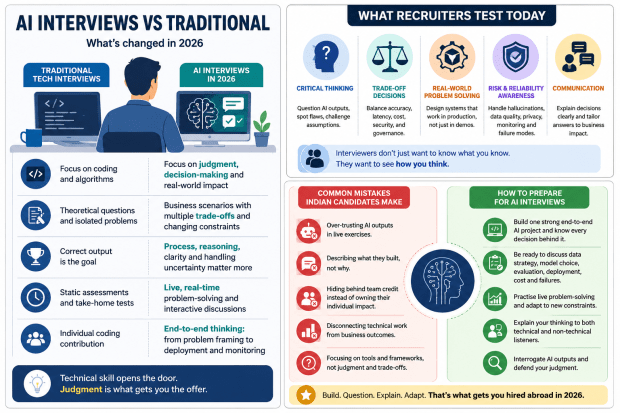
Recruiters test judgment, not just technical skill
With AI tools now generating working code in seconds, the old coding-puzzle format is fading fast. “Companies have moved toward live, real-time problem-solving instead. They want to watch you think while you build something, not just grade the output,” says Abhishek Agarwal, President at The Judge Group India.
Instead of isolated programming problems, employers present business scenarios requiring multiple decisions, selecting a model, refining prompts, weighing trade-offs, or redesigning a solution after new constraints appear.
Strong candidates define the business problem before touching the technology, Merlerati says, asking clarifying questions, comparing approaches, and explaining how they’d monitor the system post-deployment. Weak candidates jump straight to naming a model or framework without justifying the choice.
Live AI exercises are now standard
Practical, real-time tasks are replacing theory-heavy questions. Chandra says candidates may be asked to improve a prompt, build a small retrieval pipeline, debug an AI-generated solution, or compare model outputs, with some companies actively encouraging AI tool use to see how candidates work with AI, not whether they avoid it.
Others ban AI tools outright to test independent thinking. Agarwal advises candidates to find out which approach a company follows before the interview.
AI interview questions recruiters are asking in 2026
Sample question from Chandra: “Design an AI customer-support assistant handling one million queries a month, walk us through model choice, retrieval architecture, evaluation, guardrails, latency and cost.”
Other common asks: reviewing a prompt and its outputs to spot failure patterns and build an evaluation framework; explaining when RAG beats fine-tuning; reducing hallucinations; defending against prompt injection; and optimising latency and inference costs. Merlerati notes that prompt engineering is now a baseline skill, not a differentiator.
Chandra says candidates should also expect questions on when an AI agent should escalate to a human, and how systems should be monitored once live, testing whether they understand AI in the real world, not just in theory.
How interviewers spot memorised answers
Recruiters increasingly introduce follow-up twists mid-interview to see how candidates adapt. Khanna says interviewers often plant a hidden flaw in a model or dataset, without saying so, and simply watch whether it gets caught.
“Someone who memorised the vocabulary usually nails the first question and then trips the moment a follow-up wanders off script,” he says.
Merlerati calls this the “messy middle”, questions with no textbook answer, like what happens if training data turns noisy? or what changes if latency requirements tighten? “These conversations quickly separate practical experience from memorisation,” he says.
Production skills matter more than prototypes
Employers are now evaluating whether candidates can deploy AI at scale, not just build a working demo. Merlerati says weak answers “skip over limitations, evaluation criteria and deployment considerations in favour of naming a model or framework” and failing to explain what happens when a system breaks is the biggest red flag.
Chandra says companies expect candidates to speak fluently on evaluation metrics, failure modes, monitoring, safety and cost alongside raw model performance.
Common mistakes Indian professionals make in AI interviews
Indian professionals remain strong on technical fundamentals but stumble elsewhere, the experts say:
Over-trusting AI outputs in live exercises. “Treat the AI’s answer like a rough first draft worth interrogating, not gospel,” Agarwal says.
Describing what they built, not why. “Interviewers abroad tend to want the thinking more than the tidy answer,” says Khanna.
Hiding behind team credit. Merlerati says many candidates describe what “the team” built instead of owning their individual contribution when global employers want specific, measurable impact.
Disconnecting technical work from business outcomes. Chandra advises preparing a full narrative for every resume project: the business problem, personal contribution, evaluation approach, and what was fixed after failures.
How to prepare for AI jobs abroad
The consensus: build, don’t collect certificates. Chandra’s advice, “Build one serious end-to-end AI system and prepare to defend every decision behind it,” covering data strategy, model choice, evaluation, deployment, cost and lessons from failure.
Merlerati says one strong case study demonstrating judgment and business impact outweighs a long list of tools and certifications.
Khanna’s final tip: practise explaining the work to a non-technical listener. “Technical depth takes months to build properly. Thinking clearly out loud when a question catches you off guard usually decides the final round.”
The bottom line for Indian professionals eyeing AI roles abroad: the interview is no longer a test of technical ability alone and it’s a test of judgment, communication, and the ability to explain why, not just what.