



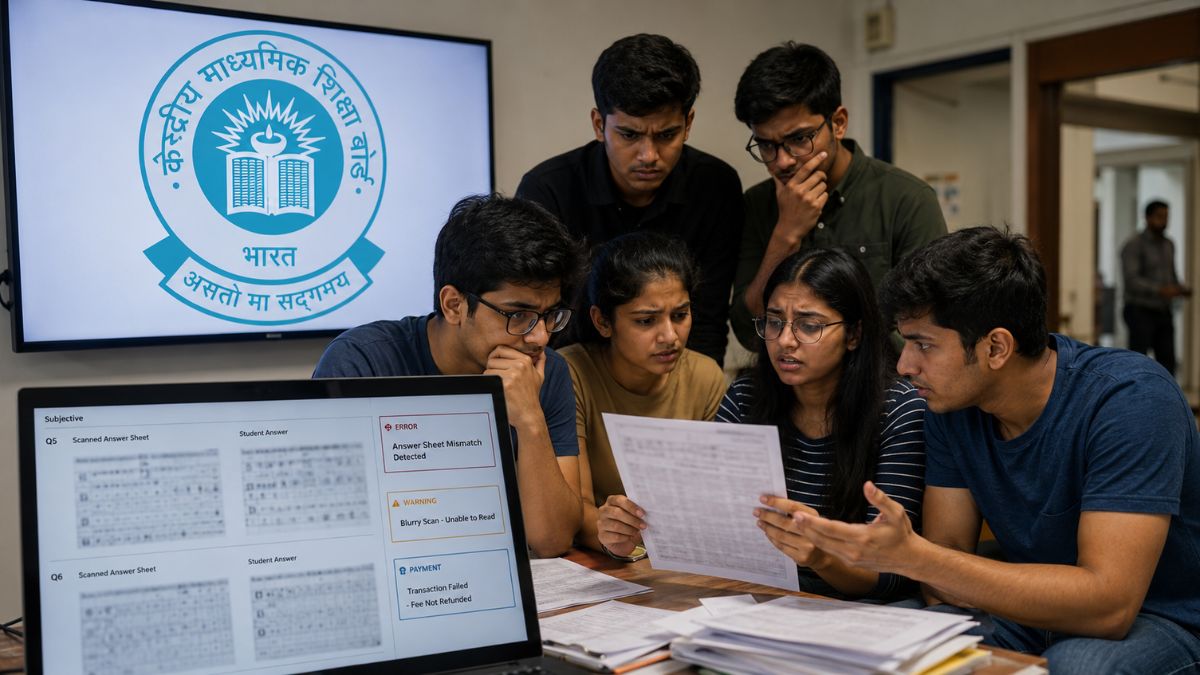
The Central Board of Secondary Education’s new digital evaluation process for Class 12 board examinations has come under scrutiny after students flagged complaints over blurred answer sheets, alleged mismatched copies, missing pages and glitches in the payment portal during the post-result re-evaluation process.
At the heart of the dispute is the On-Screen Marking system, introduced for Class 12 board examinations this year. Under the system, answer books are scanned and uploaded on a portal for digital evaluation.
According to an Indian Express report, over 98 lakh answer books belonging to more than 18 lakh students were evaluated digitally for the first time. Of these, around 13,000 answer books were found to be illegible and had to be evaluated manually.
The system works through a coding process. Answer books are marked with a secret code, moved from examination centres to regional offices, scanned and uploaded to a portal.
Evaluators then log in to assess the copies according to a marking scheme prepared by CBSE school teachers. The system requires examiners to mark each step and answer, and the final total is calculated automatically.
However, the rollout has run into criticism after students who sought scanned copies of their answer books for re-evaluation complained of unclear scans, missing pages and, in some cases, receiving another student’s answer book.
Class 12 student Vedant’s post triggered wider concern
The immediate trigger was a social media post by a Class XII student named Vedant, who alleged that the Physics answer sheet uploaded by CBSE under the re-evaluation process was not his. Vedant’s post soon went viral, prompting other students and parents to raise similar concerns online over answer sheet access, marking discrepancies and the functioning of the post-result portal.
The issue soon moved beyond one student’s case and turned into a wider debate over the reliability of CBSE’s digital evaluation and re-valuation system. In the most recent update to the story, CBSE responded to Vedant’s post an hour ago admitting the evaluation blunder and informed the student that his ‘correct answer sheet’ has been checked and shared with him by the board.
Dear Vedant,
— CBSE HQ (@cbseindia29) May 25, 2026
Thank you for bringing your concern regarding your Physics answer book to our attention.
Upon review, the matter has been examined, and the correct copy of your answer book has been sent to your registered email address. Necessary action for updating your result,…
CBSE to issue refunds after payment glitches
The answer sheet row has also coincided with complaints over CBSE’s payment system. The board had earlier said that technical glitches on May 21 and 22 led to incorrect fee deductions in some cases while students were applying to receive scanned copies of evaluated answer books.
In some cases, students were charged more than the required amount, while in others, a lower fee was deducted. CBSE said excess amounts would be refunded to the same payment method used by students. Those who were charged less would be informed separately if they needed to pay the balance.
The board also said scanned copies of evaluated answer books would be provided in these cases without requiring students to submit fresh requests. Notably the board had also declared that students whose marks would be increased upon revaluation will automatically be refunded.
As per the Indian Express report, the portal for answer book applications became accessible on May 19, but faced glitches, forcing the initial May 22 deadline to be extended multiple times till May 25. CBSE cited “unprecedented traffic” and “several attempts of unauthorised interference” as reasons for disruptions.
CBSE on what put pressure on their evaluation system
The scale of applications this year has also added pressure on the system. According to the Indian Express report, CBSE officials said on May 23 that the board had received 2.94 lakh applications for 8.56 lakh answer books. This was more than twice last year’s 1.31 lakh applications for 2.82 lakh answer books. By then, 2.5 lakh copies had been sent out.
The surge came after CBSE reduced the fee for obtaining scanned copies of answer books from Rs 700 to Rs 100. The cost of verification was also reduced from Rs 500 to Rs 100, while the re-evaluation fee was cut from Rs 100 per question to Rs 25 per question.
CBSE also said the fee would be refunded if re-evaluation leads to an increase in marks.
Rahul Gandhi attacks Centre over CBSE row
Following the virality of Vedant’s post, opposition parties like INC that have been demanding the resignation of the education minister following the NEET paper leak row also weighed in on the issue. Leader of Opposition in Lok Sabha, INC’s Rahul Gandhi took to X, alleging that serious questions had been raised over CBSE examinations and the evaluation process.
He referred to complaints around wrong marking, re-evaluation glitches and accused the government of ignoring students’ concerns. His remarks added a political dimension to the row, which has already sparked anxiety among students and parents who say the re-evaluation process is time-bound and crucial for college admissions.
IIT experts, PSU banks roped in
Union Education Minister Dharmendra Pradhan has directed that teams of professors and technical experts from IIT-Madras and IIT-Kanpur be deputed to examine technical issues reported since the rollout of this year’s re-evaluation services and assist CBSE in ensuring a glitch-free process.
Pradhan also spoke to Finance Minister Nirmala Sitharaman and sought support from the finance ministry to overhaul CBSE’s payment gateway system. Following the discussion, four public sector banks — State Bank of India, Bank of Baroda, Canara Bank and Indian Bank — were asked to help CBSE strengthen its payment gateway infrastructure and integrate it with the post-examination portal.
Why and how was the OSM process started in the first place?
The controversy has raised larger questions over the execution of CBSE’s digital evaluation process. The board has defended OSM, arguing that it reduces totalling errors, improves standardisation and makes the evaluation process more objective.
CBSE Chairman Rahul Singh earlier said OSM evaluation was “code-independent”, meaning papers could be evaluated outside the same region, making the process more consistent and fair across regions.
The Indian Express report noted that while CBSE’s governing body had suggested implementing on-screen marking across subjects only after pilot projects across regional offices. They further reported that such pilots were not conducted across all regional offices.
A dry run was held in January in five schools, followed by training and a mass mock evaluation for teachers.
For now, CBSE has maintained that complaints will be addressed through the verification and re-evaluation process. But the episode has put the board’s digital transition under pressure at a time when lakhs of students are relying on the post-result process for corrections that could affect admissions and future academic plans.