




The Indian Space Research Organisation (ISRO) has tightened its rules governing resignations and voluntary retirement requests from senior scientific and technical personnel working on crucial national missions, including the Gaganyaan human spaceflight programme, amid a recent spate of resignations, The Indian Express reported on Thursday.
The Indian Express reported that ISRO has decided that requests for voluntary retirement or resignation from scientific and technical personnel associated with Gaganyaan and other important missions will no longer be accepted routinely. Such cases will now require a higher-level review by the Department of Space.
The move follows concerns that the exit of personnel involved in critical projects could affect the implementation of missions of national importance.
Requests to be reviewed at Department of Space level
In an order issued on July 14, ISRO said that several requests for voluntary retirement and resignation had recently been received from Group A scientific and technical personnel, including those working on Gaganyaan and other major projects.
“Of late, it is noticed that there has been spate of requests for voluntary retirement and resignation from Group ‘A’ Scientific/Technical personnel of ISRO including those associated with the prestigious Gaganyaan and other important missions/projects severely impacting the implementation of projects of national importance,” the government order said.
“In view of this, it has been decided that voluntary retirement and resignation requests from Scientific and Technical personnel associated with Gaganyaan and other important missions/projects may not be accepted as a matter of routine,” it added.
Under the revised process, requests from scientific and technical personnel, including those up to the rank of Scientist/Engineer-SG, will have to be forwarded to the Department of Space along with the recommendations of the respective centre directors or heads of units. The final decision will be taken at the Department level.
Earlier authority given to centre heads
This development marks a shift from the framework introduced in 2020. At that time, ISRO had authorised the heads of its various centres and units to accept resignation and voluntary retirement requests from Group A scientific and technical personnel up to specified ranks, The Indian Express reported.
The new directive effectively introduces an additional layer of scrutiny for personnel involved in projects considered strategically important.
ISRO resignations take political turn
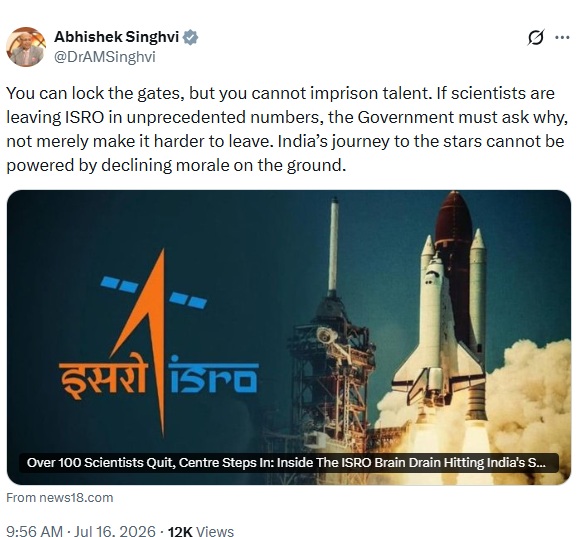
Reacting to over 100 ISRO scientists’ exit, Rajya Sabha MP, Abhishek Singhvi took to X and said, “You can lock the gates, but you cannot imprison talent. If scientists are leaving ISRO in unprecedented numbers, the Government must ask why, not merely make it harder to leave. India’s journey to the stars cannot be powered by declining morale on the ground.”
Gaganyaan faces talent-retention challenge
The order comes as ISRO is working on Gaganyaan, India’s ambitious human spaceflight programme, alongside several other major missions involving space exploration, launch vehicles, satellite technology and national security. The space agency has increasingly faced competition for specialised talent following the opening up of India’s space sector to private companies over the past decade.
The emergence of private space companies has created new career opportunities for ISRO scientists and engineers, often with more competitive salaries, incentives and other benefits. Several private space companies operating in India have recruited former ISRO personnel, including scientists and engineers who have retired from the agency.
The growing private space ecosystem has therefore expanded opportunities for highly specialised professionals with experience in propulsion, spacecraft systems, launch vehicles, avionics, mission operations and other areas.
Reacting to government tightening exit policies, former ISRO scientist Sandeep Ojha spoke to news agency ANI and said, “People do resign—often because the private sector is expanding and offers alternative job opportunities. Regarding the project structure, there is a hierarchy involving Project Managers and Deputy Project Managers. There is also an administrative track leading to roles like Division Head, Group Director, Deputy Director, and Director. Yes, if someone leaves a role they have been deeply involved with, it can certainly be a setback—albeit a temporary one.”
“It might slow things down a bit, especially when a veteran of 20 or 25 years departs. While the team is capable enough to bridge that gap, a temporary setback is inevitable,” he further said.