



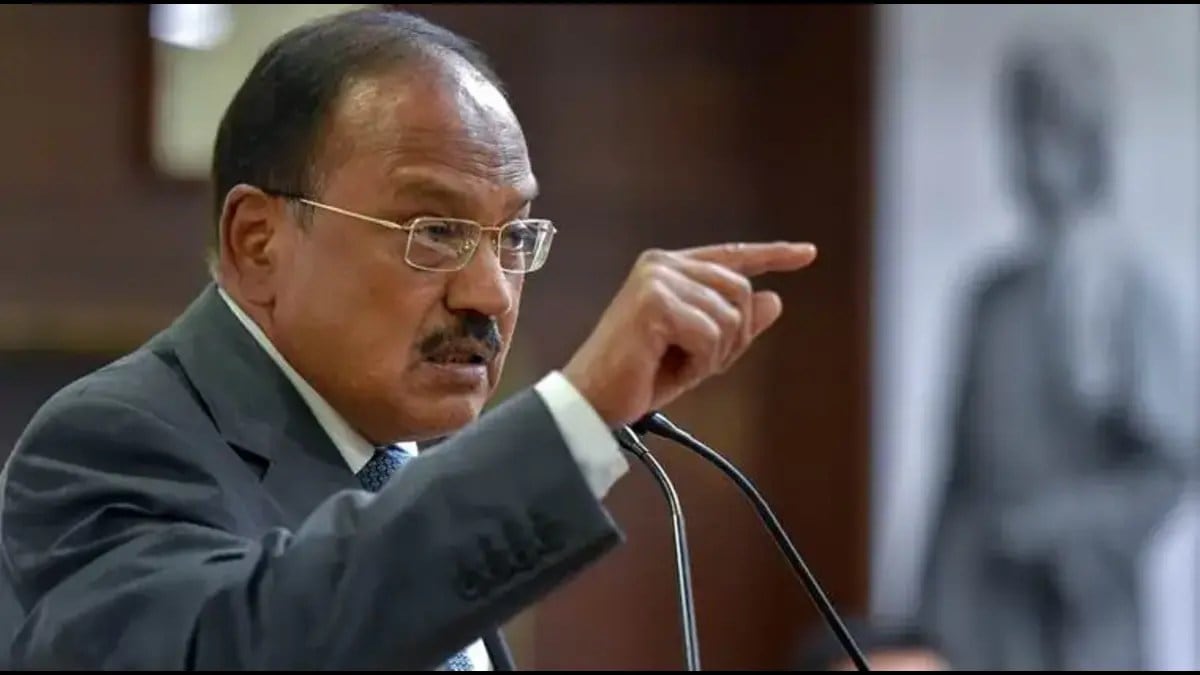
India emphasised its readiness to help reduce tensions in West Asia and called for urgent measures to secure maritime trade routes, as National Security Advisor (NSA) Ajit Doval warned that disruptions to oil and gas supplies threaten the global economy.
Doval’s remarks came while addressing the 1st International Security Forum and the XIV International Meeting of High-Ranking Officials Responsible for Security Matters in Moscow, an event held from May 26 (Tuesday) to May 29 (Friday) that drew more than 140 delegations from foreign states and international organisations. Participants included secretaries of security councils, national security advisers, directors of law enforcement agencies and special services and secretaries of international organisations.
Concern over ‘West Asia’
“The conflict in West Asia needs a very special mention. The ongoing tensions in the region continue to raise very serious concerns,” Doval said, pointing to escalating risks to maritime traffic and energy infrastructure. He noted that such disruptions underline “how fragile the contemporary situation is,” and highlighted the direct consequences for global energy markets.
Safeguarding international waterways
Ajit Doval stressed the need to ensure ‘safe and uninterrupted movement of international trade through international waterways, including the Strait of Hormuz and the Red Sea,’ saying these sea lanes are essential for the global economy. “India stands ready to contribute constructively to support all efforts to reduce tensions and help restore stability,” he added, offering New Delhi’s constructive support for initiatives aimed at de‑escalation.
Tensions surrounding the Strait of Hormuz have intensified following recent military action in the region. The article’s account notes that the Strait became a focal point after the United States and Israel carried out an attack against Iran, after which Tehran reportedly undertook military retaliation and, according to some reports, sought to choke the waterway- disrupting global oil and gas flows to press for a ceasefire.
Tackling terrorism requires consistency, not ‘double standards’: Ajit Doval
National Security Advisor Ajit Doval urged countries to adopt a consistent, decisive approach against terrorism, warning there can be no double standards in combating this grave threat to international security. Speaking at the 1st International Security Forum and the XIV International Meeting of High‑Ranking Officials Responsible for Security Matters in Moscow, Doval said every nation bears responsibility to fight terrorism and must choose whether to confront sponsors and financiers of terror or tacitly support them; responsible states, he added, should evaluate their choices and take firm action against terrorist groups and the states that back them.
Contested tolling proposal and US response
Regional observers have reported that Iran has sought to impose a tolling system on commercial vessels transiting the Strait of Hormuz, potentially in coordination with Omani interests. The United States moved swiftly to oppose those efforts- US Treasury Secretary Scott Bessent warned that Washington “will not tolerate any effort to impose a tolling system in the Strait of Hormuz,” underscoring the high diplomatic and strategic stakes surrounding freedom of navigation in the passage.
Call for United Nations reform
Beyond maritime security, Ajit Doval also pressed for reforms at the United Nations. “The United Nations is facing a very serious crisis. The structured institutions of 1945 are increasingly proving to be incapable of addressing the security challenges that the world is facing; therefore, there is an urgent need for reform in the United Nations to make it more representative,” he said, arguing that the post‑war institutional framework must be updated to meet contemporary threats.
Prime Minister Narendra Modi’s similar stance
The call for institutional reform echoed remarks made last week by Prime Minister Narendra Modi. Speaking at a joint press meeting with Cyprus President Nikos Christodoulides, PM Modi said India “will continue to support efforts for an early resolution to ongoing conflicts and for peace,” and added that reform of global institutions is “urgent and important for resolving the growing global challenges.” Modi cited Ukraine and West Asia among the global issues discussed with the Cypriot leader.
Forum participation and context
Held in Moscow, the 1st International Security Forum and the XIV International Meeting of High-Ranking Officials Responsible for Security Matters convened officials from over 140 delegations, providing a platform for discussions on security cooperation, law enforcement and mechanisms to respond to contemporary threats. The gathering brought together top security officials- from secretaries of security councils and national security advisers to directors of special services- to deliberate on regional and global security dynamics.
India’s constructive posture
Ajit Doval’s intervention framed India as willing to play a constructive role in stabilising West Asia and safeguarding the maritime routes that underpin global trade and energy supplies. His dual focus on immediate security measures to protect critical waterways and on longer‑term institutional reform at the United Nations captures New Delhi’s broader diplomatic posture: seeking practical steps to reduce tensions while advocating changes to global governance to better address 21st‑century security challenges.