



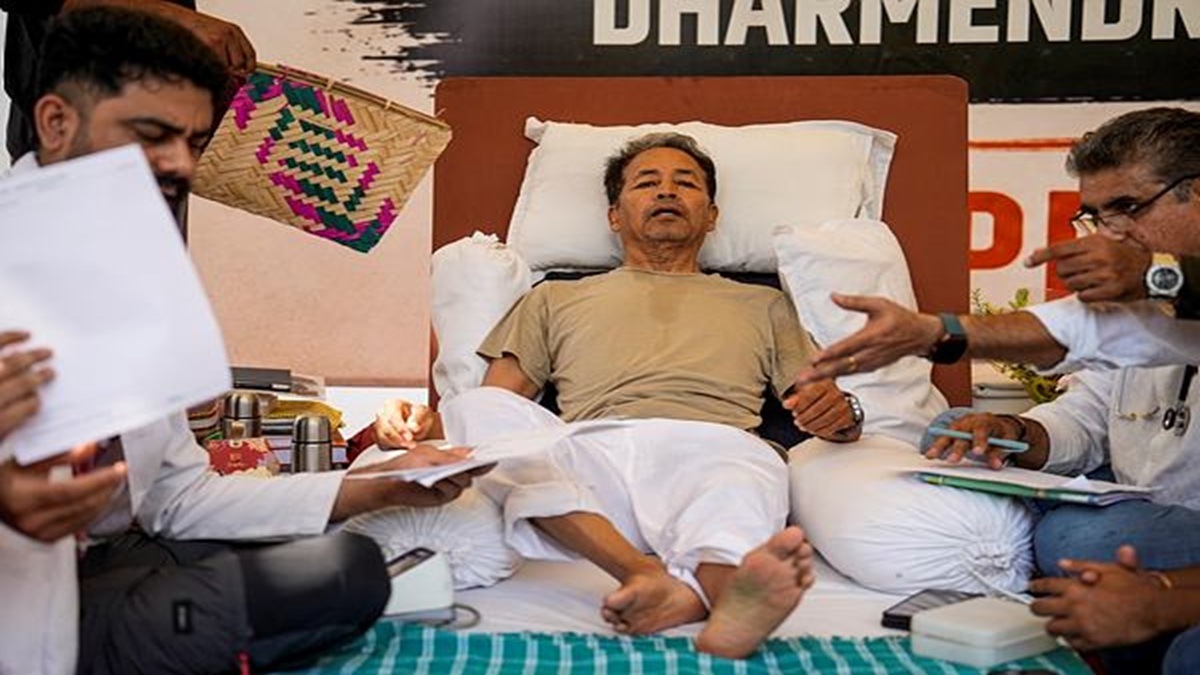
The Delhi High Court has issued firm directions that climate activist Sonam Wangchuk’s health must be clinically monitored on a daily basis and that government doctors should provide any necessary medical intervention, after a public interest litigation (PIL) raised grave concerns about his deteriorating condition during an indefinite hunger strike.
A Division Bench comprising Chief Justice Devendra Kumar Upadhyaya and Justice Tejas Karia took note of Solicitor General Tushar Mehta’s assurance that the Centre and the Delhi government will keep Wangchuk under regular medical supervision, and disposed of the petition after recording that undertaking.
What does the Delhi High Court says?
“We observe life of any citizen is precious and all efforts ought to be made by government authorities to save the same,” the Bench said while dictating the order. The High Court directed that Wangchuk’s medical condition be clinically monitored on a daily basis and that “whatever medical intervention is required shall be taken.”
The Bench emphasised that government doctors should regularly examine him and, if they opine that intervention is required, appropriate steps must follow.
The PIL concerning activist Sonam Wangchuk’s hunger strike was taken up by a Division Bench of Chief Justice Devendra Kumar Upadhyaya and Justice Tejas Karia of Delhi High Court
Solicitor General Tushar Mehta appeared virtually for the Centre and the Delhi Government.
During…
— ANI (@ANI) July 16, 2026
Solicitor General Tushar Mehta, appearing virtually for both the Centre and the Delhi government, told the court that Wangchuk already receives daily medical check-ups and that the authorities regularly share his health parameters. When the Bench asked whether there was a mechanism to monitor his health, Mehta responded affirmatively and added, “Certainly. If Your Lordships so desire, someone can go again and conduct a medical check-up.” The court recorded Mehta’s assurance that monitoring would continue and that government experts would provide necessary medical treatment.
The PIL was filed by advocate Rakesh Kumar Saini on the basis that Wangchuk — a noted climate activist from Ladakh — has been on an indefinite hunger strike at Jantar Mantar since June 28, protesting issues he has raised publicly and seeking government engagement. The petition flagged a dramatic decline in the activist’s health, alleging an 8.25 kg weight loss and repeated episodes of low blood sugar, dizziness, severe muscle wasting and profound weakness.
The urgency application pointed to a newspaper report dated July 14, asserting that Wangchuk’s condition had deteriorated to the point of posing a serious threat to his life. The petitioner urged the High Court to direct immediate medical attention, initiation of dialogue with the activist over his demands, and steps to safeguard his life — including administration of liquid nutrition, proteins, vitamins and other essential medical support, if required.
The PIL stressed the State’s constitutional duty to protect life and health, arguing that allowing a citizen’s health to decline without intervention could amount to state inaction in the face of imminent danger. The plea also invoked provisions relating to abetment of suicide under the Bharatiya Nyaya Sanhita, contending that authorities cannot remain passive when an individual’s life is at risk. While the petition acknowledged that peaceful protest and hunger strikes fall within democratic rights, it maintained that the government nonetheless had an obligation to take protective action to prevent irreversible harm.
Medical monitoring as the ‘immediate remedy’
Rather than directing forcible medical intervention, the Delhi High Court chose a calibrated path: it recorded the government’s assurance that monitoring and expert interventions would continue and required that such clinical oversight be maintained. The Bench’s language underscored the primacy of preserving life while leaving treatment decisions to medical professionals: “We would like him to be regularly examined by government doctors. If the doctors feel any medical intervention is required, appropriate steps should be taken. Every life is precious,” the court observed.
News Alert! Hearing a PIL on fasting activist Sonam Wangchuk's deteriorating health, the Delhi HC observed that "life is precious."
The court directed the Centre and city govt to have doctors regularly monitor him and provide medical aid if needed.
Concurring with the court,… pic.twitter.com/geXJJ5LnHR
— Press Trust of India (@PTI_News) July 16, 2026
The PIL prayed for multiple reliefs: immediate medical care for Wangchuk, initiation of talks between the authorities and the activist on the issues raised, and the availability of life-saving nutritional and medical support if needed. After hearing the submissions and recording the Solicitor General’s assurances, the Division Bench disposed of the petition, while clearly instructing the relevant agencies to maintain daily clinical oversight.
What are the operational challenges and procedural backdrop?
The case’s hearing coincided with a period of disruption in the Delhi High Court, when the Delhi High Court Bar Association (DHCBA) called for abstention from work on July 15 in protest against the proposed enhancement of pecuniary jurisdiction of district courts from Rs 2 crore to Rs 10 crore. The association requested its members not to appear before the Delhi High Court — either physically or virtually — and had announced closures of bar rooms and other facilities. Whether the matter would be taken up urgently depended in part on court scheduling and the availability of advocates, but the Division Bench proceeded to review the PIL and secure an assurance from the Solicitor General.
The court’s intervention highlights an enduring tension in democratic governance: protecting the right to protest while ensuring the State’s duty to preserve life. By ordering daily clinical monitoring and accepting the government’s undertaking to provide medical support when indicated, the High Court sought to balance respect for Wangchuk’s agency and protest with the constitutional obligation on public authorities to prevent harm.
With the court-ordered monitoring in place and the Solicitor General’s recorded assurance, immediate priorities will include ensuring the continuity of daily medical assessments, timely reporting of any clinical deterioration, and a transparent process for deciding on medical interventions if doctors recommend them. The PIL also sought engagement between the activist and authorities; while the court did not explicitly mandate dialogue, it recorded the need for authorities to act to safeguard his life — a step that may put pressure on the administration to open channels of communication.
The Delhi High Court’s directions make clear that, regardless of the political or policy questions motivating a protest, the State must take proactive steps to preserve life. By insisting on daily clinical monitoring and authorising government doctors to intervene when necessary, the Bench provided an immediate protective framework for Sonam Wangchuk while underlining the broader constitutional duty of the authorities to guard citizens’ health amid acts of civil disobedience.