



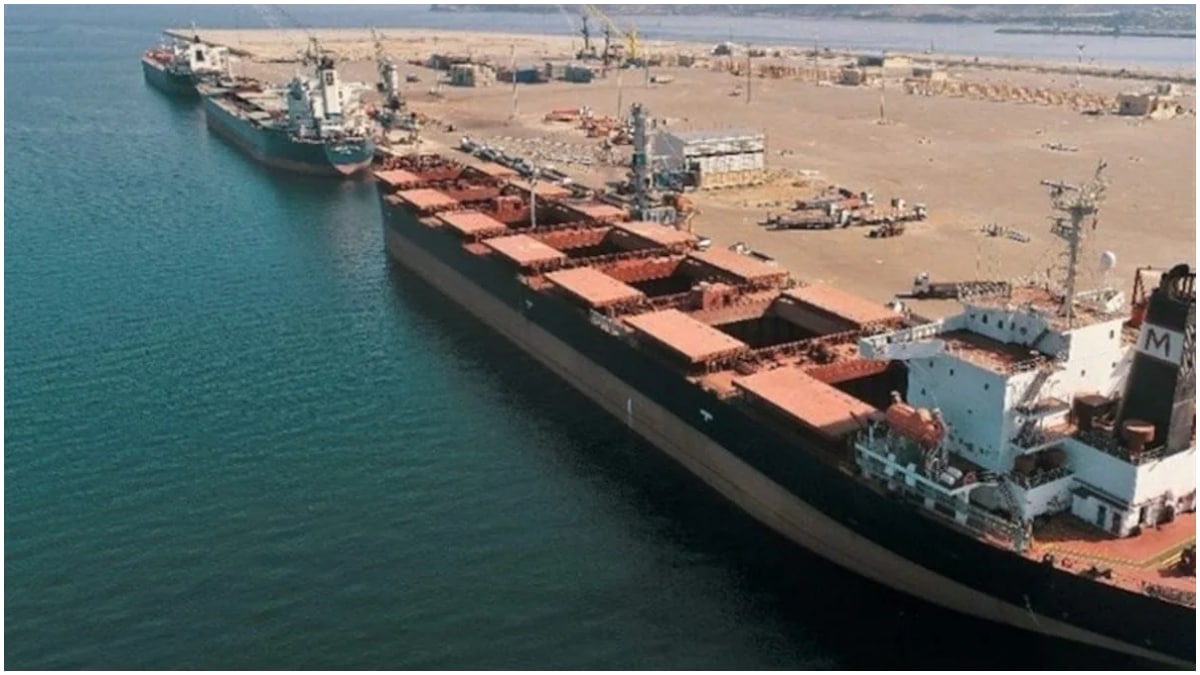
The US military expanded its airstrikes against Iran in the early hours of Friday — hitting key bridges, electrical equipment and even collapsing a tower at Chabahar port. The latter has been the focus of repeated strikes, and Secretary of War Pete Hegseth also took to X with a photo of the crumbling structure at the key port on Friday.
The situation assumes greater significance for India in light of its Rs 800 crore investment to develop the area over the past few years. India signed a 10 year agreement with Iranian authorities to operate one of the two terminals at Chabahar port. Subsequent US sanctions have seen matters enter into a state of limbo — even as Iranian leaders urged New Delhi to persist despite the curbs and ongoing war.
Hegseth highlights damage after massive strikes
Chabahar port has been a repeated target of American airstrikes since war broke out at the end of February. Iranian state media acknowledged a third round of strikes on the facility without immediately acknowledging the tower’s collapse. Meanwhile US Secretary of War Pete Hegseth shared a now-viral photo of a surveillance tower at Chabahar port collapsing amid billowing smoke to underscore the American attacks on Friday. Tehran described the tower in question as overseeing commercial traffic into the port.
Iran had operated the key port with support from India until recently — having signed a 10-year agreement in 2024 to Shahid Beheshti terminal. The project was considered strategically important as it gave New Delhi a clear route to Afghanistan and Central Asia while bypassing Pakistan.
Rs 800 crore funding allocation
Data from the government reveals that India allocated Rs 400 crore for Chabahar port from FY17 to FY24. India also allocated Rs 400 crore for Chabahar Port in FY26 — with the last tranche of this amount transferred in August 2025. The Ministry of External Affairs told the Lok Sabha in April this year that India had already fulfilled its financial commitments under the contract signed between India Ports Global Limited and the Ports and Maritime Organisation of Iran.
Chabahar had been an integral part of Indian economic and strategic plans for nearly two decades — culminating in the 10 year deal. But matters have changed drastically since Donald Trump returned to power. The US State Department revoked its sanction exception from 2018 in mid-September last year. Subsequent talks had granted India a conditional sanctions waiver until April 26. No funds were allocated for the port as Finance Minister Nirmala Sitharaman outlined the annual budget in April.
“India has fulfilled its financial commitment of contributing USD 120 million for the procurement of port equipment. Therefore, there was no further requirement of budget allocation for Chabahar Port for FY27,” the MEA told the Lok Sabha in April.
Does India still operate Chabahar port?
India has taken steps to wind down its active operational exposure after the US announced fresh sanctions under the Trump administration. The decision also ensures that its state-run entities are protected from heavy tariffs and penalties. Multiple reports also indicate that all the directors of IPGL had resigned en masse in September 2025 — a day before the sanctions came into force.
The bilateral 10-year contract remains legally in place — ‘frozen’ amid the war and US sanctions. A report by the Impact and Policy Research Institute also added in late April that officials had structured a “temporary transfer” of IPGL holding in the India Ports Global Chabahar Free Zone. These had reportedly been shifted to a local Iranian entity — “with an understanding, not yet a binding published instrument, that operational control would revert to India once sanctions ease”.
Chabahar has also been a topic of discussion for Iranian leaders amid the war. Foreign Minister Abbas Araghchi on Friday hailed the port as a “major symbol of cooperation” as he joined the BRICS summit in May. He told news agency PTI that the pace of investment had “slowed down” due to the restrictive nature of US sanctions — reiterating that the partnership remains strong.
“ I am confident that this port will serve as a golden gateway for India to access Central Asia, the Caucasus, and Europe through this transit route, and also for Europeans, Central Asians, and others to access the Indian Ocean. It is a very strategic port, important for both us and India, as well as many other countries. So, I hope that Indians will continue their work at Chabahar Port so that it can be fully developed in the service of the interests of India and other countries in the region,” he added.