



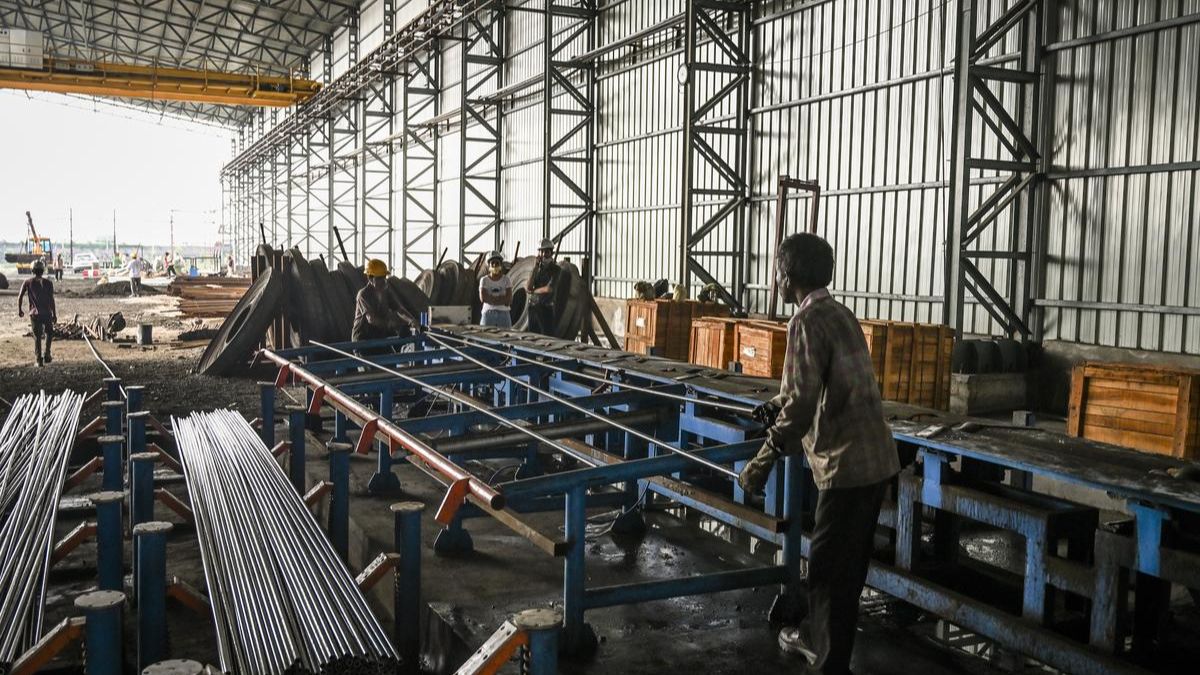
India’s factory output growth moderated to a three-month low of 4.8% year-on-year (y-o-y) in January 2026, after hitting a 26-month high of 8% in December, according to data released by the Ministry of Statistics and Programme Implementation (MoSPI) on Monday. The slowdown was broad-based across mining, manufacturing, and electricity, with some base effects also contributing to the deceleration.
According to MoSPI, the mining and electricity sectors recorded growth of 4.3% y-o-y and 5.1% YoY in January, respectively. Manufacturing output growth slowed to a three-month low of 4.8% YoY in January from 8.4% in December. In January 2025, the IIP had grown by 5.2%.
Manufacturing sector
In the manufacturing sector, the top three positive contributors in January were “Manufacture of basic metals” (13.2%), “Manufacture of motor vehicles, trailers and semi-trailers” (10.9%), and “Manufacture of other non-metallic mineral products” (9.9%). “In the industry group “Manufacture of basic metals”, item groups such as “Flat products of Alloy Steel”, “MS slabs”, and “HR coils and sheets of mild steel” showed significant contribution to growth”, MoSPI said.
On the demand side, consumer dynamics weakened, with consumer durables output slowing to 6.3% YoY from 12.4% YoY in December, and consumer non-durables contracting by 2.7% YoY (versus 8.5% YoY growth in December). Capital goods grew 4.3% YoY (vs 8.3% in December), intermediate goods 6% YoY (vs 7.8%), infrastructure/construction goods recorded 13.7% YoY (vs 12.8% in December), and primary goods a modest 3.1% YoY in January (vs 4.4% in December).
What do economists say?
Rajani Sinha, Chief Economist, CareEdge Ratings, said the favourable impact of Goods and Services Tax (GST) rate rationalisation and earlier Reserve Bank of India rate cuts is expected to continue supporting consumption going forward.
“On the investment side, momentum remains healthy, with sustained double-digit growth in infrastructure and construction goods. The Centre’s continued push towards capital expenditure-led growth, alongside early signs of a revival in private capex, bodes well for the investment outlook,” Sinha said. “Overall, evolving external and climatic risks will remain crucial for the near-term industrial growth trajectory.”
Madan Sabnavis, Chief Economist at Bank of Baroda, said the performance was less impressive in textiles and readymade garments, which registered negative growth, with exports under pressure.
This was before the new tariff dispensation from the US was announced, he said. “Another segment which continues to underperform is FMCG or non-durables, which had negative growth over a very low base of 0.1% last year (virtually flat). The benefits of GST are yet to be seen here,” Sabnavis said. Rating agency Icra expects the favourable base to push up IIP growth to 5.0-6.0% in February.
Sabnavis said that if the present tempo is maintained, growth can move towards 4.5% for the year.