



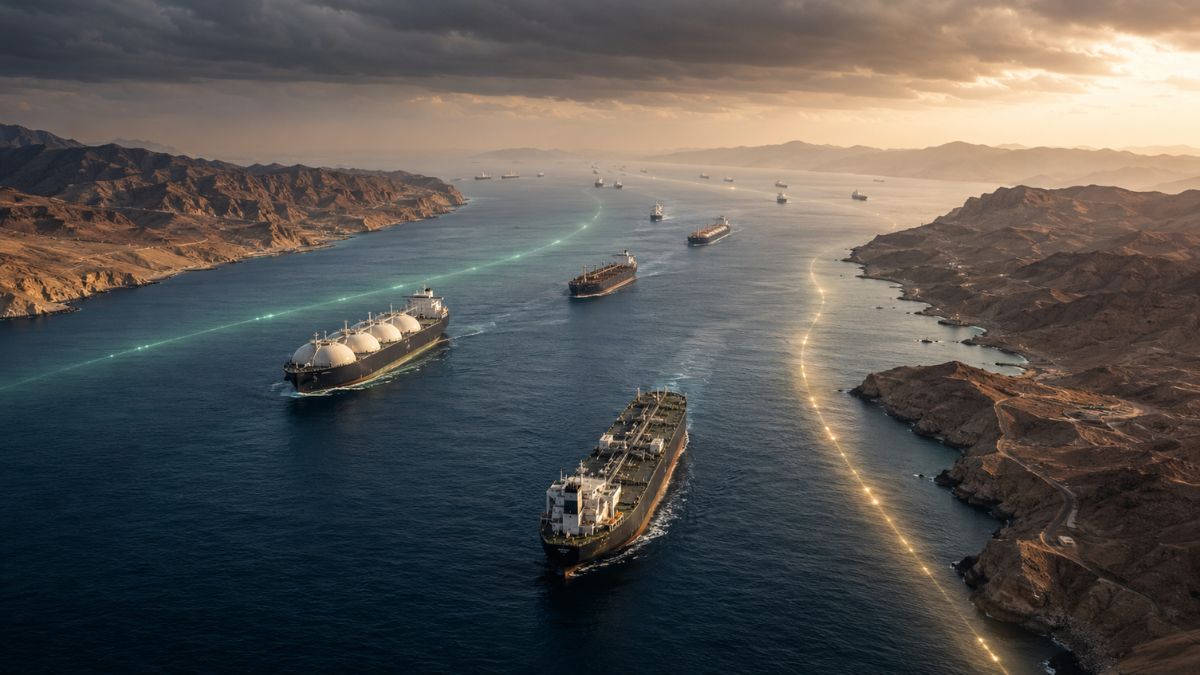
India and other major Asian oil-importing economies are likely to negotiate directly with Iran to secure passage for energy shipments through the Strait of Hormuz, but a return to pre-war traffic levels is unlikely in 2026, Moody’s noted in its latest global report, as quoted by PTI.
In a report on geopolitical risks, the international ratings agency said there was little prospect of a swift and durable settlement between the US and Iran and, therefore, of a full reopening of the Strait of Hormuz.
Just to remind our viewers, this is a critical maritime chokepoint through which about one-fifth of global oil and liquefied natural gas flows moved thus far. .
Passage through Strait of Hormuz likely to be based more on bilateral pacts
Moody’s said that while global shipping transit flows are expected to improve gradually, the progress is likely to be materialised via a series of bilateral arrangements rather than a general reopening of the passage.
Such a process, it said, would allow only incremental improvement from near-zero flows and would remain slow, opaque and vulnerable to interruption.
“We expect oil importers — particularly China, India, Japan and Korea — to negotiate passage bilaterally with Iran, potentially through coordinated transit corridors such as those reportedly emerging near Larak Island and through Omani territorial waters,” Moody’s said in its May Global Macro outlook.
“A return to pre-conflict traffic volumes in 2026 is unlikely,” the ratings agency added. The assessment comes as ship movement through Hormuz remains sharply below normal levels.
Notably, maritime traffic through the Strait has fallen by more than 90 per cent from pre-conflict levels, with shipping activity curbed by risk aversion, high insurance costs and the presence of sea mines. Brent crude has fluctuated widely between USD 90 and USD 120/bbl.
Moody’s on conditions of safe passage and impact on oil market
According to Moody’s, even if safe passage resumes over the next six months, the oil market is likely to remain supply-constrained, keeping energy prices elevated and volatile. The agency said it now expects Brent crude to remain in the $90-110 per barrel range for much of the year, with periodic swings outside the band depending on fresh developments.
The impact, Moody’s said, would not be limited to oil markets. Sustained Brent prices in the $90-110/bbl range could reduce real GDP growth by 0.2-0.8 percentage points for several major economies.
Moody’s on India’s exposure to global crisis and economic challenges
India is among the more exposed economies, given its dependence on imported crude and the share of its supplies linked to West Asia. Moody’s said around 46% of India’s crude imports come from the Middle East, leaving the economy vulnerable to higher landed costs, currency pressure, current account stress and fiscal management challenges.
In its May Global Macro Outlook, Moody’s cut India’s calendar-year 2026 GDP growth forecast by 0.8 percentage point to 6%. It also raised its inflation estimate for India by 1 percentage point to 4.5%, citing the pass-through from higher energy prices and broader supply constraints.
As per MEA spokesperson Randhir Jaiswal’s post recent press briefing on May 13, a total of 13 India flagged vessels were stuck in the strait of Hormuz, 4 days ago.
While India has moved to strengthen its energy reserves by signing critical energy security deals with UAE, a country with a high volume of petroleum reserves that recently announced its exit from OPEC+, the country continues to face economic pressure fueled by rising global volatility.
Concerns for the larger global economy
Moody’s said the disruption to shipping through the Strait has moved beyond a temporary supply shock and is increasingly becoming a structural constraint on global energy flows. It expects disruptions to continue through autumn, with higher energy prices feeding into headline and core inflation.
“This will complicate the path for monetary policy across major economies, raise production costs across energy-intensive sectors, erode household purchasing power and tighten financing conditions for exposed borrowers,” Moody’s said.
For Asian importers, however, any Iran-backed or bilaterally negotiated passage arrangement would be at best a partial relief. Moody’s view suggests that oil markets may have to operate for the rest of 2026 under a globally fragmented era where access to the Gulf is negotiated vessel by vessel or corridor by corridor rather than guaranteed through a fully reopened Strait.