



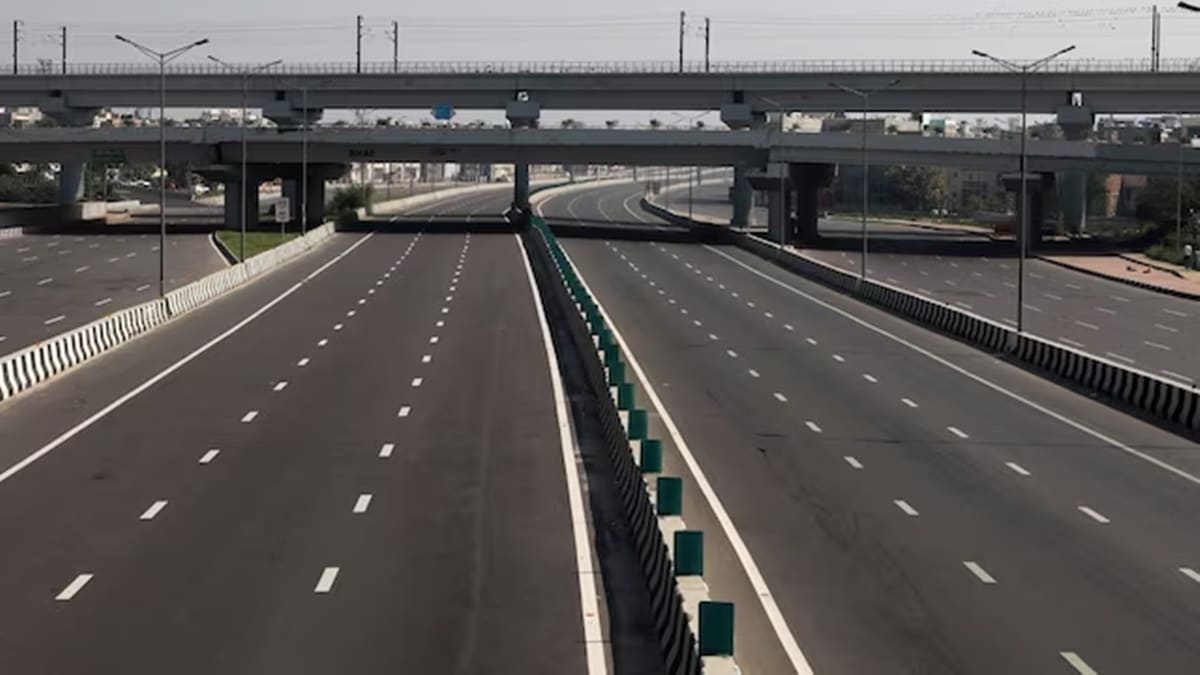
Come May 1, when traffic begins to flow through the long-awaited “Missing Link” on the Mumbai–Pune Expressway, commuters may barely notice the most remarkable part of the journey: a tunnel that is quietly thinking, sensing and responding in real time. Inside this engineering marvel, safety is not left to chance—it is automated.
Air Safety
If a car or bus were to catch fire, sensors embedded along the tunnel walls would detect a spike in temperature within seconds. Even before emergency teams can react, a high-pressure water mist system would kick in, drenching the vehicle and the surrounding area. Linear heat-detection cables run the entire length of the tunnel, triggering nozzles placed every four metres that release 36.5 litres of water per minute. Simultaneously, control rooms are alerted, digital signboards flash warnings, and traffic is regulated to prevent pile-ups.
Air, too, is constantly monitored. Massive overhead jet fans—stretching nearly 200 metres and operating at 1,500 RPM—continuously track carbon monoxide and nitrogen oxide levels. The system automatically adjusts airflow, pushing out toxic gases and maintaining breathable conditions even under stress scenarios.
Layered onto this are multiple redundancies: emergency push buttons every 60 metres, SOS call boxes every 150 metres, and a dense network of cameras that track traffic, enforce speed limits and relay real-time visuals to control centres. In effect, the tunnel functions as a self-aware corridor—one that can detect, respond and guide.
This is part of the ₹6,695-crore Missing Link project being executed by the Maharashtra State Road Development Corporation (MSRDC) between Khopoli and Lonavala—arguably one of India’s most ambitious road modernisation efforts. After nearly eight years of construction, the new alignment will cut travel time between Mumbai and Pune by 20–25 minutes, while bypassing the treacherous ghat section notorious for landslides, sharp curves and chronic congestion.
The scale is equally striking. Touted as Asia’s widest tunnel, the twin-bore structure integrates advanced communication, monitoring and evacuation systems rarely seen together at this scale. Satish Sharma, who oversees tunnelling operations for the project, says the combination of width, length and embedded safety systems makes it globally distinctive. While a smaller tunnel in the US may be marginally wider, he notes, few match the overall scale and technological integration achieved here. For India, he adds, this represents a significant leap in tunnel modernisation.
Cross-passages connect the two tunnels at regular intervals, allowing vehicles to be diverted seamlessly during emergencies. Drivers can be guided in real time to these escape routes, ensuring that even in worst-case scenarios, traffic does not descend into chaos.
For the first six months, only cars and buses will be allowed through, with heavy vehicles to follow later—giving operators time to fine-tune systems under live conditions.
Bypassing the Ghats
Above ground, the project is no less ambitious. The tunnels are linked by what is billed as the country’s highest cable-stayed road bridge—standing at 182 metres above the ground, roughly the height of a 60-storey building—part of a broader redesign of a choke point where the expressway converges with the old NH-4 near Khandala. This stretch has long been a bottleneck, with slow-moving trucks and unpredictable terrain turning routine commutes into hours-long ordeals.
First proposed in 1995 and approved in 2017, the Missing Link has been years in the making, delayed by complex terrain and forest clearances. But its completion marks more than just a reduction in distance—from 19 km to 13 km on a key stretch. It signals a shift in how highways are being built in India: not just faster, but smarter and safer.