



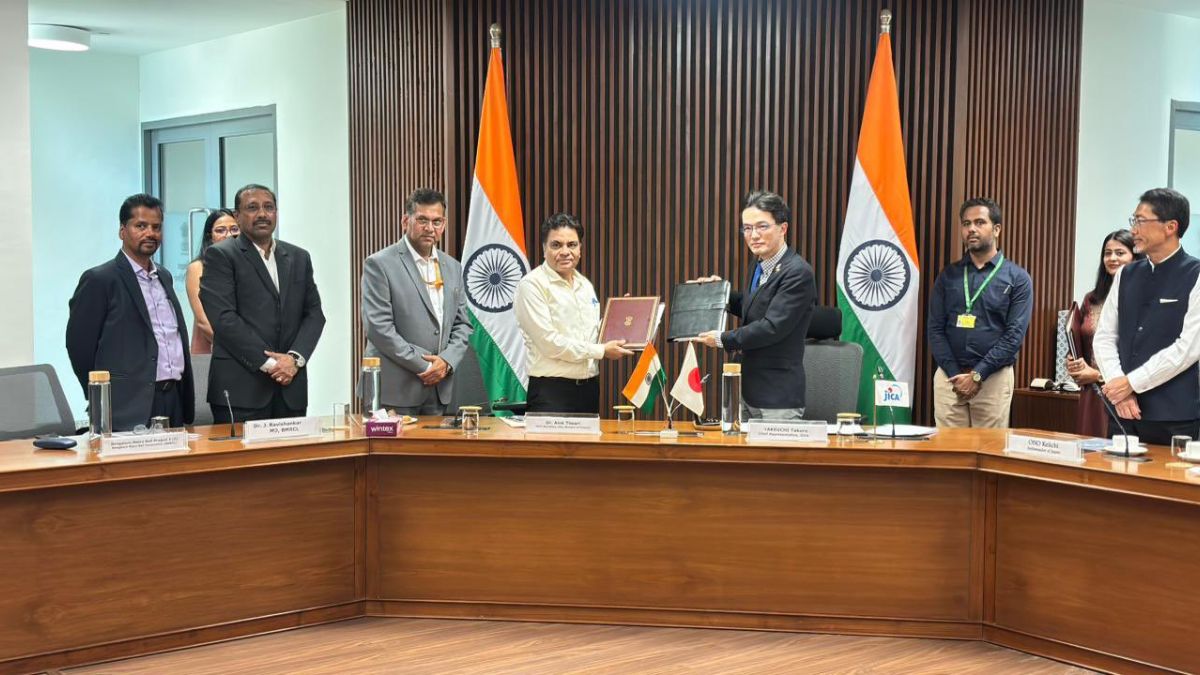
The Bangalore Metro Phase 3 project is set to receive a major funding boost as the Japan International Cooperation Agency (JICA) has signed a loan agreement worth approximately Rs.6,100 crores to support the project. Takeuchi Takuro, Chief Representative of JICA India, and Alok Tiwari, Joint Secretary of DEA, signed the loan agreement on Tuesday.
The loan agreement was signed by Mr. Takeuchi Takuro (Chief Representative, JICA India) and Mr. Alok Tiwari (Joint Secretary, DEA). The signing took place in the presence of BMRCL’s Managing Director, Dr. J. Ravishankar, and Director of Finance, Mr. S. Sivamathan.
Funding structure and financial closure for Bangalore Metro Phase 3
The Government of India has approved a total senior debt of ₹6,775 crore for the Bangalore Metro Phase 3 project. JICA has agreed to provide the financial assistance in two tranches. The first tranche amounts to ₹6,100 crore (approximately 102,480 million Japanese Yen), while the remaining amount will be released as a second tranche. With this funding the financial closure for the Bangalore Metro Phase 3 project will be achieved.
The loan will support procurement of rolling stock, signalling systems, and other critical metro components. These systems are essential for ensuring operational efficiency, safety, and scalability of the network.
Bangalore Metro Phase 3: Distance, Connectivity, and Expansion
Phase-3 of the Bangalore metro project will cover a total distance of 44.65 kilometers,enhancing connectivity across key areas. It consists of two major corridors. The first corridor stretches 32.15 kilometers from JP Nagar 4th Phase to Kempapura along the Outer Ring Road (West). The second corridor spans 12.5 kilometers from Hosahalli to Kadabagere along Magadi Road.
The Phase 3 expansion is designed to improve connectivity across high-density corridors and reduce congestion in traffic-intensive zones. The project includes elevated and underground sections, along with interchange stations to integrate with existing metro lines.
The project is being implemented by Bangalore Metro Rail Corporation Limited (BMRCL) and is aligned with long-term urban mobility planning. Approved by the Government of India in September 2024, the total estimated cost of the project stands at ₹15,611 crore. Once completed, the expansion is expected to ease congestion, improve mobility, and support sustainable urban growth in Bengaluru.