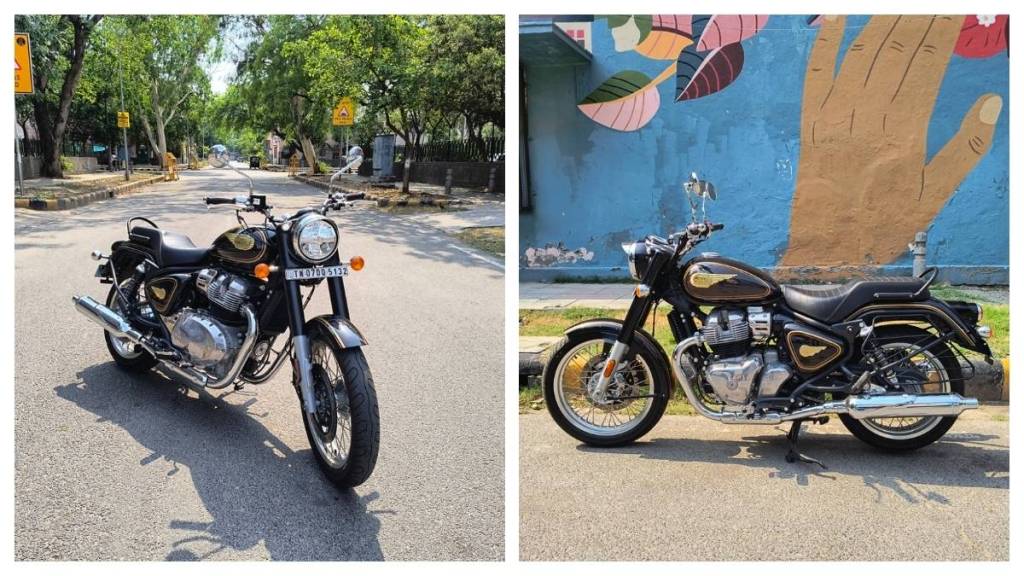
Comfortable and upright seating position, just the right proportions, easy to ride on highways, good pricing, and an amazing exhaust note—the Royal Enfield Bullet is beyond motorcycles. First introduced in 1932, the Bullet is the world’s oldest motorcycle in continuous production. While the Bullet 350 has been around for a while, the Bullet 650 was launched last week, and we tested it in the gruelling June heat of Delhi.
What is it?
Priced at Rs 3.65 lakh (ex-showroom), it’s powered by a 648-cc twin-cylinder petrol engine. Available in two colours—Cannon Black and Battleship Blue—it sits alongside Royal Enfield’s Interceptor 650 (starting Rs 3.35 lakh), Continental GT (Rs 3.53 lakh), Classic 650 (Rs 3.65 lakh), Bear 650 (Rs 3.75 lakh), Shotgun (Rs 3.98 lakh), and Super Meteor 650 (Rs 4.2 lakh). Two other bikes in the segment are BSA’s Gold Star 650 (Rs 3.46 lakh) and Scrambler 650 (Rs 3.25 lakh).
How’s the design?
It is an ageless design. Park it in the 1950s, 2026, or the next century, and the Bullet 650 won’t look out of place. Every element feels crafted out of love: the fuel tank with hand-painted golden pinstripes, a gleaming 3D winged badge, retro-styled controls with polished aluminium switchgear—and those twin ‘tiger eye’ pilot lamps dating back to 1954 look cool even in this century.
How’s the riding stance?
It has raised handlebars, giving the rider an upright posture. The bench seat is comfortable, and low. But the footrests are wide and can hurt your ankles if you aren’t wearing riding boots or ankle-high shoes. The dashboard is minimalist—analogue, with a small digital display.
How does it ride?
Fire the engine and the exhaust note is music to a motorcyclist’s ears—at lower RPMs, the sound is soothing, and while it gets louder as you accelerate, it never turns into ‘noise’. Its 6-speed gearbox and slipper clutch give it a smooth power delivery. You can shift into sixth gear even at 50-55 km/h and go all the way to 120 km/h with almost no vibrations felt through the handlebars, seat, or footpegs. Suspension is from the Japanese company Showa, and it effortlessly absorbs potholes.
Acceleration is good, and my test bike did 0-100 km/h in about 7 seconds. I couldn’t test the fuel efficiency, but expect it to be 25-30 km/litre.
What about weight?
At 243 kg, it’s both good and bad.
Good because, on open highways, the bike feels stable even at speeds above 100 km/h.
Bad because this weight shows up in traffic. Navigating narrow streets is a hassle, the turning radius is wide, and the bike feels heavy when reversing using your legs or balancing in stop-and-go traffic. If, God forbid, you fall, it might take two strong adults to pick the bike—for a generation used to light smartphones, its 243 kilos can’t be easily swiped left or right.
Should you buy it?
If you want a piece of history, or a motorcycle to make your parking lot look cool, there is no better choice in this price range. But if you mostly ride in heavy traffic and an occasional highway jaunt, the Bear 650 is your toy. But the Bear doesn’t have the bite of the Bullet.