




“AI is the most consequential technology of our lifetimes,” Meta CEO Mark Zuckerberg told employees in a May memo. Breaking down the most devastating news he could have shared with his employees, he said the company found it necessary to lay off 8,000 workers because “success isn’t a given” in the competitive world of artificial intelligence. The same announcement resulted in an Indian Meta employee losing yet another cut-throat race in the US: immigration.
Sridhar Vanka, who has been serving as a technical program manager at Meta for the past four years, was one such employee whose life turned upside-down when Zuckerberg shared the “layoff memo,” as viewed by CNBC. In an emotional LinkedIn confession posted a few days ago, the Indian-born techie confirmed that he was one of the thousands of employees impacted by the social media giant’s most recent job cuts.
Indian techie laid off in latest Meta job cuts speaks out
While most American Meta employees may have probably just lost a job, Vanka’s professional status wasn’t the only thing that took a hit two months ago. In his social media post, he affirmed that losing his job also cast his lawful immigration status in the US under a lens of uncertainty, hinting at how he may have been residing in the country as a visa holder.
“Late to the game here but I was impacted by Meta’s last round of layoffs in May this year. The clock has now run out on my immigration status here in the US so I have had to make the difficult decision to move my family back to India,” he wrote on LinkedIn.
Sharing a personal look at what he’s been going through since he was laid off, the former Meta employee said that the last seven weeks had been an “emotional roller coaster – optimism, hope, uncertainty, anxiety, heart breaks and waiting – lots and lots of waiting.” While it’s inevitable that he may have been anticipating another professional break in the US after losing his Meta job, Vanka didn’t hold back while expressing his frustration about his immigration status taking over his identity altogether.
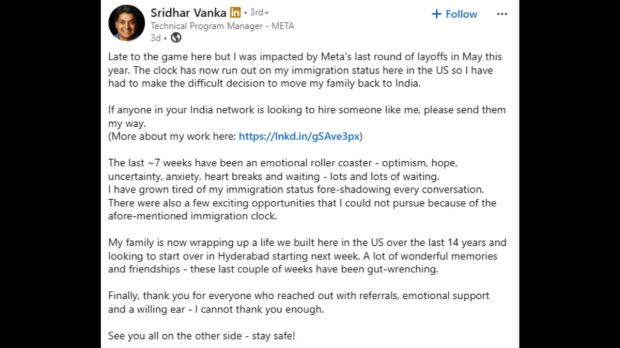
“I have grown tired of my immigration status fore-shadowing every conversation. There were also a few exciting opportunities that I could not pursue because of the afore-mentioned immigration clock,” he continued.
According to his LinkedIn profile, Sridhar Vanka led “TPM for WhatsApp integration into Meta Accounts.” He joined the social media giant’s Greater Seattle Area office in July 2022. Before that, he completed a more than five-year-long stint at Amazon in Seattle. Switching through designations, he ultimately settled into the role of a senior technical program manager before leaving the company founded by Jeff Bezos.
Years before kicking off his professional journey in the US, he spent quite some time building his resume as a techie in India. For over six years, he was a senior project manager at IBM Global Business Services. Even prior to that, he held multiple roles at Tata Consultancy Services. Some of these designations saw him switch from Indian locations to US offices in the early 2000s. Vanka holds a B.Tech degree in Civil Engineering from the National Institute of Technology (NIT), Jamshedpur.
In light of the current circumstances, Vanka said his family is now “wrapping up a life” they built in the US over the last 14 years and “looking to start over in Hyderabad starting next week.” Reminiscing about the time spent in America, he added, “A lot of wonderful memories and friendships – these last couple of weeks have been gut-wrenching. Finally, thank you for everyone who reached out with referrals, emotional support and a willing ear – I cannot thank you enough.”
Vanka also plugged his professional achievements, as highlighted on his LinkedIn, and urged professionals in India to consider him for any future opportunities that may align with his job profile.
Other professionals attached to Meta in some capacity sympathised with Vanka’s situation and shared uplifting messages and wishes in the comment section.
Vidya Srinivasan, another Meta employee, wrote: “So sorry about the turn of events, Sridhar. Uprooting your life and starting over is genuinely hard. Please lmk if I can be of any help- I’m happy to connect you with my network in Hyderabad.”
Jackson Bryant-Comstock, a director of product management at Meta, said: “Sridhar was such a pleasure working with you the last few years. I’m bummed to see your hand be forced, especially for the impact it means to your family but I know your next swing will be just as bold and exciting as the last.”
Navigating immigration status as a laid off employee
Official US Citizenship and Immigration Services (USCIS) data has shown over 70% of approved H-1B visas going to Indian nationals in recent years. Given Vanka’s remarks, it’s likely that he too may have arrived in the United States by availing the same non-immigrant work visa’s benefits. On top of that, tech professionals dominate the H-1B visa list.
According to the National Foundation for American Policy’s (NFAP) analysis of government data, Amazon, Meta Platforms, Microsoft and Google had the most approved new H-1B petitions in FY 2025. Mark Zuckerberg’s tech giant held the second-most approved H-1B petitions for initial employment (1,555) and the fourth-highest number of approved H-1B petitions for continuing employment (4,740). The annual limit for H-1B visas is capped at 65,000, in addition to 20,000 exemptions for those holding a US master’s degree or other equal certification.
As per the established laws, a laid-off H-1B visa holder is put in a grace period of 60 days to find a new path to continue residing in the US. Usually, non-immigrant workers count on finding a new employer to sponsor their ‘specialty occupation’ visa. However, finding a new source of employment isn’t always easy.
Ideally, a worker must find a job within 45 days of being let go from a job, as a new employer’s attorney needs at least about 15 days to prepare an H-1B transfer application, according to the Immigrant Advocates Response Collaborative (I-ARC), a network of more than 80 immigration legal services and organisations assisting immigrant New Yorkers.
Petitioners may also find a different legal pathway to remain in the country by switching to a different non-immigrant visa status. This must happen before the grace period expires.