



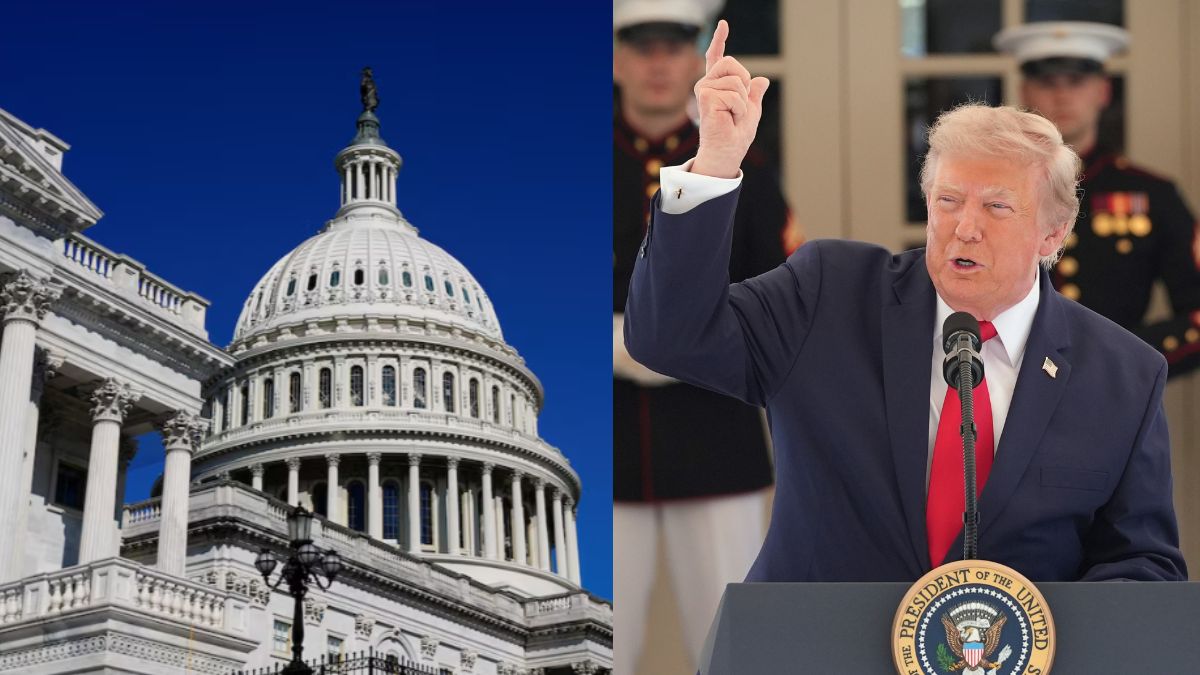
US Congress has taken the next step toward making daylight saving time (DST) permanent in the country. The years-long bid, backed by President Donald Trump, to end the twice-annual practice of changing clocks saw positive development on Tuesday (US time) when the US House of Representatives passed the bill called the ‘Sunshine Protection Act’ in an overwhelming 308-117 vote.
The next step? The legislation needs approval from the US Senate and a signature from President Trump to be enacted. If that happens, clocks in the US would no longer revert to standard time in November. Nonetheless, states will be allowed to voluntarily observe daylight saving time, as the bill seeks to extend daylight into evening hours. Hawaii and Arizona don’t observe daylight saving time.
What is the Sunshine Protection Act?
The official US Congress website states the proposed H.R.139 – Sunshine Protection Act of 2025 “makes daylight saving time the new, permanent standard time. States with areas exempt from daylight saving time may choose the standard time for those areas.”
EBSCO, the provider of research databases, describes daylight saving time as a “practice aimed at energy conservation by adjusting clocks forward in the spring and back in the autumn, which results in longer daylight hours during afternoons.”
“Besides conserving energy by allowing businesses such as retailing and sports to reduce the amount of time they must light and heat their facilities, studies have shown that the observation of DST has also helped to decrease traffic-related accidents,” EBSCO states.
The House Energy and Commerce Committee voted 48-1 in favour of the act in May. Although largely unpopular in the contemporary world, the US used year-round daylight saving time during World War II. It was eventually enacted again in 1974 to conserve energy. However, the US Congress repealed it later that year.
Back in March 2022, the US Senate voted unanimously to make daylight saving time permanent. At the time, the US House failed to push for the legislation amid surging opposition. Critics of DST mostly speak out against early morning hours, citing safety concerns and productivity issues, especially for students and other professionals who need to be outdoors before sunrise under the daylight saving time system.
Where do officials stand?
Donald Trump has repeatedly argued against twice-yearly clock changes. However, the way he’s previously framed his argument on the daylight saving time issue has caused members of his political party to clash in the past.
Back in 2024, he vowed on social media that “The Republican Party will use its best efforts to eliminate Daylight Saving Time, which has a small but strong constituency, but shouldn’t,” adding that the clock changes are “inconvenient, and very costly to our Nation.”
Since Trump mentioned “ending” daylight saving time instead of making it “permanent,” several lawmakers butted heads over what he actually meant.
Last year, he again stressed on Truth Social that both the US House and Senate should “push hard for more Daylight at the end of a day.” He also reiterated, “Very popular and, most importantly, no more changing of the clocks, a big inconvenience and, for our government, A VERY COSTLY EVENT!!!”
As the US House passed the bill on Tuesday, the White House said the measure “would eliminate the time, hassle, and cost involved in changing clocks twice a year, saving Americans hundreds of millions of dollars in value annually.”
Meanwhile, Republican Senator Tom Cotton still oppose the bill, arguing that permanent daylight saving would lead to very late winter sunrises. He contends that it would force children across many parts of the US to leave for school in darkness.
On the other hand, Republican Rep. Robert Aderholt, who voted in favour of the bill, said, “The twice-a-year time change has long been a source of frustration for families, businesses, and workers across the country. I’ve heard from many constituents who simply want to pick one time and stick with it. The Sunshine Protection Act accomplishes that by providing consistency throughout the year.”
Addressing the student safety concern raised by Cotton and others, he added, “One concern I do have is the impact on school children,” as quoted by Fox 54.
“In December and January, permanent Daylight Saving Time would mean the sun would not rise until nearly 8:00 a.m. in much of North Alabama. That means many students would be standing at bus stops or walking to school before sunrise. As a father and soon-to-be grandfather, that’s something I take seriously.”
Doubling down on the need to ensure kids’ safety, he continued, “I believe we can enjoy the benefits of ending the clock changes while also making sure student safety remains a priority. Whether that means reviewing bus schedules, adjusting school start times where practical, or identifying other commonsense solutions, we should make every effort to ensure children are not routinely waiting for the bus in the dark.”
In an official press release, Airlines for America, a group representing major US air carriers, issued a warning about DST’s impact on air travel.
“Changes to existing Daylight Savings Time (DST) would have considerable implications for aviation, including passenger disruption, crew and aircraft positioning, and domestic and international connectivity issues,” it said. “Airlines operate expansive interconnected domestic and global networks that are reliant on stability and predictability. Any changes would need an implementation timeline that reflects these global complications.”