



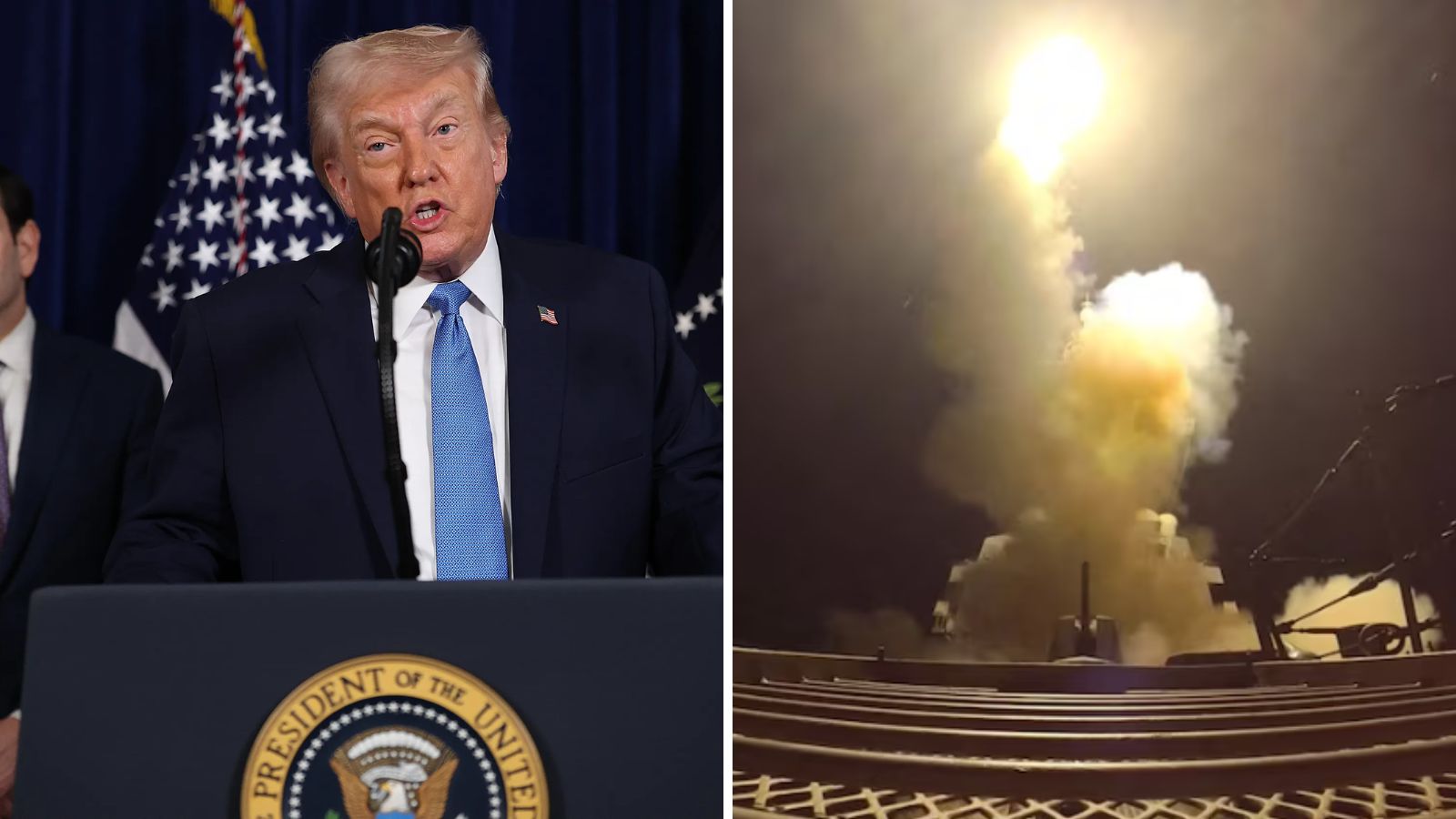
The conflict between the US and Iran intensified further as the US launched another round of strikes on Iranian targets, with Trump warning that more attacks would follow. Iranian media reported explosions in Bandar Abbas and on the islands of Kish, Qeshm and Abu Musa, while Iranian missiles struck two UAE tankers in the Strait of Hormuz, killing one Indian crew member and leaving six others injured.
Iran-US war latest updates – July 14
- The US has resumed military strikes on Iran, ending the fragile truce reached less than a month ago.
- Trump announced that the US will restart its naval blockade of Iran and take control of shipping through the Strait of Hormuz.
- Trump also said ships passing through the strait will have to pay a fee equal to 20% of the value of their cargo in return for US security. The move marks a major shift in US policy, as Washington had earlier opposed any tolls on international waterways.
- US Central Command (CENTCOM) confirmed it has launched a third straight night of attacks on Iranian targets.
- Trump told a radio interview that the US would continue striking Iran over the next two days, saying Tehran could do little to stop it.
- The White House has formally informed Congress that fighting with Iran has resumed, setting up another debate over presidential war powers.
- Iran has vowed retaliation, with senior officials calling revenge for the killing of Supreme Leader Ayatollah Ali Khamenei “the right of the Iranian nation.”
- Iran’s military claimed it launched fresh attacks targeting US military assets in Jordan, Bahrain, Kuwait and Oman.
- Brent crude climbed to about $83 a barrel after Trump’s announcement, up sharply from around $76 on Friday.
- The proposed 20% transit fee could more than double the cost of shipping oil through the Strait of Hormuz, according to logistics experts.
- The UAE said two of its oil tankers were hit by Iranian cruise missiles while passing through the Strait of Hormuz. The attack reportedly killed one Indian sailor and injured eight others, according to the UAE Defence Ministry.
Trump says Iran has been pushed 'back to the Stone Ages'
Speaking to Newsmax, President Donald Trump claimed the US military campaign had severely weakened Iran.
"Now, they have something left, but it's been largely taken away. As an example, their military had 159 ships; 159 ships are under the sea."
He also claimed that Iran had lost nearly all of its military aircraft and much of its defence infrastructure.
"They had 200 aeroplanes; their aeroplanes are all gone. Their radars gone, their anti-aircraft is gone, their weapon-making capability is largely gone – about 84 percent."
Trump added, "So they are a much different country than they were four months ago. In four months we've brought them back to the Stone Ages to a large extent."
He said Iran still has some missile capability but insisted it no longer poses the same military threat.
"Iran was the bully of the Middle East, and they weren't going to be bullying me," he added.
Iran claims fresh attacks on Bahrain
Iran's Islamic Revolutionary Guard Corps (IRGC) said it carried out missile and drone attacks on the AlJuffair military base in Bahrain.
The group claimed it targeted weapons storage facilities, a satellite communications centre and a building housing US troops.
The IRGC said the strikes were part of the second phase of its retaliation campaign, named "Nasr 2", and claimed the operation was still continuing.
Soon afterward, air raid sirens sounded once again across Bahrain, with the Interior Ministry urging residents to seek immediate shelter.
UAE condemns 'brazen' attack on oil tankers
The United Arab Emirates has strongly condemned what it called a "brazen" Iranian missile attack on two of its oil tankers.
According to the UAE Ministry of Defence, Iran fired two cruise missiles at the tankers Mombasa and Bahia while they were sailing near Oman in the Strait of Hormuz.
Both ships caught fire after the strikes.
An Indian crew member aboard the Mombasa was killed. Eight others were injured, including six who suffered serious injuries. The injured include four Indians and two Ukrainians.
Calling the attack a violation of international law, the UAE said it has the right to defend its assets and will take all necessary steps to respond to Iranian actions.
The UAE's statement came as warning sirens were also heard in Bahrain, although authorities there did not immediately confirm whether any attack had taken place.
Dozens of US military aircraft seen over the region
Military activity across the Gulf has increased sharply.
Flight tracking data showed at least a dozen US military aircraft flying over the Persian Gulf, the Gulf of Oman and Saudi Arabia early Tuesday. The aircraft included nine KC-135R and two KC-46A aerial refuelling tankers, along with an E3-B Sentry airborne warning aircraft and a US Navy P-8 Poseidon surveillance aircraft.
The E3-B can monitor nearly 120,000 square miles of airspace and track around 600 targets at the same time, including aircraft, missiles, drones and tanks. The refuelling aircraft help fighter jets stay in the air for longer without needing to land.
Analysts say risks have increased
Tim Waterer, Chief Market Analyst at KCM Trade, said the latest developments have significantly increased uncertainty.
"The latest escalation, including the US reinstatement of the blockade and Iranian responses, has clearly injected fresh risk into the market," he told Reuters.
He added, "While a full closure hasn't occurred, the competing objectives of both sides have made the supply picture highly uncertain."
US tightens security in the UAE
US has canceled all consular appointments at its embassy and consulate in the UAE over the coming days.
The US has also relocated all non-emergency government personnel out of the country as a precaution.
With American airstrikes continuing, Iran claiming fresh attacks on US military facilities, commercial ships coming under fire and oil prices surging, the conflict is showing no signs of easing. The Strait of Hormuz remains at the centre of the crisis, with global markets and governments closely watching what happens next.
Oil prices record biggest jump in years
The latest escalation has sent shockwaves through energy markets.
Brent crude surged 9.59% to settle at $84 a barrel, its highest closing price since June 12 and its biggest single-day gain in more than six years.
US benchmark WTI crude climbed about 9.4% to $78.14 a barrel, its strongest close since June 15.
Analysts said fears over disruptions in the Strait of Hormuz, through which a large share of the world's oil passes, pushed prices sharply higher.
Paul Christopher, Head of Global Investment Strategy at Wells Fargo Investment Institute, said, "Until something changes with the status of the Strait, we believe the bias remains for higher oil prices and, in turn, higher expected inflation and interest rates, and episodes of equity price volatility."
US launches third straight night of strikes
The US military has begun a third consecutive night of strikes against Iran under President Donald Trump's orders, US Central Command (CENTCOM) confirmed.
The attacks started at 4:45 p.m. ET on Monday. According to a US official, the targets included Iranian coastal surveillance systems, drone facilities and missile capabilities. CENTCOM said the strikes are meant to weaken Iran's ability to attack civilian ships and commercial traffic in the Strait of Hormuz.
Soon after the strikes began, Iranian media reported explosions in Bandar Abbas, the country's biggest southern port, as well as on the islands of Kish, Qeshm and Abu Musa. Iran's state-run IRNA said at least three explosions were heard in Bandar Abbas, while officials said a projectile struck the western part of the city. No immediate casualties were reported. Explosions were also reported in Jam and Kangan in Bushehr province.
Tensions spread across the region
Saudi Arabia said its air defence systems intercepted a ballistic missile fired by Yemen's Iran-backed Houthi rebels toward the kingdom's southern region. A Saudi government spokesperson confirmed the interception, highlighting how the conflict is expanding beyond Iran and the United States.
With fresh US strikes, attacks on commercial vessels, tighter military action in the Strait of Hormuz and growing regional involvement, fears are rising that the conflict could widen further in the coming days.
US to restart naval blockade
CENTCOM also announced that the United States will restart its naval blockade of ships travelling to and from Iranian ports from 4 p.m. ET on Tuesday.
The announcement added to worries in the oil market, with traders fearing further disruption to shipping in the Gulf. As a result, global oil prices jumped by more than 9%, reflecting concerns that the conflict could affect the movement of crude through the Strait of Hormuz.
Iranian missiles hit two UAE tankers
An Indian crew member was killed and eight others were injured after Iranian cruise missiles struck two UAE oil tankers, Mombasa and Al Bahiyah, while they were passing through the Strait of Hormuz in Omani territorial waters, according to the UAE Ministry of Defence. The Indian national who died was serving aboard the Mombasa. Of the eight injured, six are Indian nationals and two are Ukrainian nationals, with four of the injured in serious condition. The missile strikes also sparked fires and caused material damage to both tankers, though UAE authorities said the fires were later brought under control. The attack comes amid escalating tensions between the US and Iran, with the UAE blaming Tehran for the strike.
US launches another round of strikes
The US military carried out another wave of attacks on Iran after President Donald Trump ordered fresh strikes, according to the US Central Command (CENTCOM). Soon after the operation began, Iranian media reported explosions in the southern port city of Bandar Abbas as well as on the islands of Kish, Qeshm and Abu Musa.
Even before the strikes took place, Trump had signalled that more attacks were on the way. During a radio interview, he said, "We're going to hit them very hard tonight, and we're going to hit them hard tomorrow."
The latest strikes mark another sharp escalation in the fighting, with both countries continuing to exchange military action.
Iran's Foreign Minister on Trump's Hormuz fee proposal
Iran's Foreign Minister Seyed Abbas Araghchi has responded to US President Donald Trump's "Guardian of the Hormuz Strait" fee proposal. In his tweet, he wrote, "POTUS is absolutely right. Whoever provides secure and safe passage of commercial vessels through the Strait of Hormuz should be compensated for this service. Iran has always been the GUARDIAN of the Strait and will remain so FOREVER."
Iran's Foreign Minister Seyed Abbas Araghchi responds to US President Donald Trump's "Guardian of the Hormuz Strait" fee proposal.
— ANI (@ANI) July 13, 2026
In his tweet, he wrote, "POTUS is absolutely right. Whoever provides secure and safe passage of commercial vessels through the Strait of Hormuz… pic.twitter.com/v450no56gT
'We're attacking them tonight'- Trump on Iran
Trump on Iran: "We're not going to put up with it. We are just going forward — we're attacking them tonight. We're taking out all their capability for anything having to do with the Strait... What they're doing is being very foolish, very stupid."
.@POTUS on Iran: "We're not going to put up with it. We are just going forward — we're attacking them tonight. We're taking out all their capability for anything having to do with the Strait... What they're doing is being very foolish, very stupid." pic.twitter.com/wkspzB3kcH
— Rapid Response 47 (@RapidResponse47) July 13, 2026