



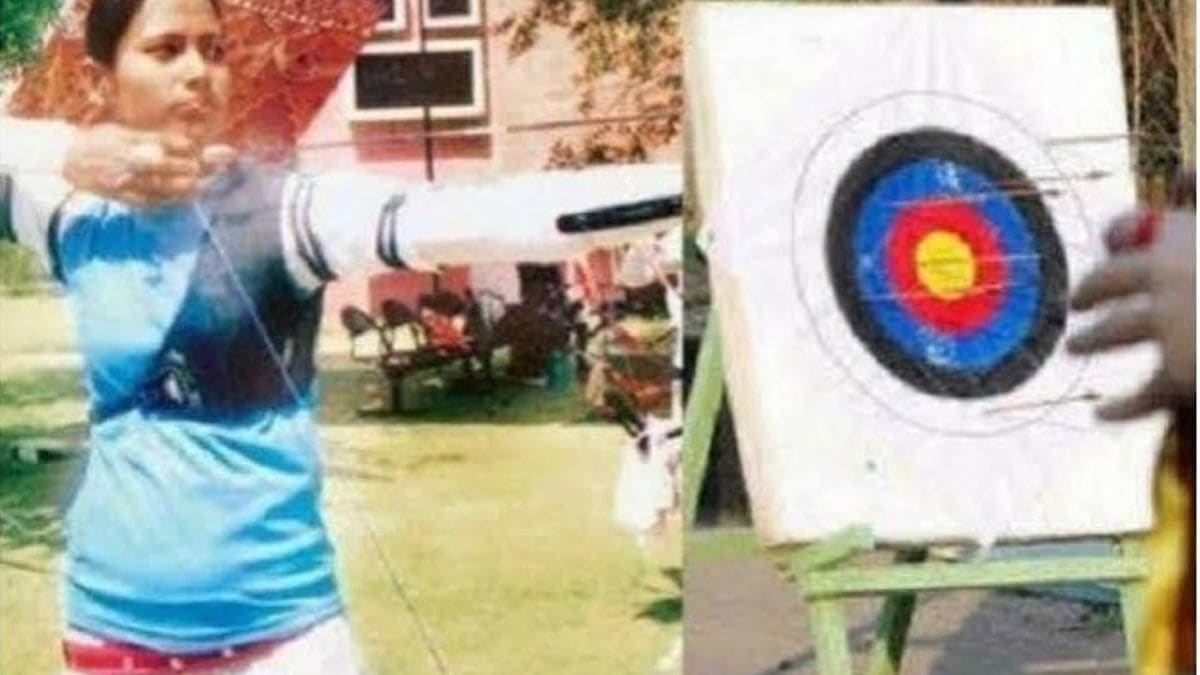
A world-class recurve bow, valued at more than ₹4 lakh, changed hands online in 2012 for ₹50,000. The seller was Nisha Rani Dutta, an Indian archer who had once represented the country at international tournaments. The buyer was a young archer from Manipur.
The money went into repairing her family’s home in Jharkhand, damaged by heavy rains. There was no sponsor, no institutional backup and no savings large enough to cover the cost.
For Dutta, the bow was not just equipment. It had been gifted to her in 2010 by her Korean coach during her stint at the Mittal Champions Trust in Bengaluru, after he reportedly saw enough promise in her technique to invest in her development. By 2012, it had become the only asset she could realistically convert into cash. This is her story.
From Pathmada to the international circuit
Dutta grew up in Pathmada village near Jamshedpur and was selected into the Tata Archery Academy in 2005. Under coach Dharmendra Tiwari, she trained full-time and quickly moved into the competitive circuit.
By the time she was still in her teens, she was already appearing on international podiums. A team bronze at the Bangkok Grand Prix came in 2006. In 2007, she was named Best Player at the Asian Grand Prix in Taiwan. A year later, she won an individual silver at the South Asian Archery Championship.
She was competing in the same ecosystem as archers who would go on to become established names in Indian sport. The pathway looked stable from the outside: academy training, international exposure, and eventual absorption into a sporting career. The structure beneath it was far less stable.
A stipend that rarely stretched the month
At the Tata Archery Academy, Dutta received a monthly stipend reported to be around ₹500-₹600. Even by mid-2000s standards, it was minimal. A portion of it, she later said in interviews, regularly went back home.
Her family depended on a small plot of agricultural land. Farming income was inconsistent. Seeds and basic inputs were not always affordable, and financial pressure shaped much of her early sporting life.
For a brief period, things improved after she joined the Mittal Champions Trust in 2008. Monthly support rose to around ₹3,000, and she gained access to better equipment and international-standard training setups.
The arrangement did not last long. When funding priorities shifted after 2009, the support ended. There was no structured transition into employment, no long-term stipend continuation, and no clear pathway beyond competitive sport. She returned to Jharkhand without income from sport.
The bow and the roof
By 2012, her family’s mud house had deteriorated badly after repeated rain damage. Repairs could not wait, and borrowing options were limited. Formal credit was not accessible, and there were no institutional sports guarantees to fall back on.
The bow remained the only asset of value. She sold it for ₹50,000. It was a fraction of its original worth, but it covered immediate repair costs. The sale also marked an informal end to her competitive trajectory at the highest level.
Archery, unlike many mainstream sports, demands continuous investment. A competition-level recurve bow alone can cost between ₹1 lakh and ₹4 lakh, with arrows, accessories and maintenance adding significantly more. Once support structures disappear, retaining that equipment becomes financially impossible for athletes from low-income backgrounds.
Outside the medal bracket
Indian sports policy tends to concentrate long-term financial security around Olympic, Asian Games and Commonwealth Games medallists. Athletes who perform at continental or circuit levels often exist outside that safety net.
Dutta’s results placed her within national contention but not within the category that guarantees long-term pension or secure employment.
After her situation was reported in the media, she applied for government jobs under sports quota provisions. According to contemporaneous reports, she expressed frustration with the lack of stable employment pathways for athletes once their competitive phase ended.
“I need a permanent job and not just assurances and felicitations,” she was quoted as saying in 2012.
Relief after visibility
Once her case became public, support followed quickly. A local NGO in Jharkhand provided immediate assistance of around ₹25,000. The Union Ministry of Youth Affairs and Sports later sanctioned ₹5 lakh from the National Welfare Fund for Sportspersons to help with home repairs and immediate financial relief.
The intervention stabilised her situation in the short term. But it also underscored how dependent athlete welfare can be on visibility rather than system design.
What remains after 2012
After the relief packages were announced, public information about Dutta becomes limited. There is little reporting on whether she returned to competition, transitioned into coaching, or found long-term employment within sport.
Her case is frequently cited in discussions on athlete welfare, but rarely followed beyond the moment of crisis.
What remains documented is the earlier arc: a promising archer, international medals in her teens, years of training on a minimal stipend, a short-lived private support system, and a career interrupted by financial necessity.
Beyond one case
Dutta’s story sits within a broader pattern in Indian sport. Athletes in non-cricket disciplines often depend on a combination of academies, temporary sponsorships and uncertain government pathways. When any one of those breaks, the entire structure can collapse.
For many athletes, the gap between national representation and financial stability remains unclosed.