



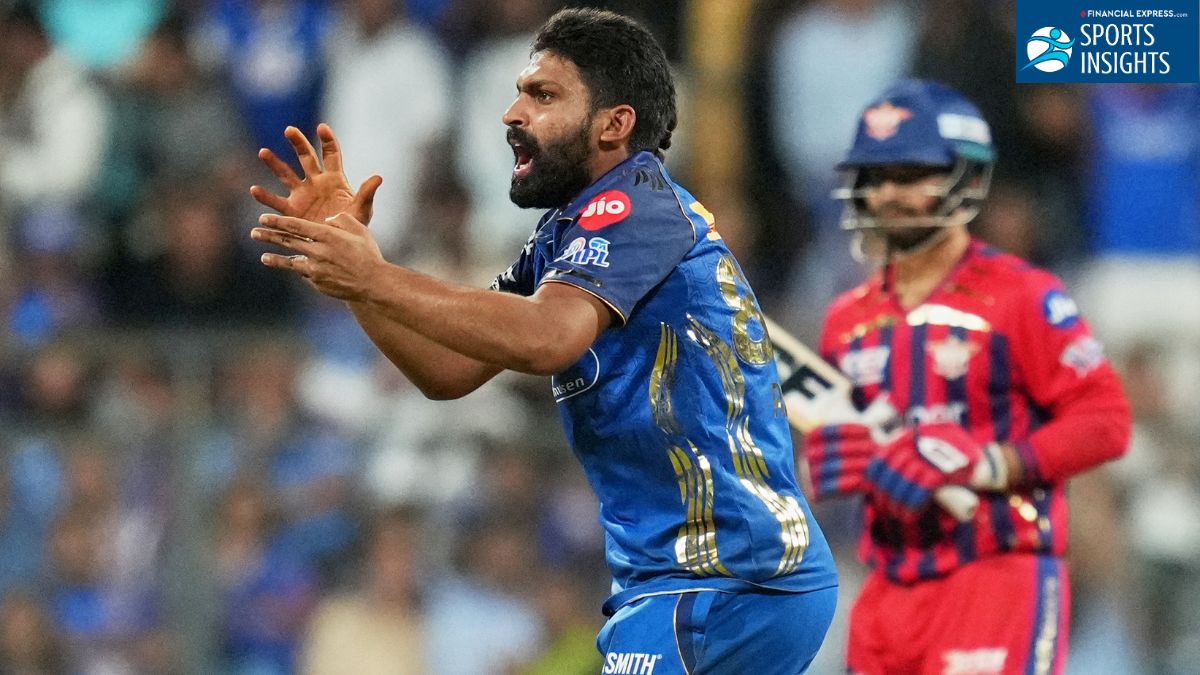
The heat in Jalandhar that summer was the kind that makes you want to stay inside and do nothing. 45 degrees. Maybe 46. The kind of heat where the tar on the road goes soft and your slippers stick to it.
Raghu Sharma was out there anyway, running laps by himself around a dusty ground, sweat pouring off him, lungs burning, wondering if this whole thing was stupid.
He was 18 He weighed 102 kilograms. His family wanted him to be an engineer. Every coach he met took one look at him and saw a fat boy who started too late.
That was 2011. India had just won the World Cup. Sharma watched the final on a small TV somewhere in Punjab and something inside him shifted. He decided he wanted to play cricket. Not as a hobby. For real.
Fifteen years later, on a humid May evening in Chennai, he stood at the MA Chidambaram Stadium waiting for Hardik Pandya to hand him a blue and gold cap. He was 33. Most players his age are thinking about retirement. Sharma was making his debut.
The boy who taught himself to spin by watching YouTube
Sharma did not come up through the fancy academies. No BCCI pipeline. No Under-19 India camps. He was a medium-pacer at first, which makes sense if you picture a heavy kid running in and trying to hit the deck hard.
Then his hamstring gave way during a practice session at the Jalandhar District Cricket Association. He could not run. So he stood at the end of his run-up and started fiddling with leg cutters. Wrist spin from a standstill.
Madan Lal, the 1983 World Cup hero, happened to be watching. He saw something in the wrist. Told the boy to forget pace bowling entirely. Sharma did not have a spin coach. He did what any engineering student would do. He went home and opened YouTube.
He found Shane Warne’s leg spin tutorials. Watched them for hours. Two fingers up, two down. The grip. The wrist position. The drift. The dip.
He learned the leg break first, then the googly, then the flipper, then the slider. All from a screen. All alone in a room in Jalandhar while his friends were probably out doing normal things.
There is something almost funny about it. One of the greatest leg spinners in history, a blonde Australian who played in front of ninety thousand people at the MCG, teaching a Punjabi engineering student how to hold a cricket ball through a video on the internet.
But that is how it happened. Sharma built his entire bowling action from pixels and patience.
The selectors told him he was too old at twenty-five
He made his Ranji Trophy debut for Punjab in 2017. Took seven wickets against Goa in his second match. Looked like he belonged. Then he vanished. Fitness concerns. Preference for younger boys. The usual excuses. At twenty-five, a selector sat him down and said the quiet part out loud. Too old. No long-term plan for you.
Think about that for a second. Twenty-five. In any normal job, you are just starting. In Indian cricket, you are already expired goods.
So Sharma moved to Puducherry. Then Sri Lanka. Then England. He played for Galle Cricket Club in 2022 and took 46 wickets in six first-class matches. Average of 15.71. Five five-wicket hauls. Three ten-wicket match hauls. Nobody in India noticed. Or maybe nobody cared.
In 2023 he turned up at Longton CC in some league in northern England that nobody here has heard of. Took 48 wickets at 13.08. Met Imran Tahir during a club game. Forty minutes with the South African changed things.
Tahir showed him how to control his pace and how to bowl a googly that actually turned both ways with disguise. Sharma had been doing it wrong for years. Forty minutes fixed it.
The net bowler who would not go away
Harbhajan Singh recommended him to Mumbai Indians as a net bowler in 2016. Sharma went for trials. Failed them. Did not bowl well enough. Did not look fit enough. Did not impress anyone. He went back to domestic cricket, back to the grind, back to being invisible.
Eight years. That is how long he waited between failing that trial and getting another shot. In those eight years he lost the weight, rebuilt his action, went to Sri Lanka, went to England, came back to Punjab, played for Uttarakhand, took wickets everywhere, and kept showing up.
Wasim Jaffer put in a word. Harbhajan remembered him. The Mumbai Indians scouts started watching again.
In May 2025, a young pacer named Vignesh Puthur got ruled out with stress reactions in both shins. Mumbai needed a replacement. They looked at Sharma. Signed him for thirty lakh rupees. He did not play a single game that season. Just nets. Just intra-squad matches. Just waiting again.
But they saw enough to keep him for 2026.
The debut that almost did not feel real
May 2, 2026. Chennai. The El Clasico. Mumbai Indians against Chennai Super Kings. Sharma had watched this fixture on television for 18 years. Now he was fielding at deep midwicket while Trent Boult ran in from the other end.
He did not take a wicket. Figures of 0 for 24 in four overs. But here is the thing. Boult went for over 11 an over. Sharma went for six.
Two days later, at the Wankhede, he got his first wicket. Akshat Raghuwanshi, a debutant like him, tried to charge down the track and attack. Sharma saw him coming. Held the ball back. Dragged his length down. The ball dipped, the batter was early, the ball lobbed back to Sharma. Simple catch.
Then came the moment that made him famous.
He pulled a folded piece of paper from his pocket. Held it up to the cameras. Suryakumar Yadav looked confused. Jasprit Bumrah looked confused. Everyone watching looked confused.
The note said this: “Radhe Radhe. A very painful 15 years, by divine mercy of Gurudeva, ended today. Thanks, Mumbai Indians (Blue and Gold), for giving me this opportunity. Ever grateful. Jai Shri Ram.”
Fifteen years. Written on a piece of paper he carried in his pocket. Just in case.
The God he found in Vrindavan
Sharma went to Vrindavan in 2014. He was twenty-one. His cricket was going nowhere. He needed something to hold onto. He found Vaishnavism. Found a guru. Found a way to make sense of the rejection.
He told ESPNcricinfo later, “I feel God sees everything. If you are doing your work with discipline, you will definitely get the reward. I enjoyed even my failures.”
That last line is the one that stays with you. I enjoyed even my failures. How many of us can say that? How many of us can watch our dreams slip away year after year and still find something to enjoy in the trying?
Between 2019 and 2021, when his playing career looked dead, Sharma coached at the Cricket Academy of Pathans in Jaipur. Run by Yusuf and Irfan Pathan.
He taught young kids how to spin a cricket ball while wondering if his own chance would ever come. Teaching probably made him better. When you have to explain something to a child, you understand it more deeply yourself.
What this says about the rest of them
There are hundreds of Raghu Sharmas in India. Boys who start late. Boys who do not come from cricket families. Boys who get one look from a selector and then never get another. Most of them quit. They become bankers or software engineers or shopkeepers. Sharma almost became an electrical engineer.
His story is not a template. You cannot tell every rejected twenty-five-year-old to just keep going because Raghu Sharma made it at thirty-three. The odds are still terrible. The system still prefers the eighteen-year-old from the NCA who has been coached by the right people since he was ten.
But Sharma proves something else. He proves that the system is not perfect. That it misses people. That a boy from Jalandhar who learned to bowl googlies from a YouTube video can end up playing for Mumbai Indians if he is stubborn enough and good enough and lucky enough in exactly the right combination.
He also proves that cricket still has room for romance. For the fifteen-year wait. For the handwritten note. For the fat boy running alone in forty-five-degree heat because he saw Sachin Tendulkar lift a World Cup and decided he wanted in.
The numbers that do not tell the story
Fifty-seven first-class wickets at 22.04. Eighteen List A wickets at 27.50. One IPL wicket at the time of writing. These are not numbers that make you stop and stare. They are not Rashid Khan numbers. They are not even close.
But the numbers from Sri Lanka matter. Forty-six wickets in six matches. The numbers from England matter. Forty-eight wickets in a season. The strike rate in first-class cricket matters. He takes a wicket every 40 balls or so, which means he is not just containing. He is attacking. Even on flat tracks. Even when the game is drifting away.
In the 2024-25 Vijay Hazare Trophy, he took fourteen wickets in eight games. Third highest among spinners in the tournament. In the Ranji Trophy that season, playing for Uttarakhand, he took seven wickets in a match against Himachal Pradesh. At thirty-three, he was still getting better.
What happens now
Mumbai Indians were ninth in the table when Sharma debuted. Two wins from eight games. A season going nowhere. They played him as an Impact Player, which is a fancy way of saying they used him when they needed control in the middle overs and did not want to weaken their batting.
Against Chennai, he gave them control when no one else could. Against Lucknow, he gave them a wicket when they needed a breakthrough. Small contributions. But in a team struggling for identity, small contributions from unlikely places start to matter.
Will Sharma play for India? Probably not. Thirty-three is too late for that in the modern game. The selectors will look at his age and move on. They always do.
But Sharma has already won the only argument that matters. He proved that the fifteen years were worth it.
That the weight loss and the loneliness and the Sri Lankan club cricket and the English league cricket and the coaching job in Jaipur and the failed trial in 2016 and the waiting and the note in his pocket were all worth it.
Raghu Sharma is not a hero. He is not a sensation. He is a leg spinner who waited fifteen years for one night, got it, and wrote a thank you note to God on a piece of folded paper.
That is enough. That is more than enough.