



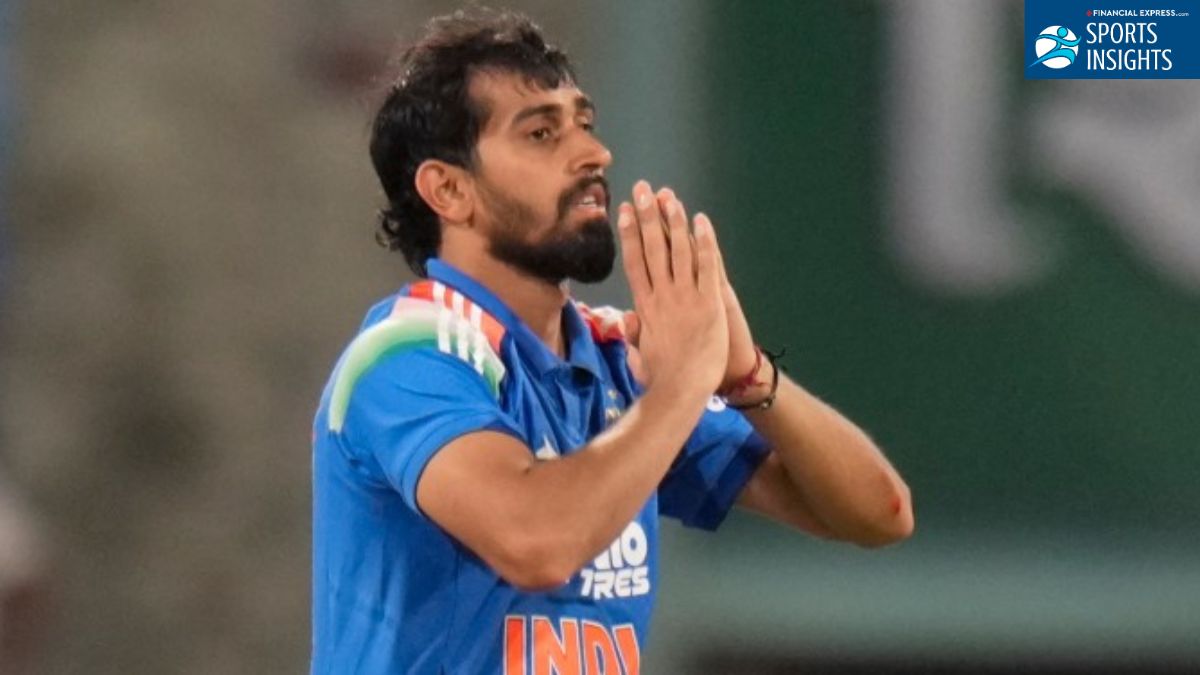
Prince Yadav was asleep in a hotel room in Jaipur on the night of May 19, 2026, when his phone began to buzz. He was there to play Rajasthan Royals the next day. The caller was Sanjiv Goenka, the owner of his Indian Premier League team, Lucknow Super Giants. Goenka wanted to be the one to tell him personally: India had picked him.
Six weeks later, on July 12, 2026, a hamstring gave way 7,000 kilometres away at Trent Bridge, and Yadav’s phone rang again.
This time it was not one call. It was two selections at once, for two different tours, because two Indian bowlers had broken down within days of each other.
Harshit Rana pulled his right hamstring during the third T20 International against England. Varun Chakaravarthy tore his left one around the same time. Both injuries happened during the kind of relentless international calendar that has become normal in cricket now, and both left a hole that only a fresh body could fill.
That fresh body belonged to a 29-year-old from Delhi’s Najafgarh region who had never touched a leather cricket ball until he was 18.
A father who wanted a government job
Ram Niwas did not want his son to play cricket. He was a retired head constable with the Railway Protection Special Force, and to him, cricket was a fantasy that poor families could not afford. He pushed Prince toward stable government jobs, toward the Delhi Police recruitment exams, toward anything with a pension attached to it.
Prince kept failing those exams, sometimes on purpose. His mind was elsewhere.
Until he was 18, elsewhere meant tennis-ball cricket on dusty grounds in Kheda Dabar village, a place known for little else except a visit from then-President Pratibha Patil back in 2012.
Most professional cricketers are inside a proper academy by age 12. Yadav was still bowling a rubber ball at 18, and it was that ball, heavy and unpredictable off the ground, that taught him how to bowl a yorker that crushes toes.
Then a coach on a scooter changed everything.
Amit Vashistha, who had already trained first-class players like Pradeep Sangwan and Lalit Yadav, happened to stop near the ground where Prince was bowling. He watched him land six yorkers in a row. He called the boy over.
Yadav showed up the next day with two tennis balls and nothing else. He had never gripped a seam properly. To build strength without a gym, he and former India Under-19 pacer Pradeep Sangwan tied sandbags to his back and ran through waterlogged paddy fields near his village. There was no shortcut available to him, so he took the long way, one muddy sprint at a time.
Then, in 2019, the BCCI banned him for two years for age fudging in Under-19 tournaments. His paperwork said he was born in December 2001. School records said June 1996. The suspension wiped out two full domestic seasons. It could easily have ended a career that had barely begun.
The only mercy was that Covid lockdowns swallowed some of that lost time anyway. Yadav bought basic gym equipment and trained alone at home, quietly, while the world outside stood still too.
Why a torn hamstring is a business event
To understand why Yadav’s story matters beyond cricket, it helps to understand what a fast bowler’s body actually goes through.
Every time a fast bowler releases the ball, his front leg absorbs an impact of up to 12 times his own body weight. His body also endures sideways braking forces of nearly five times his weight.
Bowlers carry roughly 80% more physical workload than batters or fielders in the same team. It is, in effect, controlled repeated trauma, delivery after delivery, over after over.
Team physios track this using something called the Acute: Chronic Workload Ratio, or ACWR. It simply compares how much a bowler has bowled in the last seven days against his average over the last 28 days. A ratio between 0.8 and 1.3 is considered safe. Anything above 1.5, and the body is being asked to do far more than it is used to, and injuries follow.
Rana suffered a Grade 1 tear. Chakaravarthy’s was Grade 2, more serious. Both are now recovering at the BCCI’s Centre of Excellence in Bengaluru, a 40-acre facility near the airport built specifically so that Indian cricket does not have to gamble on a player’s body healing on its own.
It is such good infrastructure that Hardik Pandya, one of India’s biggest stars, permanently moved his training base to Bengaluru just to be near it, paying local bowlers out of his own pocket to train under proper medical supervision.
For a player like Rana or Chakaravarthy, this facility softens the blow of injury. For a player like Yadav, a national call-up is the only ticket in.
What a call-up is actually worth
Here is where the story turns from sport to money, though for Yadav it never really felt like money. It felt like survival, then suddenly, it felt like arrival.
Domestic cricket in India pays by the day. A player with fewer than 20 first-class matches earns 40,000 rupees per day of play. Yadav had featured in only two first-class games for Delhi, so that baseline is where he sat. A four-day match, if he played every day of it, brought him 1.6 lakh rupees.
One international appearance changes that arithmetic completely. A single ODI cap pays 6 lakh rupees. A single T20I cap pays 3 lakh. Yadav earns more in one afternoon wearing the India shirt than he would in an entire first-class match.
There is a bigger prize sitting behind that too. Any uncapped player who plays at least 3 Tests, 8 ODIs, or 10 T20Is in a contract year automatically qualifies for a central BCCI contract. The lowest tier of that ladder, Grade C, pays a flat 1 crore rupees a year, along with free access to the same Bengaluru facility that is currently repairing Rana and Chakaravarthy.
Before the Trent Bridge injuries, Yadav had played 2 ODIs against Afghanistan and 4 T20Is against Ireland and England. His new dual selection, for the England ODI series and the Zimbabwe T20I tour, puts him within touching distance of that Grade C threshold.
Two more injuries elsewhere in the squad were, in a very real sense, the difference between a boy from Najafgarh chasing a contract and a boy from Najafgarh holding one.
None of this happened in isolation. Yadav had already signed with Lucknow Super Giants, first as a net bowler in 2023, then for 30 lakh rupees at the 2025 IPL auction, a price the franchise kept unchanged going into 2026. He repaid that faith this season with 16 wickets in 13 matches, the kind of form that gets national selectors calling.
The ball that beat Kohli
There is one wicket that explains why Yadav was even on the selectors’ radar when the phones started ringing at Trent Bridge.
It came against Royal Challengers Bengaluru in the 2026 IPL season. Yadav ran in and bowled Virat Kohli, arguably the most trending batter in the world. Kohli did not offer a shot. The ball simply went through him.
What makes the wicket resonate beyond the highlight reel is that Kohli had, without quite meaning to, helped build the very ball that dismissed him. The two had met earlier through veteran pacer Ishant Sharma, and Kohli had given Yadav some plain, unfussy advice.
“Teri achi ball sabke liye achi hai aur buri ball sabke liye buri,” Kohli told him. Your good ball is good for everyone and your bad ball is bad for everyone. Then he added, come what may, never focus too much on the result.
Yadav took that advice and built the inswinger that later removed Kohli for a duck. It is the kind of full-circle moment that cricket occasionally hands out for free, and it did more for Yadav’s stock than any highlight package could.
The village answers the phone
News of Yadav’s first India call-up in May reached Najafgarh before Yadav himself had finished processing it. He called his mother first. She was already crying.
His father was out buying groceries when his wife called to tell him. Ram Niwas, the man who once pushed his son toward a police exam, described to Times of India what happened next.
“I never expected this to happen,” he said. “Today my phone hasn’t stopped ringing, and people are standing at my door to congratulate us. Even those who never used to visit are coming today. I have no words. I was at the market, carrying a shopping bag, when my wife called me. Since then, I’ve only been answering phone calls. I’ll buy the groceries some other time.”
Coach Amit Vashistha, the man who once stopped his scooter for a stranger bowling yorkers, had his own reaction, coloured by an old regret.
He thought of his former student, Pradeep Sangwan, the pacer who had helped train Yadav in those muddy fields but whose own career never got the international recognition many felt it deserved. Today, Vashistha’s biggest dream had come true in front of his own eyes, through someone else’s son.
Arriving is easy, staying is not
International cricket does not care how good a story is. It only cares what happens next, and for Yadav, what happened next was hard.
His T20I debut brought a sharp spell of 3 wickets for 22 runs against Ireland, an ideal start. But the England series that followed tested him in a different way.
In the fifth T20I at the Utilita Bowl, he went for 60 runs in his four overs and took nothing. His economy rate that day was 15, roughly double what a bowler wants to concede in the shortest format.
Along the way, Yadav lost his first four international matches, matching a record held by Ambati Rayudu for the worst start to a career by an Indian player. It happened while the senior team itself was struggling, losing the series 4-0 to England and slipping from its number one ranking in T20Is.
Yadav is aware of exactly what is at stake every time he walks out now. His own words carry the weight of a young man who knows the door that opened for him could close just as fast.
He does not want to be remembered as someone who played one series and disappeared. He wants to prove himself at every stage, for India.
A body worth more than a pension
There is something worth sitting with here. Ram Niwas spent years pushing his son toward government exams because a fixed salary felt safer than a game. He was not wrong to worry. Most young cricketers never make it past the tennis ball stage, let alone the international one.
But Prince Yadav’s body, the same body his father once hoped would sit safely behind a desk, is now doing something a government salary never could. It is being watched by sponsors, tracked by physios, insured against breakdown, and priced by the match.
Every time he runs in to bowl, somewhere a franchise, a broadcaster, and a national selector are all quietly recalculating what he is worth. It is not a comfortable way to make a living. But it beats failing a police exam on purpose because your mind is somewhere else.
Two other men’s hamstrings gave way at Trent Bridge, and by the next morning, a tennis-ball bowler from Najafgarh had a seat at India’s table.
In Indian cricket, that is simply how the depth chart works now. Someone falls and somewhere, quietly, a boy who once ran through paddy fields with a sandbag on his back is already answering the phone.