



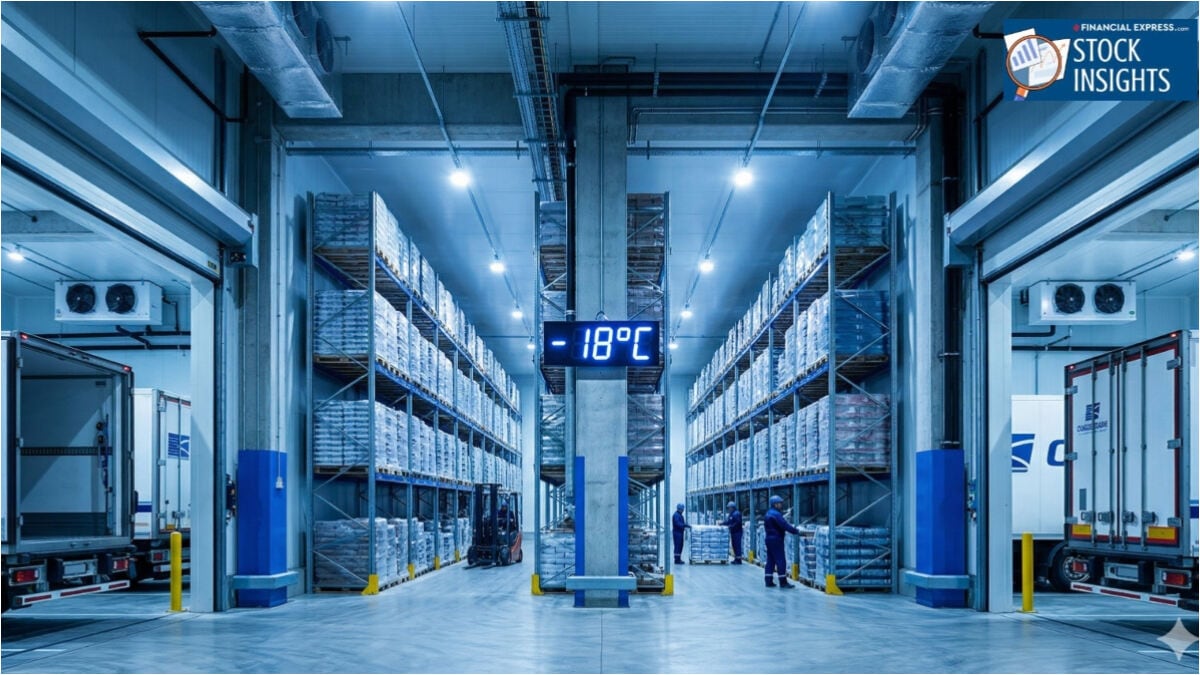
From drone deliveries to hyperlocal solutions, the logistics sector is evolving. But when it comes to keeping the supply chain running smoothly, especially for temperature-sensitive goods like food, pharmaceuticals, and chemicals, cold chains play a crucial role.
In India, the cold storage market was valued at USD 6.56 billion in 2025. It is likely to grow to USD 18.26 billion by 2033, at a CAGR of 12.6%.
If you look at the segments, cold storage infrastructure clearly leads with about 68%, while transportation and value-added logistics follow behind. By application, fruits and vegetables account for around 37% of the market share due to India’s large agricultural output, while dairy, meat, seafood, processed food, and pharmaceuticals are taking over slowly.
In temperature segmentation, the market is divided into chilled (0°C to 15°C), frozen (-18°C to -25°C), and deep-frozen (below -25°C). Of this, frozen storage is gaining traction as consumption of packaged and frozen foods rises.
However, when it comes to investment, the sector is less discussed. Here are two cold chain stocks that investors should keep an eye on: Ice Make Refrigeration Ltd. and Transport Corporation of India Ltd.
Top Cold Chain Stocks to Watch in India
Ice Make Refrigeration Ltd.
Ice Make Refrigeration began its journey in 1993 and has since been offering tailored cooling solutions to different sectors. The company has a portfolio of over 50 products categorised into seven segments: cold storage, commercial refrigeration, industrial refrigeration, ammonia refrigeration, and transport refrigeration.
With its five advanced manufacturing plants across India, the company is able to serve over 28,000 customers. Among these, the notable names include:
| Amul | Kohler | ISRO | Havmor |
| Coca Cola | Aditya Birla Chemicals | Intas | Indian Red Cross Society |
| Hindustan Unilever | HLL Lifecare | Kitchen Xpress | Cambay |
| Subway | Paras | Himalayan Food Park | Future Retail |
| Indian Railways | Vadilal | Arvind | KMSCL |
Beyond domestic dominance, the company has a presence in over 24 countries through exports.
The company is pursuing aggressive expansion, and to achieve its goal, it announced a capital expenditure of ₹1.5 billion in September 2025. While there is no disclosure on how the funds will be utilised, the allocation is expected to be towards technological upgrades, capacity expansion, and research and development.
While annual results for FY26 will be announced in a few weeks, in FY25, the cold room segment dominated revenue with a 51% contribution. Ammonia refrigeration came next, contributing 17%, while commercial refrigeration added another 16%.
When you look at the industry mix, dairy and ice cream led the way with a 30–40% share, while pharma and chemicals contributed around 15–20% of the revenue.
Moving to the most recent December quarter of FY26, the company posted a revenue of ₹153.4 crore. On a sequential basis, the revenue surged by around 4%, while on a year-on-year basis, it was a 38% increase.
Profit in the December quarter dipped to ₹1.5 crore, in contrast to ₹2.0 crore in the September quarter and ₹3.59 crore in Q3FY25. The primary reason behind the compressed profit margin in Q3FY26 is the volatility in the commodity prices such as steel, copper, and refrigerants.
Also, as per the management commentary, the company ventured into two new business verticals. Since these segments are in the initial phases of market development, costs related to market establishment, sales network build up, and customer acquisition generally remain high, temporarily depressing profitability.
Ice Make Refrigeration has also managed to reduce its working capital requirements from 37.4 days to 21.0 days.
Ice Make Refrigeration Limited 5-Year Financial Performance
| Particulars | FY21 | FY22 | FY23 | FY24 | FY25 |
| Sales (₹ in crores) | 135 | 206 | 312 | 378 | 480 |
| Operating Profit (₹ in crores) | 10 | 14 | 32 | 41 | 43 |
| Net Profit (₹ in crores) | 04 | 07 | 21 | 26 | 23 |
| EPS (₹) | 2.3 | 4.7 | 13.1 | 16.6 | 14.7 |
In terms of price performance, Ice Make Refrigeration’s stock prices fell by over 3% in the past 6 months and by over 10% year to date. By contrast, five-year returns were over 900%, which is a CAGR 59%.
As of Q3FY26, both foreign institutional investors and domestic institutional investors have increased their holdings on a sequential basis by 0.10% and 0.68%, to 0.11% and 1.99% respectively.
Transport Corporation of India Ltd.
Established in 1958, Transport Corporation of India Ltd. (TCIL) is the country’s leading integrated logistics and supply chain service provider. The company offers end-to-end multimodal logistics solutions across road, rail, sea, and air, serving diverse industries such as automotive, retail, pharmaceuticals, and e-commerce.
Its business is broadly divided into four key segments: Freight, Supply Chain Solutions (SCS), Seaways, and Energy. The Freight division handles full truckload (FTL), less-than-truckload (LTL), and project cargo movement, while the SCS division provides warehousing, distribution, inventory management, and supply chain consulting.
TCIL operates dedicated cold chain solutions through its subsidiary, TCI Cold Chain Solutions. In this subsidiary, 80% of the stake is held by TCI, while Mitsui & Co., Ltd. holds the remaining stake. The subsidiary has ambient warehouse space of 15 million square feet, over 20,000 pallet positions, temperature control facilities between -18°C and 25°C, and humidity control facilities ranging from 35% to 65% RH.
In Q3FY26, Transport Corporation posted consolidated revenue of ₹1,249 crore, compared to ₹1,205 crore in the September quarter and ₹1,147 crore in the December quarter of the previous financial year. Of the total revenue, the supply chain segment showed consistent performance, with sales growing by over 25% on a YoY basis. Warehousing and multimodal services contributed decently to the growth of this segment. The freight segment grew slowly at just 2.3% in the December quarter, while the seaways segment did better with an 8.7% year-on-year rise.
TCI Cold Chain Solutions’ revenue also grew 17% YoY to ₹26.8 crore.
When it comes to net profit, the consolidated Q3FY26 figures stood at ₹116 crore, which is a ₹2 crore decline on a sequential basis but an increase of ₹14 crore on a YoY basis.
Transport Corporation of India Limited 5-Year Financial Performance
| Particulars | FY21 | FY22 | FY23 | FY24 | FY25 |
| Sales (₹ in crores) | 2,802 | 3,259 | 3,783 | 4,024 | 4,492 |
| Operating Profit (₹ in crores) | 263 | 412 | 425 | 411 | 463 |
| Net Profit (₹ in crores) | 150 | 293 | 321 | 354 | 416 |
| EPS (₹) | 19.1 | 37.5 | 40.9 | 45.1 | 53.8 |
Similar to Ice Make Refrigeration, TCI also saw muted performance on D-Street. Over six months, TCI shares slipped 16%, with a 6.7% dip this year. Still, long-term investors have seen gains of over 275% in five years.
Despite lagging on the price chart, HDFC Mutual Fund has raised its stake marginally in Q3FY26 to 8.81% and added it to their HDFC Retirement Savings Fund (Hybrid).
Ice Make Refrigeration vs Transport Corporation of India vs Others
| Company | P/E | Dividend Yield (%) | ROCE (%) |
| Ice Make Refrigeration | 85.76 | 0.30 | 20.64 |
| Transport Corporation of India | 17.20 | 0.92 | 20.52 |
| Container Corporation of India | 27.93 | 1.95 | 13.87 |
| Snowman Logistics | – | 2.63 | 4.25 |
The comparison shows a clear split between growth expectations and operational stability. Ice Make Refrigeration appears priced for high future expansion, supported by strong return efficiency and improving working capital, but recent margin pressure suggests earnings volatility.
In contrast, Transport Corporation of India reflects a more balanced profile, with steady profitability, diversified operations, and relatively attractive valuation, indicating better risk-adjusted positioning.
Among peers, Container Corporation offers moderate efficiency with income visibility, while Snowman Logistics lags significantly in capital efficiency despite a higher yield, suggesting weaker overall operational performance.
Sector Headwinds: Why Growth Isn’t Reflecting in Stock Prices
Even with strong long-term demand, the following factors are dragging down listed companies in this space:
- Around 80% of the cold chain industry is unorganised, with many regional cold storage facilities and logistics players across India. This limits pricing power and scale benefits for organised players.
- Capacity expansion has outpaced near-term demand. India already has over 8,800 cold storages with around 402 lakh metric tonnes of capacity, but utilisation remains inconsistent across regions and seasons.
- Margins are under pressure due to rising energy costs, such as electricity, diesel for reefer transport and broader logistics inflation. Recent global supply disruptions and commodity volatility have added to the strain.
- Companies in this sector require high capital expenditure and often carry debt-heavy balance sheets to build warehouses and refrigerated fleets. This has kept return ratios subdued, especially in a high-interest-rate environment.
- Lastly, demand concentration in low-margin segments like fruits and vegetables, along with seasonality, reduces earnings visibility.
What’s for Investors?
The cold chain theme offers strong long-term growth, but near-term realities demand caution. Readers should focus on companies with pricing power, diversified product lines, and efficient capital allocation.
Ice Make Refrigeration Ltd. is betting on expansion-led growth despite margin volatility, while Transport Corporation of India Ltd. offers relatively stable earnings with better valuation comfort.
It is recommended to closely track margin trends, capacity utilisation, and debt levels as a long term industry consolidation gradually plays out.
It may be a good idea to add these stocks to your watchlist and keep track to see how they perform in time to come.
Disclaimer:
Note: We have relied on data from www.Screener.in throughout this article. Only in cases where the data was not available, have we used an alternate, but widely used and accepted source of information.
The purpose of this article is only to share interesting charts, data points and thought-provoking opinions. It is NOT a recommendation. If you wish to consider an investment, you are strongly advised to consult your advisor. This article is strictly for educative purposes only.
Rishabh Sinha is a seasoned financial content creator with over 10 years of experience in BFSI domain. His portfolio spans over 20 of India’s most trusted financial brands. Rishabh brings depth, structure, and a reader-first approach to every piece he crafts.
Disclosure: The writer and his dependents do not hold the stocks discussed in this article.
The website managers, its employee(s), and contributors/writers/authors of articles have or may have an outstanding buy or sell position or holding in the securities, options on securities or other related investments of issuers and/or companies discussed therein. The content of the articles and the interpretation of data are solely the personal views of the contributors/ writers/authors. Investors must make their own investment decisions based on their specific objectives, resources and only after consulting such independent advisors as may be necessary.