



Nuclear energy is recognized as a key contributor to India’s efforts to decarbonize and achieve net-zero carbon emissions. The Indian government has set an ambitious goal of reaching 100 GWe of nuclear capacity by 2047. Currently, there are 12 700-MWe reactors under construction (which will add 22 GWe), indicating a big scope for additional reactors to meet the 2047 target.
Furthermore, the business landscape has been bolstered by a significant policy departure: the government has allowed private sector participation in setting up Bharat Small Reactors. The nuclear tailwind is further supported by the SHANTI (Sustainable Harnessing of Advancement of Nuclear Energy for Transforming India) Bill.
Here are three hidden gems to watch as India expands its nuclear ambition.
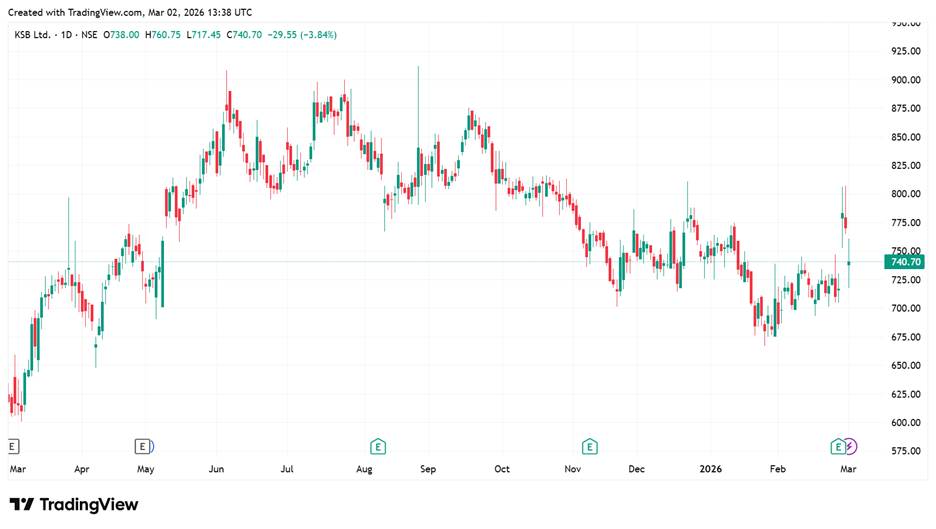
#1 The PCP monopoly: Why KSB is unreplaceable in India’s nuclear core
KSB is a market leader in the nuclear pump sector, currently the only approved manufacturer of main nuclear pumps. The nuclear business is a critical pillar of KSB’s overall operations. KSB has a competitive advantage as the only major global producer of primary coolant pumps.
Market moat: KSB’s global monopoly in primary coolant technology
KSB boasts a comprehensive product portfolio for nuclear plants, manufacturing every required pump except for the specific moderator pump. It has also recently expanded its addressable market in the nuclear space by acquiring BP & CL technology, which allows it to manufacture and supply reciprocating pumps for nuclear applications.
KSB is currently executing major orders for the Gorakhpur, Kudankulam, and Kaiga nuclear projects. Though they have faced some infrastructural bottlenecks. KSB currently has 4 pumps ready for the Gorakhpur project. They have yet to start the mandatory qualification testing.
Execution watch: Resolving the 6-MW bottleneck at Gorakhpur
This delay is occurring at the Nuclear Power Corporation of India testbed due to pending approvals for a 6 MW electrical connection and incomplete auxiliary piping. KSB has received official delivery extensions, scheduling 4 pumps for mid-2026 and the remaining four for 2027, although the company aims to deliver them earlier.
Unlike the Gorakhpur order, the Kudankulam order is for an emergency pumps package rather than the main primary coolant pumps. This project is progressing on a fast track and is expected to begin delivering a few of these pumps very soon.
Deliveries for Kaiga will only begin after the Gorakhpur deliveries are finalised. As Kaiga is a new project and a separate tender, the pumps will require their own fresh 500-hour qualification test at the testbed once the GHAVP (Gorakhpur Haryana Anu Vidyut Pariyojana) tests are finished.
Recurring revenue: The 60-year lifecycle of nuclear aftermarket services
Furthermore, the nuclear segment is expected to drive revenue for the aftermarket division. The primary coolant pumps are designed to last 40-60 years. Routine maintenance will require replacing mechanical seals and bearings, providing KSB with a steady, highly profitable stream of recurring revenue throughout the power plants’ lifecycles.
Revenue from operations surged by 7.9% year-on-year to ₹784 crore in Q3FY26, while net profit surged 10% to ₹81 crore. As of September 2025, KSB’s nuclear orders on hand stood at ₹1,313.8 crore, accounting for roughly half of its total order backlog of ₹2,639.2 crore.
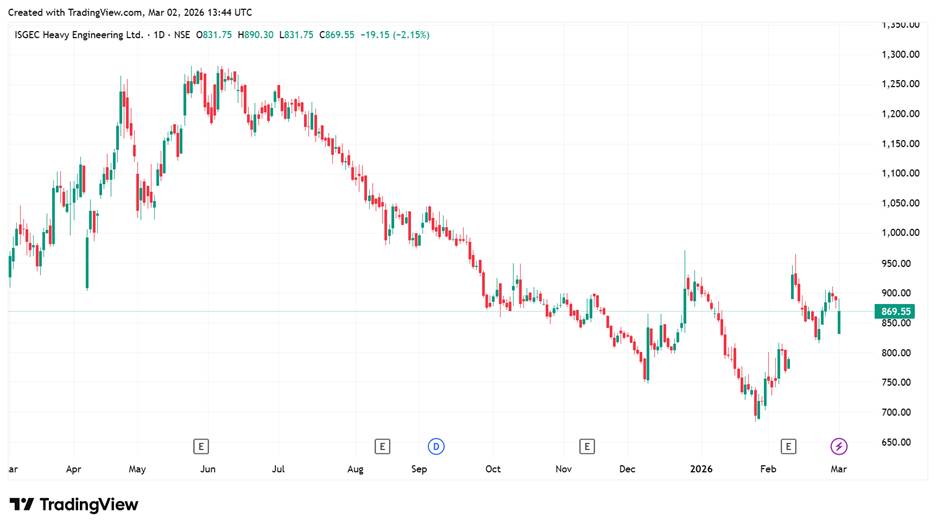
#2 “ISGEC: The ‘next L&T’ of nuclear engineering?
ISGEC Heavy Engineering is a highly diversified global heavy engineering company. It believes the nuclear power sector is a promising area for business growth in the coming decade. Its strategy is driven by policy tailwind, clean energy, and its growing manufacturing capabilities.
To capitalise on these nuclear opportunities, ISGEC is actively preparing its facilities and bidding for contracts. ISGEC Process Equipment Division, along with its built-to-print equipment group, is strategically positioned to manufacture and supply critical equipment for nuclear reactors.
Strategic pivot: Why 85% of ISGEC’s order book is now private sector
ISGEC is currently undertaking capacity expansions in its Machine Building division and foundry shops. Management has stated that these new and expanded facilities will be utilized to manufacture certain items specifically for the nuclear and defense areas. It anticipates securing orders from the nuclear sector soon.
Beyond Nuclear, the company anticipates substantial investments and capacity expansions in its core industrial sectors over the next 5 to 6 years. Management maintains consolidated revenue growth guidance of 7% to 8% for FY26 and 8% to 9% for FY27. The company expects to maintain double-digit margins in its manufacturing/machinery division.
The company is consciously shifting its order book toward the private sector (currently 85% of) and international markets, moving away from long-duration government/PSU projects. This shift favors shorter cycle times, better payment terms, and slightly better margins.
Capacity roadmap: Targeting ₹3,700 crore peak revenue by 2027
The ongoing expansion of manufacturing presses and industrial machinery is scheduled for completion by July 2026. This facility is expected to generate an additional ₹225 crore in annual revenue. Additionally, another facility is expected to be completed by July 2027.
These expansions aim to increase the division’s revenue from ₹400 crore to approximately ₹1,000 crore. After these capex projects, the total manufacturing division’s peak revenue could reach ₹3,600 to ₹3,700 crore at peak capacity.
From a financial perspective, revenue increased 17.1% year-on-year to ₹1,765 crore in Q3FY26, driven by the manufacturing of machine & equipment business. Operating margins expanded by 200 bps to 11%, while net profit surged 265% to ₹84 crore. The company’s order book stood at ₹8,709 crore.
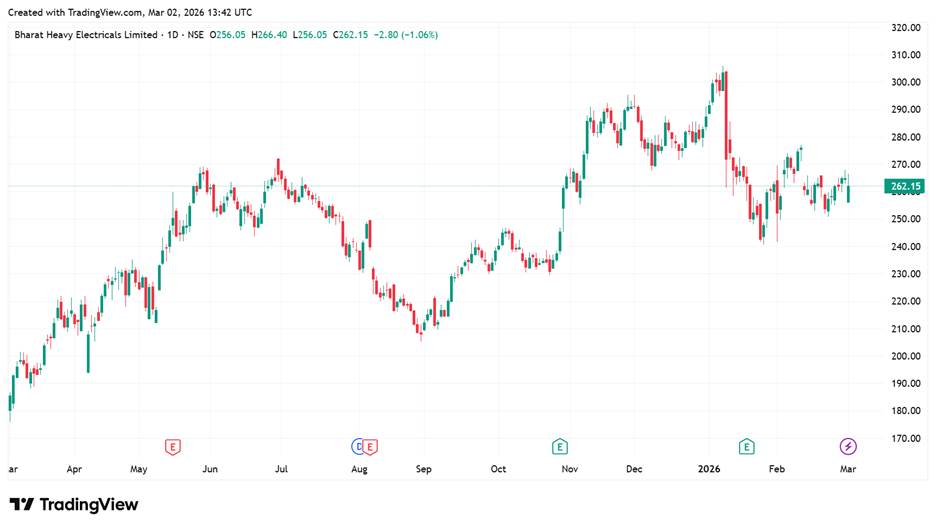
#3 BHEL’s 50-year legacy: Powering 14 nuclear units since 1970
BHEL has been part of India’s nuclear power story. Its role has evolved alongside the country’s three-stage nuclear programme, and over time, it has built a meaningful presence in the domestic ecosystem.
As of FY25, BHEL contributed to nearly 56% of India’s installed nuclear power capacity on the secondary side, reflecting the depth of its involvement in turbine and generator systems across operating plants. BHEL is India’s only indigenous supplier of nuclear turbine-generator sets.
It supports all three stages of the nuclear programme and manufactures key parts required for nuclear power plants. It remains the sole domestic manufacturer of nuclear steam turbines and generators. This domestic capability becomes particularly relevant in a sector where access to technology and supply chain security matter as much as execution.
Over the years, the company has supplied 45 nuclear steam generators, the highest cumulative number delivered by any manufacturer in India so far. The 45th unit was supplied to the GHAVP nuclear power plant in FY25, adding to its operating track record.
The EPC evolution: Leading integrated solutions for turbine islands
BHEL’s installed base today spans 14 utility-scale nuclear units commissioned since inception, aggregating 4,740 megawatts of capacity. It provides equipment across both the primary and secondary islands of nuclear plants and has supported reactor configurations of 220 MWe, 540 MWe, and 700 MWe.
This range has allowed it to remain aligned with the progression of India’s pressurised heavy water reactor (PHWR) programme. Beyond conventional PHWR deployments, BHEL has also participated in advanced reactor development. It developed the secondary-side steam cycle for the Advanced Heavy Water Reactor programme and has built EPC capabilities for turbine generator islands.
This expands its role from being only an equipment manufacturer to acting as an integrated solution provider for the turbine island portion of nuclear plants. At present, BHEL is executing EPC contracts for turbine island packages across six nuclear units at Anu Vidyut Pariyojan and Kaiga Atomic Power Plants.
BHEL Q3FY26: Profit surges 190% on operational leverage
BHEL’s financials have improved in the recent quarter as well. Revenue rose to ₹8,473 crore in Q3FY26 from ₹7,277 crore in the year ago period. Operating margin expanded 200 bps to 6%, while net profit rose to ₹390 crore from ₹135 crore in Q3FY25.
Execution risk vs. Valuation guardrails
KSB’s return ratios, including Return on Capital Employed (RoCE) and Return on Equity (RoE), are strong relative to peers. BHEL and ISGEC, whose businesses are capital-intensive, have poor return ratios. Valuation-wise, all three companies are trading below the historical median, while at a premium to industry multiples.
| Valuation Comparison (X) | |||||
| Company | Current P/E | 5Y Median P/E | Industry P/E | RoCE (%) | RoE (%) |
| BHEL | 112 | 144.6 | 44.2 | 4.9 | 2.1 |
| ISGEC | 19.6 | 26.9 | 15.5 | 14.8 | 9.4 |
| KSB | 44.7 | 46.0 | 36.6 | 24.5 | 18.3 |
India’s nuclear push opens a long runway for equipment suppliers, but execution will determine the outcomes. KSB offers stronger return ratios and recurring visibility, while BHEL is already a dominant player. ISGEC, on the other hand, is just starting out. The opportunity is real, though valuations leave limited room for operational missteps. Keep these on your watchlist to track the progress of their execution.
Disclaimer
Note: Throughout this article, we have relied on data from http://www.Screener.in and the company’s investor presentation. Only in cases where the data was unavailable have we used an alternative, widely used, and accepted source of information.
The purpose of this article is only to share interesting charts, data points, and thought-provoking opinions. It is NOT a recommendation. If you wish to consider an investment, you are strongly advised to consult your advisor. This article is strictly for educational purposes only.
About the Author: Madhvendra has been deeply immersed in the equity markets for over seven years, combining his passion for investing with his expertise in financial writing. With a knack for simplifying complex concepts, he enjoys sharing his honest perspectives on startups, listed Indian companies, and macroeconomic trends.
A dedicated reader and storyteller, Madhvendra thrives on uncovering insights that inspire his audience to deepen their understanding of the financial world.
Disclosure: The writer and his dependents do not hold the stocks discussed in this article.
The website managers, its employee(s), and contributors/writers/authors of articles have or may have an outstanding buy or sell position or holding in the securities, options on securities or other related investments of issuers and/or companies discussed therein. The articles’ content and data interpretation are solely the personal views of the contributors/ writers/authors. Investors must make their own investment decisions based on their specific objectives, resources, and only after consulting such independent advisors as may be necessary.