



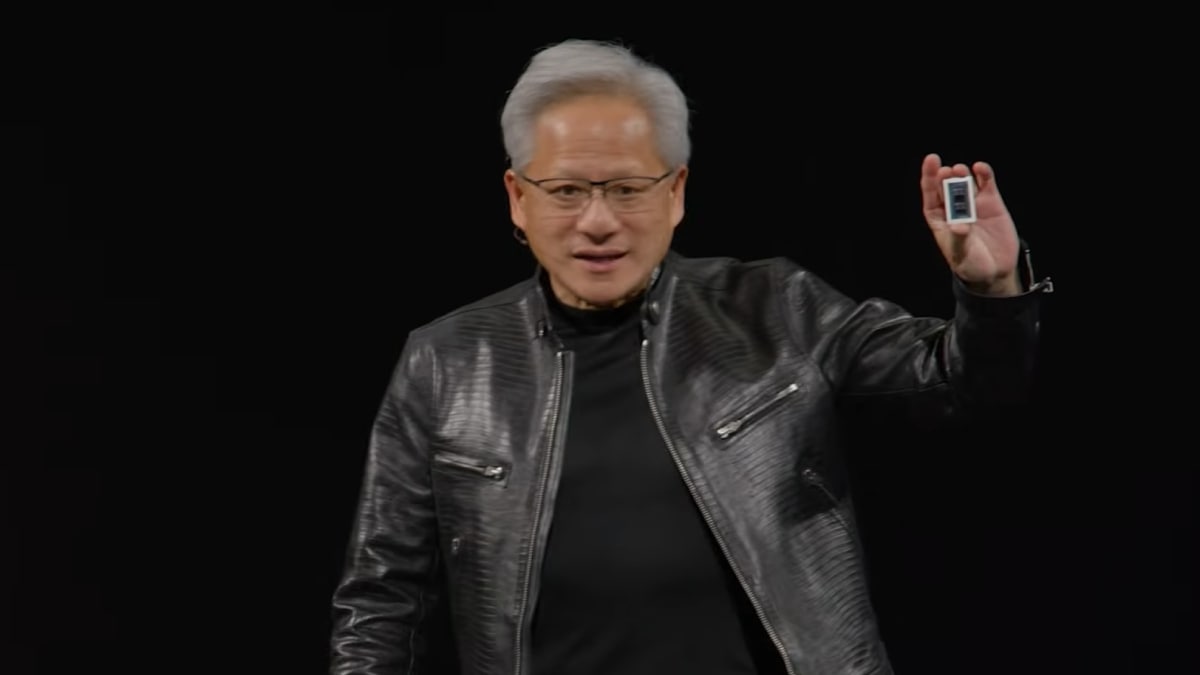
Nvidia has played its next masterstroke amid riding high on the AI wave – it released its first CPU chips for AI laptops. While its GPU chips have already ruled the world, Nvidia’s absence from the CPU market has piqued the world’s interest. Jensen Huang, the company’s CEO, took to the stage at Computex 2026 to unveil the Nvidia RTX Spark superchip, heralding it as the beginning of an era of future AI PCs.
Spark isn’t just a traditional CPU chip with a beefed-up NPU, like what Intel and AMD do. Instead, this chip acts as a platform for agentic AI to thrive.
It is crucial to understand the relevance of this chip – PCs equipped with these Nvidia Spark chips will be able to act on your behalf, i.e., reading files, conducting research, managing tasks, and operating as a persistent teammate rather than a reactive tool.
Unlike traditional laptops and AI PCs that have focused on accelerating local inference for chatbots, image generation, or video editing, Nvidia’s approach delivers hardware and software optimised for advanced autonomous agents that can run locally around the clock.
Let’s talk tech about Nvidia RTX Spark for a while
For those concerned about the technical abilities of the chip, here’s a quick rundown:
The RTX Spark is a Grace Blackwell superchip integrating CPU and GPU capabilities:
– Up to 1 petaflop of AI performance (in FP4 precision).
– Up to 128GB of unified system memory (coherent across CPU and GPU via high-bandwidth NVLink-C2C).
– Full NVIDIA CUDA, Tensor Cores (5th gen), RT Cores, and the RTX ecosystem for graphics, AI acceleration, and developer tools.
– Designed for slim Windows laptops (as thin as 14mm, under 3 lbs for the lightest models) with all-day battery life, plus compact desktops.
Nvidia says that this hardware can run 200 billion parameter AI models with large context windows, allowing for sophisticated agents without constant cloud dependency.
Deeper integration with Windows:
The RTX Spark is well-tuned for Windows PCs, and hence, Nvidia promises:
– Better integration with Windows, including new security primitives for containing agents.
– NVIDIA OpenShell and tools like OpenClaw/NemoClaw for building, running, and securing autonomous agents that interact safely with your files, apps, and context.
– Always-on operation that’s private (data stays on-device) and, most importantly, free after purchase (no per-token cloud fees).
Major OEMs are on board with Nvidia’s plan, including Asus, Dell, HP, Lenovo, Microsoft Surface, and MSI, with most of them launching their first model by fall 2026.
So why is Nvidia’s RTX Spark CPU chip the next big thing?
The answer is rather simple – Agentic AI. More accurately, the rise in adoption of agentic AI in everyday life.
Ever since OpenClaw rolled into the scene, the AI community has been openly embracing agentic AI. Agents reason, plan, use tools, and execute multi-step workflows. Some examples include an agent that reviews your documents, researches options, drafts reports, schedules meetings, or automates repetitive digital tasks, all while understanding your personal context and preferences.
Running these locally on powerful hardware offers clear advantages:
– Privacy and security: Sensitive data never leaves your device.
– Reliability and speed: No latency or internet dependency for core tasks.
– Cost efficiency: No ongoing API bills for heavy usage.
– Always available: Agents can work in the background 24/7.
And note that Nvidia isn’t the only one making strides in this space. AMD has its own ‘Agent Computers’ concept, while the broader industry is pushing local AI. Nvidia’s full-stack advantage (hardware + software + massive developer ecosystem via CUDA), however, gives it a strong lead in delivering high-performance and developer-friendly agent platforms today, thereby making it a preferable choice for AI fanatics.
For creators, developers, researchers, and power users, this Nvidia RTX Spark could dramatically boost productivity. You will have personal AI that handles coding assistance, data analysis, content creation, or even your digital life management while you focus on high-value work.
Will this mark the end of Apple’s MacBook dominance
At the moment, Apple’s M4/M5 powered Macs are enjoying tremendous success in China, the US and other markets, where the Agentic AI fever is at its all-time high. The advanced architecture of the Apple Silicon chips, coupled with incredibly powerful NPUs and a highly power-efficient setup, allows the Macs to run Agentic AI models in a greater way than any equivalent Windows PC.
While Nvidia’s RTX Spark chip promises a greater stride in the Agentic AI PC, there are some initial barriers for the Windows-side universe to tackle.
Price: These won’t be budget machines. Hence, you can expect these laptops to command a premium, similar to high-end RTX gaming/creator laptops or workstations. Also consider the added cost of substantial unified memory, which is already seeing a huge demand amid the chip shortage.
Battery and thermals: Promising up to 1 petaflop of AI performance is impressive, but sustaining heavy agent workloads on a slim laptop will be a test of efficiency claims.
Software maturity: Hardware is here, but the software isn’t. Truly reliable, general-purpose personal agents, that just work across multiple apps, are still evolving. Early commercial versions will likely excel at highly specific professional workflows like coding, research, and creative tasks. However, it will be a while before universal assistants start getting better and more capable. As of today, only those willing to get their hands dirty with coding in the modern agentic AI scene can get value out of it.
Competition from cloud: A secondary business model is pushing cloud-based agentic AI solutions for yearning customers, which could end up reducing end-user cost and making it more accessible. Hence, chipmakers like Qualcomm, Intel, AMD, and Apple, who already rely on the separate CPU-GPU-NPU-based architecture (with their own silicon and ecosystems), are also investing in on-device AI platforms. Hence, Nvidia isn’t going to get it easy for the time being.
Conclusion
For enthusiasts, professionals, and developers, Nvidia’s RTX Spark-powered ‘Agent PCs’ bring forward a momentum shift, enabling computers that actively work for you rather than just responding to commands. If implemented cleverly, these chips could enable a major evolution in the way we use our computers.
If you love to ‘AI-fy’ your life and agentic AI catches your curiosity, this is clearly a space to watch.