



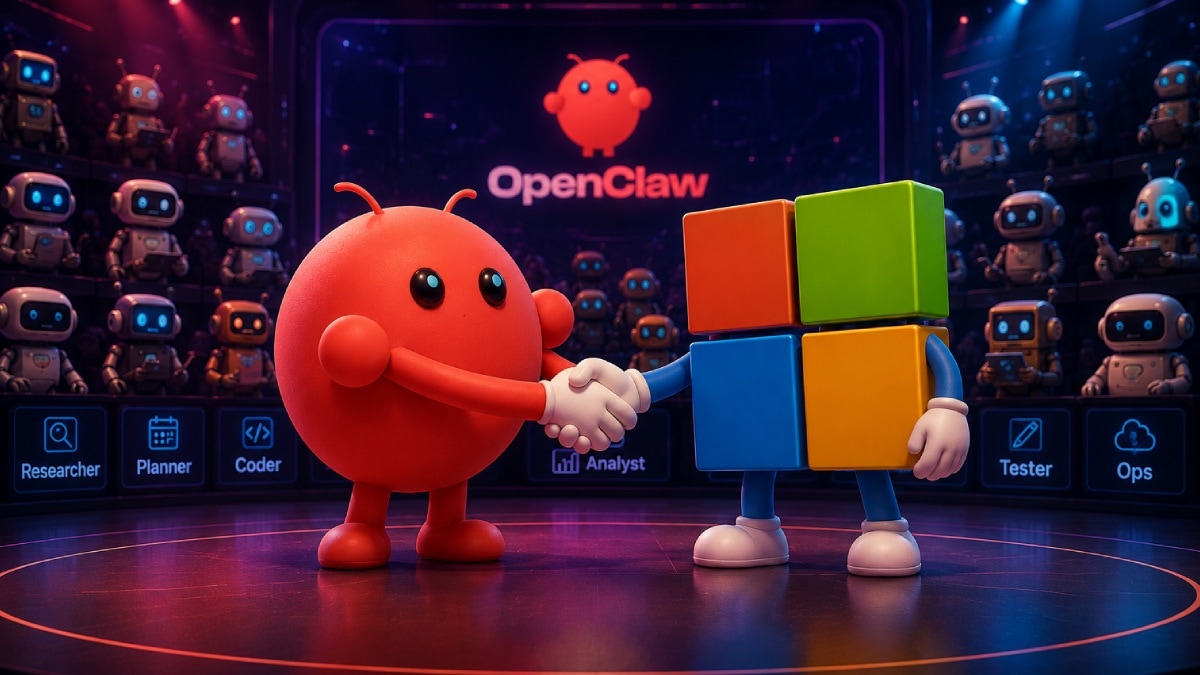
At the Microsoft Build 2026 event, the company unveiled Scout as its first agentic AI offering — an always-on, proactive personal work agent that lives inside Microsoft 365 apps like Teams, Outlook, OneDrive, and SharePoint. While the world immediately drew parallels to Peter Steinberger’s OpenClaw, on which it is based, there was a larger question looming on the pathways of the internet forum – why did Microsoft choose OpenClaw rather than build something of its own, in the usual Microsoft way? Why did Microsoft choose to rely on open-source software for what it believes is its next big thing?
While Microsoft remains mum on that front, we decided to dig in deep and analyse what exactly the Redmond giant could have in mind for its next chapter in the AI space.
But first, let’s circle back to OpenClaw – the viral AI tool that made the tech world sit up and take notice.
The OpenClaw phenomenon
Created by Peter Steinberger, OpenClaw emerged as a breakout open-source project in early 2026. It quickly amassed hundreds of thousands of GitHub stars, tempting coders and AI enthusiasts to play and experiment. Described as “the AI that actually does things,” it functions as a self-hosted, persistent agent that can run locally or on private servers. It connects to messaging platforms, executes multi-step workflows, controls apps, browses, reads/writes files, and operates autonomously with minimal prompting.
This is what the world has been seeking ever since ChatGPT arrived on the scene in late 2022.
OpenClaw’s appeal lies in its design that supports local or cloud models, a plugin/skill system, and true autonomy. Unlike chat-based tools that wait for input, OpenClaw agents run in the background on a heartbeat cycle — checking tasks, reasoning, acting, and looping. This made it a sensation among developers and early adopters seeking “AI coworkers” that could handle real digital labour.
However, its power came with risks. Early versions raised security eyebrows in enterprise environments due to broad access, and the potential for unintended actions, leading some to initially approach it cautiously.
Eventually, OpenAI acquired the platform and hired its creator, thus marking a major milestone in its story.
So why did Microsoft choose to base its Scout on OpenClaw?
Microsoft’s decision to build Scout on OpenClaw could be down to several factors:
1. OpenClaw’s momentum
It was OpenClaw that demonstrated what true agentic behaviour feels like at scale. Microsoft recognised that the raw orchestration layer, i.e., reasoning loops, tool use, long-running persistence, and multi-step planning, was already tested by a massive developer community. Replicating this from zero for something proprietary would take time and thus delay its participation in the delivery timeline.
By adopting it, though, Microsoft could focus on enterprise integration, grounded in Microsoft 365 data and WorkIQ (its intelligence layer) rather than foundational agent plumbing.
2. Open-source > reinvention
Microsoft explicitly stated that Scout reflects “our commitment to building with the community.” Instead of forking and diverging, the company is contributing directly upstream — policy conformance capabilities for security and compliance validation. Organisations running OpenClaw can now better audit and verify their environments, while Microsoft benefits from community improvements.
This helps it in positioning Scout as part of a broader ecosystem rather than a walled garden, appealing to developers who value inspectability and extensibility.
3. Enterprise-grade agent to evolve faster
The agent era demands rapid iteration. OpenClaw provided a flexible, high-velocity base. Microsoft layered on:
– Deep Microsoft 365 grounding and context awareness.
– Hybrid cloud/desktop/web operation.
Microsoft says that Scout runs in controlled environments where the agent framework doesn’t directly hold secrets or have unfettered access to corporate data.
4. Developer and platform
Basing it on OpenClaw gives Scout instant credibility in the agent developer community. It also advances Microsoft’s broader Windows and Azure agent ambitions.
At Build 2026, Microsoft showcased OpenClaw on Windows with new security runtimes (including integration with Nvidia’s tools). Scout serves as an example of what’s possible, encouraging developers to build agents on Microsoft’s platform.
5. Competitive reality
Google and others are pursuing similar agent strategies, as OpenClaw’s influence was undeniable across the industry. By embracing it rather than competing with it, Microsoft avoids being seen as behind the curve in the AI race and instead leads in making the technology safe and scalable for business. It also hedges against model and framework fragmentation, as developers can more easily port or extend skills across ecosystems.
6. Security and trust
Microsoft had previously flagged risks with unrestricted OpenClaw deployments. The move to deep integration shows mature confidence through technical controls:
– The execution is sandboxed.
– Policy enforcement is at the platform level.
– Upstream contributions benefit the entire community, rather than introducing another competitor.
– Verifiable compliance answers for auditors.
Privacy remains a valid concern. Constant access to emails, messages, and files requires strong governance, but Microsoft’s approach aims to make autonomous AI agents auditable rather than opaque.
Will Microsoft lead the charge for autonomous AI agents
By choosing OpenClaw, Microsoft is signalling that top agent platforms will be collaborative and not purely proprietary in the future. Scout isn’t just a product here — it is more of a bridge between the chaos-driven open-source agents and the structured requirements of enterprise work.