



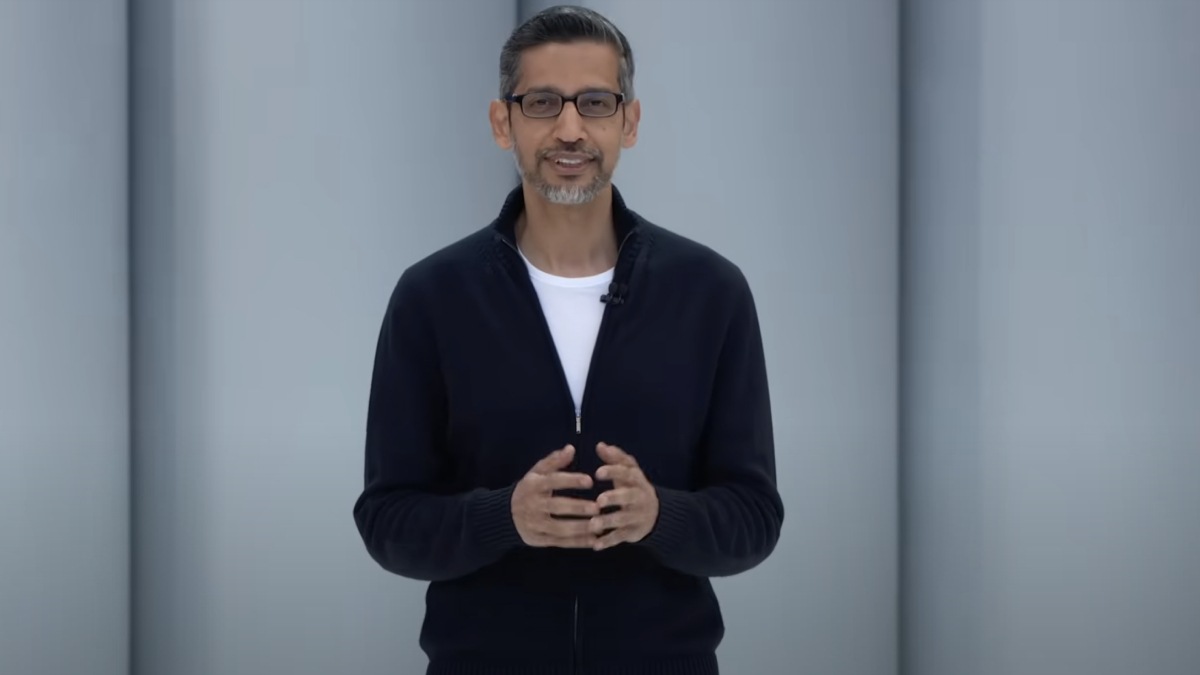
The AI race is now a matter of global attention, and Google’s Sundar Pichai has weighed in with his views on how this technology should be developed. The CEO of one of the world’s largest software companies has urged the Americans to spearhead the development of AI “boldly and responsibly”, as he stated in a short clip of the 60 Minutes interview. The comment comes on the occasion of the USA celebrating its 250th anniversary of independence.
Addressing the interviewer, Pichai described AI as “the most profound technology yet”, drawing parallels to America’s historic role as an innovator. “Once again, America must take the lead and develop it boldly and responsibly so every American benefits,” he stressed in the segment.
Pichai believes in American ingenuity for AI development
Pichai expressed a deep personal optimism about AI’s future, stating, “I’m optimistic, not because I believe in technology, but because I believe in people, and the sheer power of American ingenuity.”
He described the positive impact of modern AI-driven technology through a personal anecdote involving his father, a retired engineer in his 80s. “I’ll never forget the awe on his face during his first ride in a safe self-driving car on the streets of San Francisco. It was magical,” Pichai recalled.
The Google CEO, who is spearheading the development of AI with the company’s Gemini models, highlighted several practical ways AI is already transforming society. He stated that researchers are using AI to accelerate the discovery of life-saving cures, while teachers are leveraging the technology to create customised lesson plans for students. Even firefighters are employing AI tools to track and manage wildfires with greater precision and speed in the US.
AI has challenges, acknowledges Pichai
Although being optimistic on AI, Pichai did not shy away from the hurdles facing the development of AI in the years to come. “Of course, with any technology, there are challenges to work through — from investing and workforce training and putting right regulations in place,” he noted.
The US is presently navigating rapid AI advancement amid intense global competition, especially with China, with concerns over job displacement, ethical issues, and the need for balanced regulation.
Google’s Gemma 4 on extending AI to grassroots levels
Prior to Pichai’s interview on 60 Minutes, Google DeepMind released Gemma 4 — the most capable open-source AI model family from Google made so far, under a fully permissive Apache 2.0 license, designed for researchers and developers to play with. The Gemma lineup includes four models, ranging from compact edge-optimised variants (E2B and E4B) to powerful 31B-parameter dense and 26B MoE variants. All these models are purpose-built for advanced reasoning, agentic workflows, multi-step planning, and multimodal inputs (text, audio, and images) with context windows up to 256K tokens. The models run efficiently on laptops, phones, and edge hardware while supporting over 140 languages and function calling, making cutting-edge AI accessible for developers, enterprises, and researchers without commercial restrictions.
On the other hand, Google’s advancements in quantum computing have led the infrastructure industry to sit up and take note. The company announced plans to complete its own migration to post-quantum cryptography (PQC) by 2029, thus moving beyond standard encryption. New research from Google Quantum AI revealed that future cryptographically relevant quantum computers could break widely used elliptic curve cryptography, including the systems protecting Bitcoin, Ethereum, and most digital signatures, with far fewer resources than previously estimated. The company stressed that malicious actors are already conducting “store now, decrypt later” attacks, harvesting encrypted data today to take advantage of future quantum decryption capabilities. Google is urging governments, tech firms, and cryptocurrency platforms to accelerate PQC adoption to safeguard sensitive data, financial systems, and digital infrastructure before the quantum era fully arrives.