



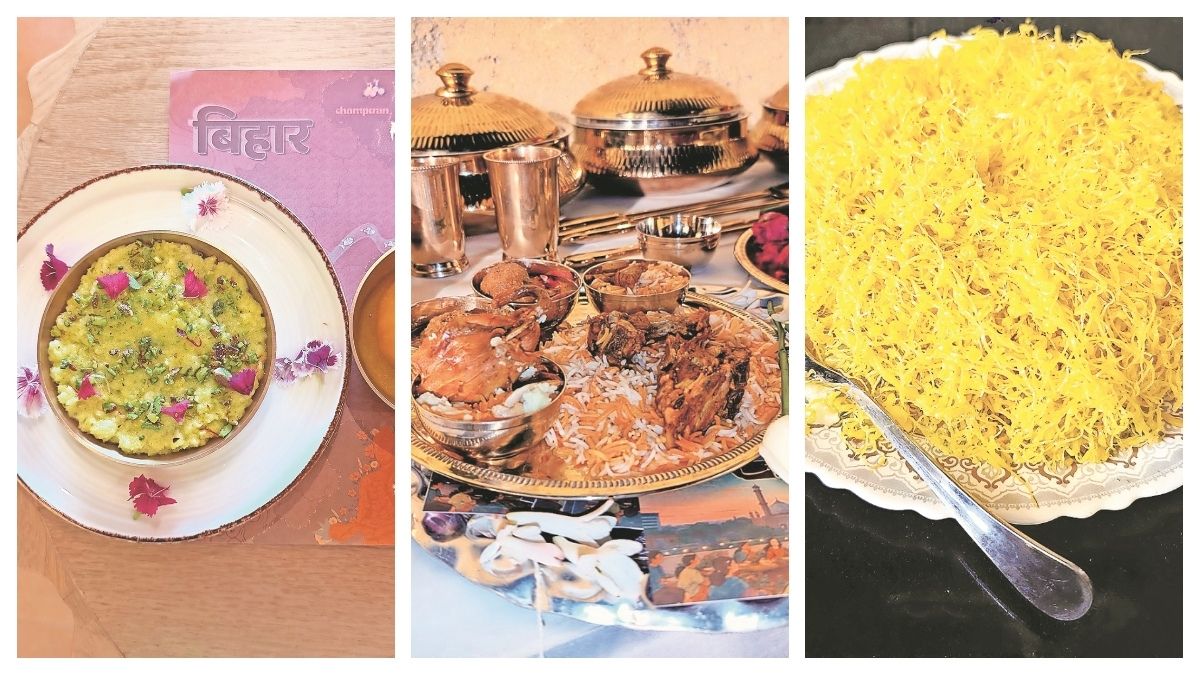
When Puja Sahu introduced ande ka halwa, a rich, velvety dessert made with eggs, ghee, khoya and sugar, to her restaurant menu, the idea came not through fine-dining establishments or culinary schools, but through personal memory. At her childhood home in Muzaffarpur, Bihar, the dessert travelled across generations — through kitchen conversations, festive gatherings and cravings that returned with familiarity.
“For my mother, the dish was comfort; for me, it became an inheritance,” says Sahu, who helped reshape perceptions of Bihari cuisine after opening The Potbelly Bihari Kitchen in Delhi in 2011 and placing ande ka halwa on the menu.
“The dessert carries traces of Mughal influence, slow cooking, richness of ghee and khoya, and the use of eggs in a sweet preparation,” Sahu says.
“In Bihar, where communities and cultures have long lived side by side, food often absorbed influences quietly over time,” says Sahu, whose grandfather wrote Urdu poetry and admired Muslim cooking traditions. “Meat was prepared with care, using techniques learned through cultural exchange rather than rigid boundaries. In that environment, ande ka halwa naturally found a place on the family table,” she recalls.
Sweet meets savoury
This forgotten world of sweet-and-savoury cooking once flourished across Mughal and Awadhi kitchens, where bawarchis delighted in culinary illusion, dishes that looked savoury but tasted sweet, or meat dishes perfumed with saffron, sugar and aromatic spices. In royal kitchens, the boundaries between dessert and main course were often fluid.
“Ande ka halwa, gosht ka halwa and mutanjan were prized food for bawarchis in Awadh and they took pride in tricking gourmet food with dishes that looked like savouries but tasted sweet,” says food historian Pushpesh Pant, whose favourite among all is mutanjan — a sweet-tasting mutton pulao that uses copious quantities of syrup and saffron, strewn with shreds of deeply seasoned yet subtly sweetened meat. “It is seldom encountered nowadays,” he adds.
Pant traces the roots of the dishes to the refinement of post-Mughal Awadhi cuisine, where cooks experimented fearlessly with flavour and texture. “Awadhi cuisine reached its acme in post-Mughal Nawabi period,” says the Delhi-based international relations expert.
Meanwhile, holding important archives of this royal culinary imagination are several books written by food historians as well as culinary custodians.
Among them is The Mughal Feast: Recipes from the Kitchen of Emperor Shah Jahan by food historian Salma Yusuf Husain, a transcreation of the Nuskha-e-Shahjahani, a handwritten Persian manuscript detailing the culinary arts of the Mughal imperial kitchen. The text in the book reveals the inventiveness of Mughal cooks through dishes such as amba pulao — a tangy mango-lamb rice preparation — and andarsa, a sweet made from rice flour and sugar.
Amba pulao balanced the richness of lamb with the sharpness of raw mangoes. Prepared with a fragrant yakhni of onions, ghee, coriander and black peppercorns, the dish used mango pulp to create a sweet-sour broth in which rice was cooked before being layered with meat, almonds, pistachios and raisins, then finished on dum.
Another important culinary archive is Cooking Delights of the Maharajas: Exotic Dishes from the Princely House of Sailana. The 1982 cookbook compiled by Maharaja Digvijaya Singh of Sailana, in Ratlam district of Madhya Pradesh, documented recipes from princely households across central India.
“It is best known for featuring several rich non-vegetarian royal recipes, more than 300, including unusual sweet-and-meat combinations inspired by princely kitchens. The cookbook draws from the culinary traditions of the Sailana royal family and other princely states. While the book is especially famous for elaborate game meats, kebabs, qormas and Mughlai-style dishes, it also includes recipes where meat is combined with dry fruits, saffron, cream, honey or sweet spices — a hallmark of royal Indo-Persian cuisine. Some princely cuisines used mildly sweet gravies or meat preparations with almonds, raisins, apricots and khoya,” says Pant.
Another important text, Bazm-e-Aakhir, a famous 19th-century Urdu book written by Munshi Faizuddin Dehlvi, chronicles the fading Mughal court of Bahadur Shah Zafar and vividly describes elaborate dastarkhwan where sweetness and meat coexisted effortlessly in dishes such as mutanjan, fragrant qormas and stuffed poultry. More cultural record than cookbook, the work captures courtly etiquette, festivals and food traditions inside the Red Fort, reflecting Persian, Central Asian and Indo-Islamic culinary influences.
“The distinction between sweet and savoury was often fluid compared to modern Indian cuisine,” Pant notes.
Meanwhile, south India, too, is home to several non-vegetarian desserts such as the muttamala, which translates to ‘egg garland’, a signature sweet dish of the Moplah (Malabar) cuisine in Kerala. It is made by drizzling beaten egg yolks into boiling sugar syrup to create intricate golden strands. Often described as the zero-waste sweet that highlights Portuguese culinary influence, it was brought to the Malabar coast by Portuguese explorers and is closely related to the Portuguese dessert fio de ovos.
Reliving the recipes
Today, some of the nearly forgotten flavours are returning through heritage dining experiences and culinary revivalists. One such dish is gosht ka halwa (meat halwa) made by slow-cooking finely minced meat with milk, ghee, sugar, and spices until it achieves the rich, creamy texture of a traditional dessert.
Chef and food historian Osama Jalali revived this rare recipe, which is said to have originated in the royal kitchens of Rampur and Delhi, in his food pop-ups. When Sahu first introduced the dessert at The Potbelly, diners were hesitant. “The very name sounded unfamiliar,” she says. “But for me, the dessert represented Bihar’s layered identity and the stories hidden inside home kitchens.”
Meanwhile, Abu Sufiyan Khan, founder of heritage initiatives Purani Dilli Walo Ki Baatein and Tales of City, has been curating ‘Dastarkhwan-e-Jahaanuma’ rooftop gatherings during Ramazan in the Jama Masjid area of old Delhi.
“At these gatherings, we serve heirloom dishes such as haleem, shabdegh, pasande and mutanjan. For many Indian Muslims, mutanjan is traditionally the first dish to break the fast. It gives a sweet and salty flavour. This dish is made especially during this time and is known for its fragrant rice cooked with ghee, sugar, saffron, cardamom, and studded with nuts. I use bater ka gosht (quail meat) as a delicacy. The term originates from the Perso-Arabic word ‘mutajjan’, which historically means ‘fried in a pan’,” Khan tells FE.