



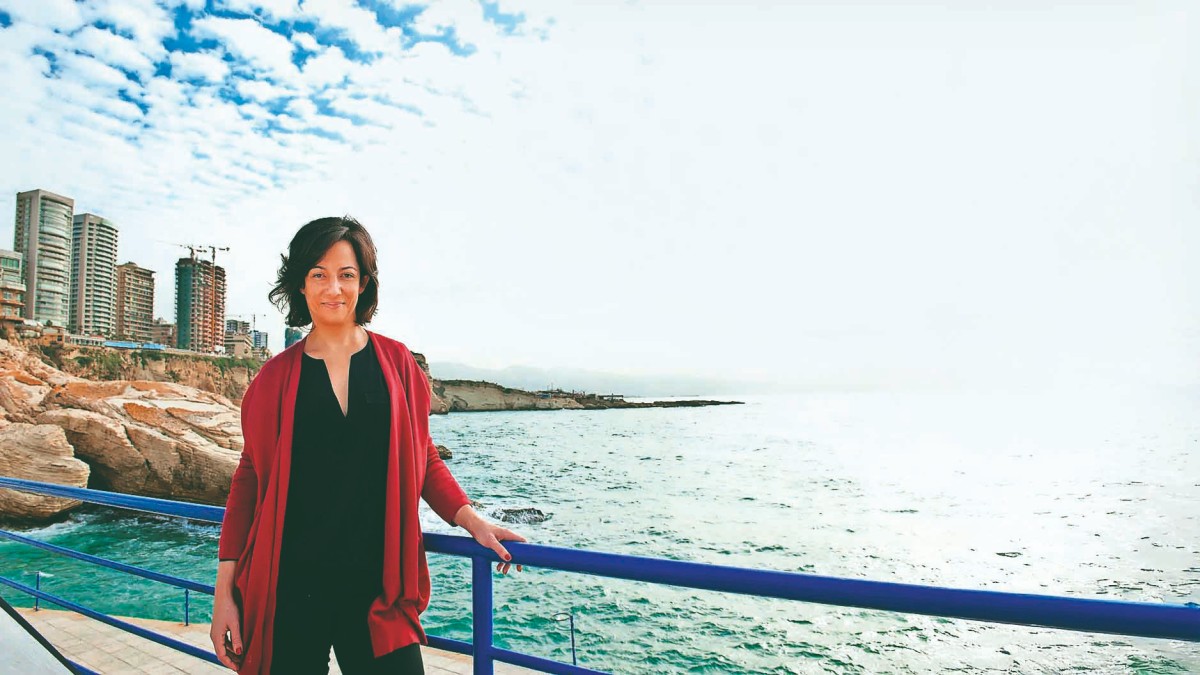
Based in Beirut, the capital of Lebanon, Kim Ghattas has been a keen observer of the Middle East. Having grown up in the times of civil war in Lebanon, Ghattas is a member of the board of trustees of the American University in Beirut and serves on the board of directors of Arab Reporters for Investigative Journalism. The author of Black Wave: Saudi Arabia, Iran and the Forty Year Rivalry that Unraveled Culture, Religion, and Collective Memory in the Middle East (2020), which provides a deep insight into the roots of instability in the Middle East, and The Secretary: A Journey with Hillary Clinton from Beirut to the Heart of American Power (2013), Ghattas is watching the situation unfolding in the region with keen interest. A speaker at the just-concluded Jaipur Literature Festival, Ghattas talks with Faizal Khan about post-war Palestine, the chances of success of US President Donald Trump’s peace plan for Gaza and the protests in Iran. Edited excerpts:
How fragile is peace in the Middle East in the aftermath of the war in Gaza, with the second phase of US President Donald Trump’s peace plan kicking off in January this year?
I’m not sure I would call it a peace plan. I think I would call it more of an American initiative. For a ceasefire, that could be long lasting. I’ve written before about how Trump can’t just manifest peace like a mantra. He has to do the work on the ground. I think at the moment, the vision for a Board of Peace and administrative council for Gaza is a little bit disconnected from the reality on the ground in Gaza, where the reconstruction challenges are huge. We don’t know where the money will come from, where Hamas is still armed, where almost all two million Palestinians in Gaza are displaced. Where, you know, the Israelis are still very active militarily. So that is not really peace. But it is still better than full-on war. So we should acknowledge that. But we should also push against some of the ideas that President Trump is putting forward.
What is the legitimacy of people like former British PM Tony Blair, who famously lied about Saddam Hussein having weapons of mass destruction before the 2003 Iraq War? How do the Middle East and the Arab countries view his appointment?
Arab countries were very much opposed to nominating Tony Blair as executive director of the Board of Peace in Gaza. Instead, we have Nickolay Mladenov, a former Bulgarian defence minister. But President Trump insists on having Blair as part of this set-up. I think Blair’s reputation in the Middle East is pretty short. People will be very wary of his ideas for Gaza. So it doesn’t instil a lot of confidence that he is part of that board. But again, I am a pragmatist, and I think you have to work with what you have.
What is the sentiment of ordinary people and civil society in the Arab world and the Middle East compared to the governments in the region which are supporting Trump’s peace plan?
I would also qualify the idea that all Arab governments are supporting the plan. I think some of them have decided that they have to work with Trump to influence what he’s trying to do. But when Trump proposed a Gaza Riviera, Arab countries were against it. I can’t speak for Palestinians in Gaza, but I think Palestinians in Gaza are relieved, at least, that the fighting and the war and the shelling has stopped. Israel’s not letting enough aid come in. They banned a lot of NGOs from working in Gaza. So the situation for Palestinians in Gaza is only really barely marginally better.
What about the relevance and legitimacy of Hamas as well as the Palestinian Authority in post-war Gaza?
Well, Israel has made it very clear that Hamas can have no role in Gaza. But the reality is that Hamas does have a role because they still have arms and they can still set the tone for what is happening. They’re still laying down the law. They’re arresting people, detaining people who speak out against them. There is a lot of anger in Gaza about what Hamas has done. And they were not there for the Palestinian people who suffered. They had their own tunnels, while people were living under direct shelling. On the other hand, the Palestinian issue and the Israeli occupation of Palestinian land is one of the great injustices of the 20th century, and it needs to be resolved somehow.
How do you think the protests and crackdown in Iran is going to impact the Gaza peace process?
I look at those two separately at the moment. Particularly because Iranians are tired of being used by their leaders to help the Islamic Republic’s designs in the region. I think what the Iranians really want is a government that takes care of them. So we’ve seen now several iterations of these protests in 2009 and in 2022. I think Iranians have had enough of this kind of governance or lack of governance. But they haven’t been able yet to really make a breakthrough to bring down this regime. I don’t think they can really do it on their own. On the other hand, regime change from the outside is never a good idea. But you could see a combination of outside pressure and internal demonstrations that eventually leads the Iranian regime to decide either it will make some changes and transform itself or maybe step aside and transform into a secular dictatorship. We could see much more turmoil in the coming months.
Has Hezbollah in Lebanon and other groups in the region opposed to Israel been weakened in the last two years of war? Or are they just lying low?
Both. They’re very weakened and lying low to see whether they can survive this phase and rebuild, or not. Depends a lot on what’s going to happen in Iran. And how the Lebanese government functions and how much they can impose themselves on the national territory.
What is your next book about?
It’s coming out in October this year. It’s called the Best Kind of American: A Story of Murder, War, And America’s Undoing in the Middle East. It’s a murder investigation into the murder of an American in Lebanon in 1984 at a moment when the Iranian Revolution in 1979 collides with the Israeli invasion of Lebanon in 1982 and creates four decades of Iran-US and Israel enmity, and wars, which continues to this day.
Faizal Khan is a freelancer