



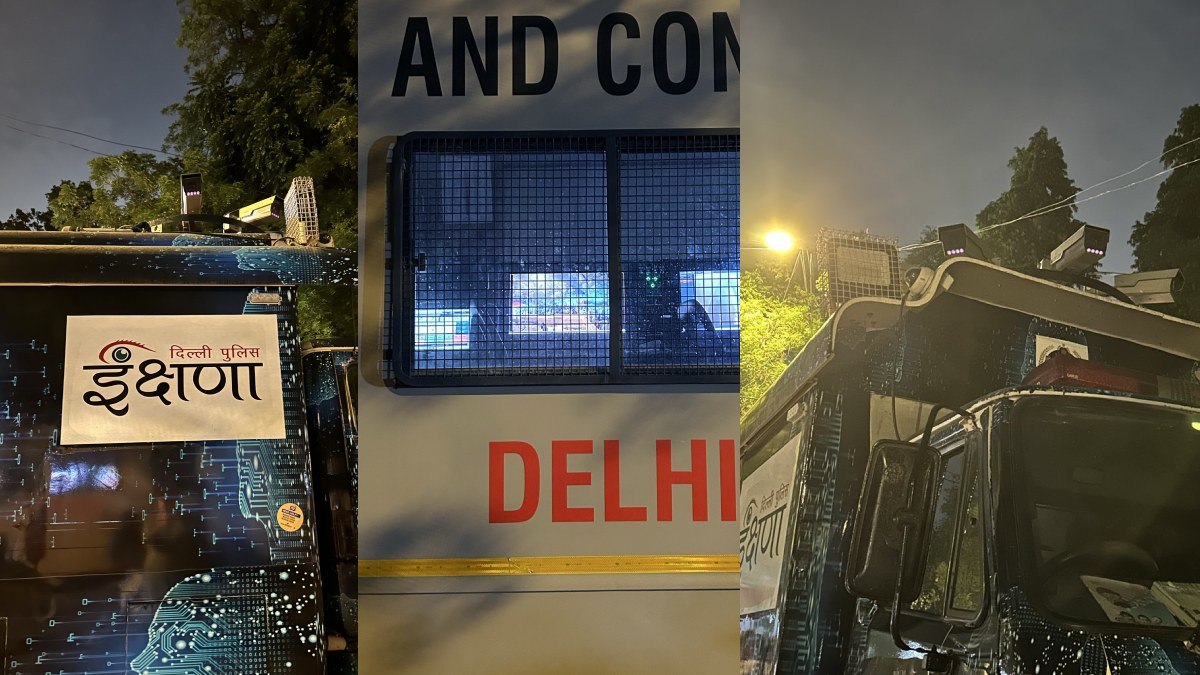
Two Delhi Police surveillance vehicles have been stationed outside Kerala House, close to the Jantar Mantar protest site, according to a report in The Indian Express. One is the force’s Mobile Command and Control Vehicle, which streams live CCTV to officers on site. The other is Ikshana, a camera van whose feeds are processed by facial recognition software.
Video circulating on social media over the past two days appears to show the system in operation: officers seated before monitors as software outlines faces in the crowd and checks them against a police database. Financial Express has not independently verified the clips.
A senior Delhi Police official told Indian Express that they are using live facial recognition on protesters at the site. The officer said it was being done to identify criminals. “We have a large database of criminals, with their pictures. So, we run facial recognition on the footage that is received from the various CCTVs in the area, to see if it flags any face the software matches with someone on our criminal database,” the officer told Indian Express, requesting anonymity.
What Ikshana is
Ikshana is a mobile CCTV unit that Delhi Police has deployed at Jantar Mantar before. It was in use at the same location during the wrestlers’ protest in May 2023, when the force described it as a live surveillance vehicle carrying eight fixed cameras arranged to cover the full circle around it, staffed by trained CCTV operators.
The van does not work alone. Its footage, and that of the larger command vehicle alongside it, is fed into recognition software that converts faces captured on video into numerical templates and compares them against images already held by the police.
The threshold at which the system declares a match is the part of this technology with the clearest public record — and it did not come from a police announcement.
Delhi Police disclosed it only after the Internet Freedom Foundation pursued a series of RTI requests, and after the Central Information Commission directed the force to answer them properly. The disclosure, first reported in 2022, was that the police treat any match above 80 per cent similarity as a positive result.
The number is more slippery than it sounds. IFF’s Anushka Jain, who works on surveillance at the organisation, has argued that the figure describes how similar two photographs are, not how often the software is correct — so treating an 80 per cent match as an identification builds a substantial margin of error into the result.
The second disclosure drew less attention and matters more. Matches scoring below the threshold are not discarded as negatives. Delhi Police classified them as false positives, subject to further verification against other corroborative evidence — meaning a low-scoring match can still open a line of inquiry into the person it flagged.
Is any of this regulated?
There is no Indian statute written specifically to govern police use of facial recognition. The Digital Personal Data Protection Act, 2023 is the nearest instrument, and it carves out broad exemptions for state agencies.
Surveillance at the site is now before the Delhi High Court. A public interest litigation filed by former JNUSU president Aishe Ghosh alleges that police have filmed protesters continuously from a permanent tower at Jantar Mantar since 20 June, capturing not only protest activity but routine moments — eating, resting, seeking medical help. The petition further alleges that police personnel threatened to send footage of student protesters to their parents, guardians and institutions.
The Solicitor General, appearing for the state, is reported to have characterised the petition as luxury litigation.
What the clips do not show
Some social media users have claimed the system is linked to Aadhaar. There is no official confirmation of any such link, and the circulating videos themselves make no reference to Aadhaar.