



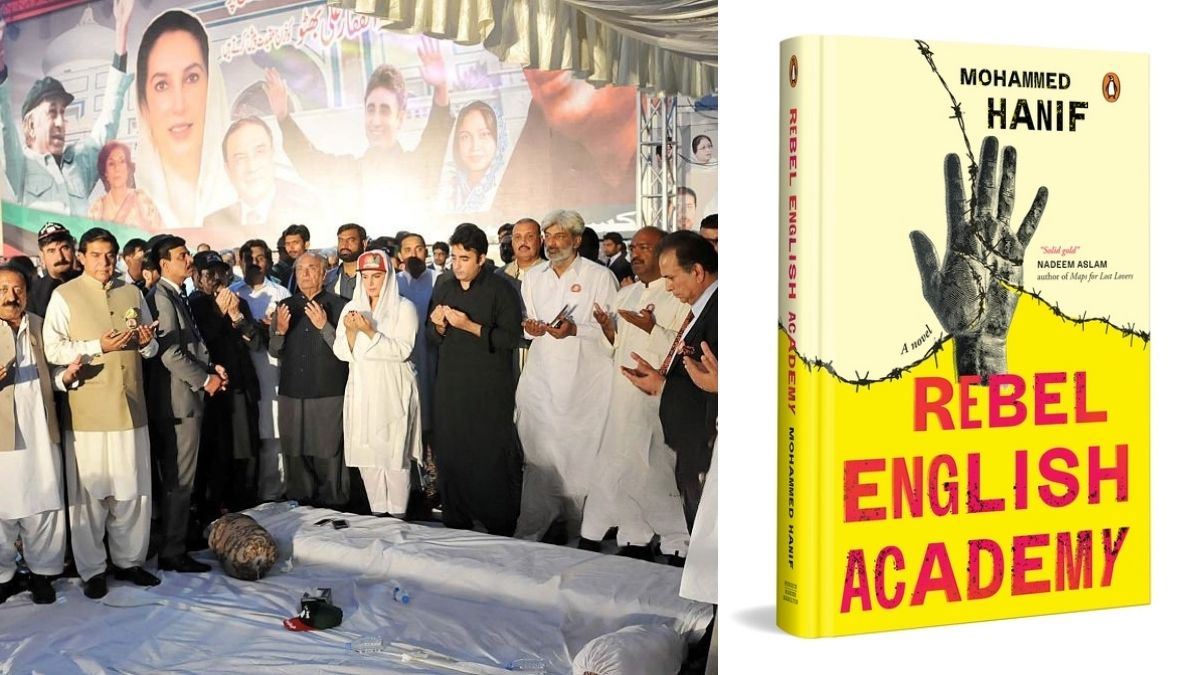
Zulfikar Ali Bhutto is facing execution in a Rawalpindi jail. Captain Gul, an officer in the Army intelligence, is assigned to secure photographs of the deceased’s genitals to establish that he was circumcised—and not a Hindu. Gul fails his assignment, and is shunted off to a place called OK Town.
Thus begins Rebel English Academy, the latest novel by Pakistani writer Mohammed Hanif. The plot moves through prisons, conspiracies and cantonments. These disparate threads converge at a mosque that functions as an English coaching centre.
Anglophone fiction from Pakistan stands apart in the subcontinent for its willingness to confront coups, assassinations and Islamic radicalisation. It does so with candour and comic fervour, and Hanif holds a special place among such Pakistani writers.
The novel revolves around Rebel English Academy, an institution headed by a former mazdoor leader named Sir Baghi. The once-revolutionary Baghi, openly gay, now teaches the imperial language to job aspirants.
The academy is located in the compound of the Gol Mosque, a rounded structure that got its nomenclature because people of the city ‘lack imagination’. The mosque’s maulvi is among the men Baghi has had escapades with.
Of the countless English-speaking centres scattered across the subcontinent, the academy in OK Town may be the most adventurous ever imagined. But if one thinks that Hanif has mocked Islam enough, they don’t yet know the novelist.
Soon after Gul’s arrival in the town, in chaos after the execution, Sabiha Bano takes refuge at the academy. The daughter of dissidents, the fiery Bano has been a student of the academy and now carries a revolver with her.
Theological Farce
A mosque. Two men. A young woman. The stage is set for a theological farce few novelists can manage. “If Allah tells us what to do in the marital bed and in the toilet and what verse to recite before getting on and off a camel, does He say anything about bringing unlicensed guns into His house?”
Allah isn’t spared, nor is His abode.
The characters are eccentric and irreverent; they distrust all ideologies and institutions. Baghi often believed that when you kill someone you kill a bit of yourself, but when you take out someone’s knee, they remember you for life. Years later, a student returns him the lesson.
No one escapes the novelist’s sting. Several male characters are gay, and those who aren’t are riddled with anxiety about their sexual performance.
The morning after Bhutto’s hanging, a crowd gathers around a quack selling ‘Himalayan aphrodisiacs’. Death hangs ‘in the air’, the novelist observes, but “people are still interested in finding aids for their libidos”. It’s comic, but it’s also about a society that places desire among its highest achievable goals, and yet, remains unsatiated.
The most scathing words have been reserved for that hallowed organisation which runs the state and shalt not be named here. Captain Gul is a swaggering sex hero who carries the epithet of ‘piston’ among his military colleagues. He “hopes his name will be whispered in Westminster and Langley, in the ruined palaces of Afghanistan and solitary cells in high-security Indian prisons”.
A former lover shatters his self-image in a chapter titled ‘The Mysteries of the Bermuda Triangle’—no disclosures here what this geography insinuates at. She quietly tells him that the baby she had just aborted wasn’t his, simply because he “doesn’t even know how babies are made”.
Throughout his life Captain Saab has told himself that women find him irresistible largely because he could deliver insights on global politics and human development indices. We learn the truth behind his bedtime tutorials, when she knocks him out: “You gave me statistics about the Bengal famine to divert my attention from the fact that you couldn’t get it up.”
The other derision is aimed at the imperial language. At some point, one begins asking: is it a mosque functioning as an English coaching centre, or the other way? The academy becomes a metaphor for rebellion against a language that has become the sole marker of status in a subcontinent of numerous languages and dialects.
And yet, several of these memorable characters and episodes don’t add up to the whole. The narrative often feels cluttered and chaotic. The threads come loose. A nation trying to survive a political execution only comes alive in flashes. The novel falls short of the craft Hanif had perfected in his previous works. It’s perhaps unjust, but also inevitable to hold a novelist against their previous works. A Case of Exploding Mangoes was a biting, blazing political thriller whose satire never loosened its grip.
Rebel English Academy, nevertheless, remains an important work that deserves recognition. If one marker of a significant novel is the plunge it takes into zones others never knew existed, this is your novel.
It is not the finest novel to emerge from Pakistan, nor even Hanif’s best. At a time when English-language expatriate writers from the subcontinent often turn to curated nostalgia, tailored traumas and family albums, it offers a more honest portrait of South Asia than many polished books.
As it mocks a former Marxist labour leader for being “a chronic petition writer”, punctures the masculinity of army generals, and refuses to genuflect before the mosque, Hanif shows us that history is often understood best when served with satire. After all, laughter is the last asylum for broken societies.
Ashutosh Bhardwaj is an independent writer and journalist
Rebel English Academy
Mohammed Hanif
Penguin Random House
Pp 320, Rs 799