



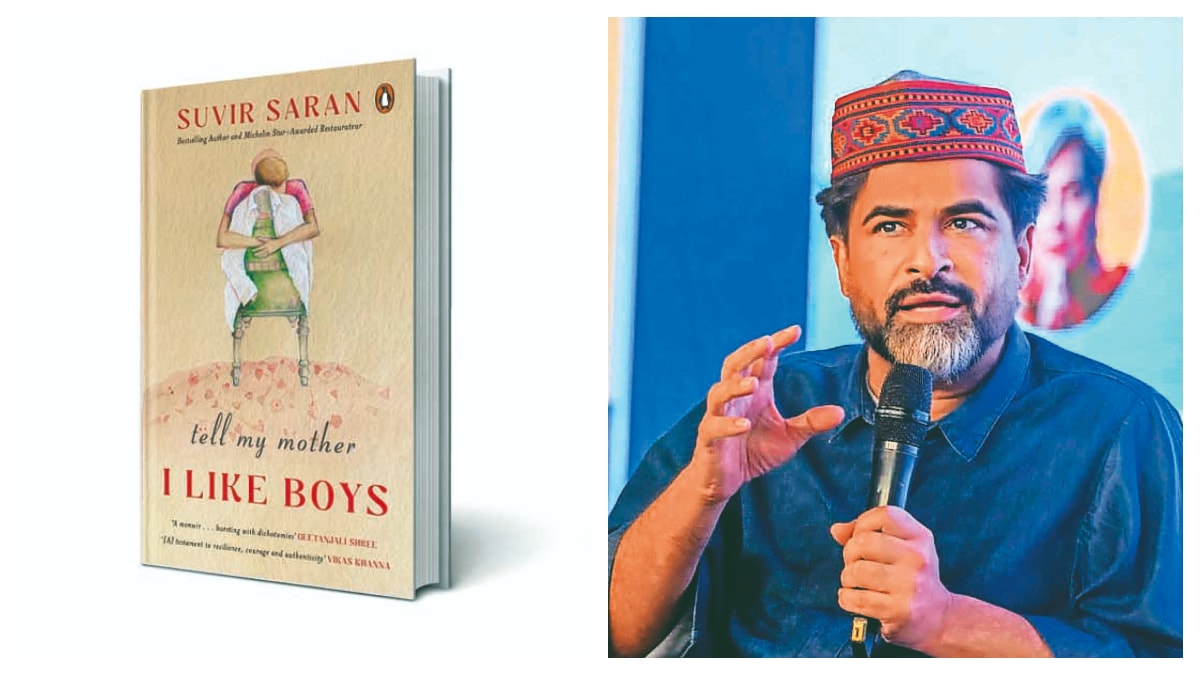
By Srinath Sridharan
If you sing honestly, people will tell it. If you don’t, they will know: Music teacher Shankar Dasgupta’s simple counsel to a young Suvir Saran was meant for music, but it became the tuning fork of his life. It is also the clearest key with which to read Tell My Mother I Like Boys. Every page carries the sound of someone determined to live, and write without disguise.
To read this book is to recognise that Suvir lives by the principle of giving not just fully, but excessively, even when the personal cost is steep. He has long understood what excellence demands: unreasonable commitment, steeled self-scrutiny, and a willingness to walk into the fire again and again until the craft—whether cooking or writing or singing—becomes honest enough to stand on its own. That intensity has shaped his culinary reputation, including Devi, the first Indian restaurant in North America to earn a Michelin star. It also shapes the voice on these pages, for it is poetic, sharp, unafraid, and incapable of half measures.
Suvir Saran has long been regarded as a force who recalibrated how the world tasted India. His influence was steady, persuasive, almost tidal. In New York, where culinary identities jostle for space, he made Indian food impossible to ignore—not as comfort cuisine, not as nostalgia, but as high craft. Devi, the restaurant that became the first in North America outside Northern Europe to claim a Michelin star, marked far more than a personal triumph. It was a cultural shift, a moment when Manhattan finally understood that Indian flavours could be as intricate, elegant, and exacting as any European plate. By the time the star arrived, Suvir had already widened the path for countless South Asian chefs and creators.
I’ve known Suvir for many years, and what he writes here is precisely who he is. Take it or leave it; his lens is plainspoken, bluntly authentic, and yet inevitably lyrical because he is incapable of separating feeling from craft.
Tell My Mother I Like Boys reminds us that behind this brilliance lay a far more fragile, complicated story. The memoir peels back the sheen of public achievement to reveal the soft, bruised interior—of a boy moving between Delhi, Bombay, and New York, often “too afraid to live his truth”, and a man learning, slowly and painfully, to step into himself. It becomes a coming-out that is also a coming-home, a reckoning with family, identity, love, culture, and the wearying pressure of living a double life.
For readers of memoir, culture, queerness, and contemporary Indian storytelling, the book offers a rare gift: a life examined without apology, and a truth reclaimed with tenderness and fire in equal measure.
What gives this memoir its emotional charge is Suvir’s willingness to revisit the fragile corners of his adolescence, including moments of discovery, desire, shame, and wonder. In one excerpt, a simple line becomes a universe: “Gudda. At 14, he gave me belonging.” That belonging is remembered with the trembling clarity of someone who knows that early kindness can become the scaffolding for adult survival.
The book is also, inevitably, a meditation on craft. Each dish becomes a form of expression, a bridge to home, a declaration of identity. Food becomes the memoir’s second narrator—sometimes consoling him, sometimes disciplining him, always revealing some deeper truth. A line from the publisher’s note captures the spirit well: “The kitchen becomes both a sanctuary and a crucible.”
Reading the memoir, one understands that this duality shaped him as much as any life event. His relationship with family—loving, layered, enduring— is the memoir’s heartbeat. The title itself, Tell My Mother I Like Boys, speaks to a truth many queer children know: that acceptance is never a single moment but a lifelong dialogue. In sharing this journey, Suvir offers candour, humour, self-awareness, and a deep appreciation for the people who held him even when they didn’t fully understand him.
There is also music throughout the memoir—literal music, of course, but also the music of prose. His sentences sway between quiet reflection and bright crescendo. He writes about heartbreak the way he writes about saffron or sambar: layered, unexpected, precise. And even when recounting difficult stretches—illness, professional exhaustion, displacement—he does so with generosity rather than bitterness. He is documenting the grace that allowed him to continue.
Nothing is minor in Suvir’s telling because nothing is minor in his living. He experiences the world with heightened sensitivity, and the memoir honours that as a strength, not a flaw. One of my favourite aspects of the memoir is how it restores the small gestures of everyday life—a brother’s silent strength, a grandmother’s tone, a lover’s glance, a bowl of dal at the right moment.
What I also wish for Suvir is that he never treats this book as a biography or a summing-up. This is not his life bound between intervals; it is only the first deep breath of what he is yet to create.
Srinath Sridharan is author, corporate adviser and independent director on corporate boards
Tell My Mother I Like Boys
Suvir Saran
Penguin Random House
Pp 240, Rs 699