



By Mohit Hira
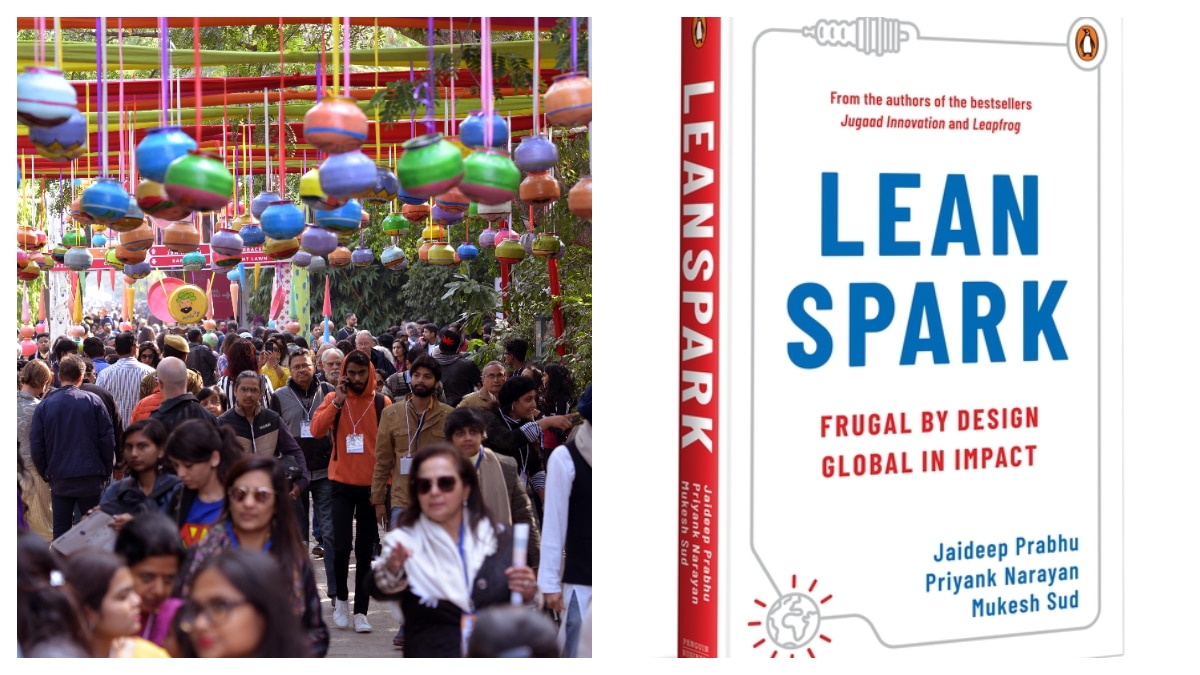
Sometimes one comes across a book that leaves you at the crossroads. LeanSpark: Frugal by Design, Global in Impact by Jaideep Prabhu, Mukesh Sud and Priyank Narayan is one of those. Read on, and you’ll figure out why.
Let’s start with the word jugaad—a much heard, oft abused refuge of a term. This book, however, aims to uplift the jugaad school of thinking into a scalable, ethical framework called LeanSpark. And it is bound to draw the attention of a range of professionals operating with limited budgets (and who isn’t?) in both corporate and entrepreneurial setups.
The authors introduce LeanSpark as a modern innovation model rooted in frugality, adaptability, and ingenuity, evolving beyond the usual makeshift jugaad fixes. It defines four pillars: lean execution (starting small with essentials), purposeful simplicity (stripping to core value), adaptive scalability (growing flexibly), and systemic sustainability (ensuring long-term ethical impact). As they state, “LeanSpark is the intentional spark of innovation that emerges under constraints. It is about resourceful problem-solving that does not compromise on functionality, ethics or long-term impact.”
It attempts to capture vivid narratives to bring alive the theory, showcasing Indian successes ripe for global adaptation. It even engrosses you with the launch of Google Map Maker from Hyderabad and the mapping of Karachi (this is worth reading). The Jaipur Literature Festival (JLF) exemplifies LeanSpark—from a shoestring 2006 launch with empty chairs, it scaled into the “greatest literary show on Earth” via community partnerships, tech for zero-waste, and premium tiers funding free access.
Organisers like Sanjoy Roy turned cloudbursts and controversies into goodwill, proving “not ‘make do’, but ‘make possible’.” And while the journey itself is interesting, it’s also a clever approach to feature the fest—especially if you’re authoring a new book that wants to grab attention without spending a great deal on promotional marketing, or LeanSparking.
Similarly, the authors tell us that the Kochi-Muziris Biennale leveraged assets by repurposing warehouses, blending local heritage with global art sans new builds. Guneet Monga’s Oscar-winning The Elephant Whisperers, shot initially on an iPhone, highlights “lean execution” followed by “purposeful simplicity”, as the authors note: “It is proof that simplicity, when executed with intent, can echo across the world.” Agree, but are there enough such evidences to warrant it supporting a theory? These stories may, however, resonate with founders converting ideas into products, and some investors spotting seemingly scalable bets. A few startups— including Orbo.ai that I am familiar with—do feature, but not comprehensively enough, I’m afraid.
Beyond inspiration, LeanSpark tries to equip its readers with the Frugal Innovation Canvas: a one-page tool probing customer segments, core problems, constraints, and differentiation from existing solutions. Useful, but not really unique. Chapters mix stories with analytics, helping startups prototype lean EVs or fintech, while corporations rethink AI and supply chains. The provocative question, “If India can build world-class innovation with less, what’s stopping the rest of the world?” challenges investors to fund constraint-driven ventures. It also presumes that our innovations are indeed “world class”—a claim that falls short when one looks at India’s track record in patents and scalable successes.
The problem, however, is that frugality, and success stories built on it, have been documented aplenty. This collection falls short on substance as it sprinkles stories without really going deep into much of them. If the intent was to quietly introduce the LeanSpark idea, then I’d say it’s worked. But if you want to unleash a radical new thought and make the reader sit up, then you’ll miss the spark in this book.
Would more quantitative ROI data on cases have sharpened the book’s appeal? Would a different approach have made it a go-to book for academia and professionals? I find it interesting but not compelling. And that’s why I stand at a crossroads here.
Mohit Hira is co-founder, Myriad Communications, and venture partner at YourNest Capital Advisors
LeanSpark: Frugal by Design, Global in Impact
Jaideep Prabhu, Priyank Narayan, Mukesh Sud
Penguin Random House
Pp 264, Rs 499