



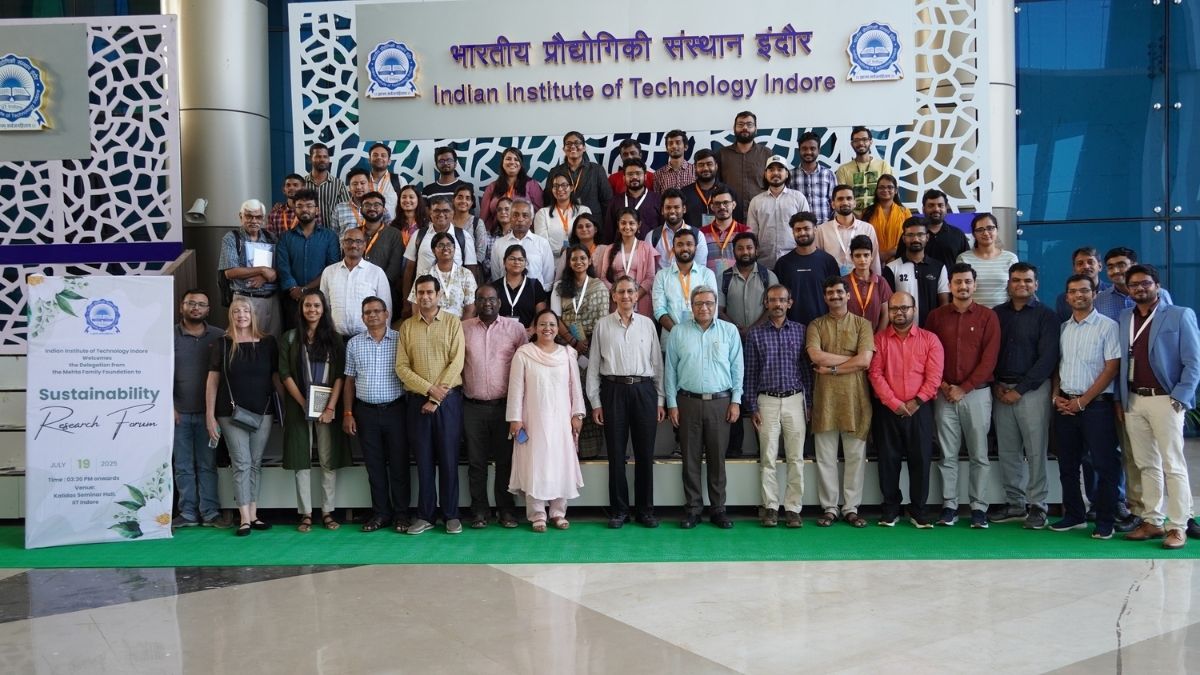
In a groundbreaking move for engineering education in India, the Mehta Family School of Sustainability (MFSOS) at IIT Indore is launching India’s first-ever undergraduate degree dedicated to sustainability this July. While other Indian Institutes of Technology (IITs) have historically confined sustainability to postgraduate studies, research, or minor elective programmes, IIT Indore is establishing a dedicated four-year BTech in Environmental Economics and Sustainable Engineering.
The school has been established through a generous endowment from the US-based Mehta Family Foundation, led by founder Rahul Mehta, and marks the foundation’s seventh major educational brainchild across the IIT ecosystem.
Why it was started
“Until now, most sustainability programmes across other IITs have been largely science- and technology-focused, confined to the MTech and PhD levels,” said Prof Pritee Sharma, professor & head of MFSOS, in an exclusive interaction with the Financial Express. Institutions like IIT Kanpur offer MTech, IIT Madras provides sustainability minors, and others focus heavily on postgraduate environmental or energy sciences.
“A critical void existed at the grassroots undergraduate level,” Prof Sharma said. “It was born out of intense industrial demand and impending structural shifts. From 2026, the government of India is implementing strict mandates and tighter environmental, social, and governance (ESG) compliance regulations for businesses. Moving far beyond traditional corporate social responsibility (CSR) activities, corporate India now requires a technically-skilled workforce that can seamlessly blend technological execution with financial and business logic.”
Green jobs
She added that, between 2024 and 2025, direct corporate green jobs spiked by over 13%. “Currently, companies are bridging the talent gap by hiring engineering graduates who hold external certifications. There is a huge mismatch between industry demand and academic supply,” she said. “IITs have a distinct responsibility to create specialised, boardroom-ready professionals to cater to this future.”
Curated for India
The curriculum was finalised after a year-long process mapping inputs from premier global universities—including Stanford, Columbia, Rice, and Purdue—alongside top Indian institutions like the Madras School of Economics and IGIDR.
Prof Sharma said that although globally inspired, the curriculum is curated for India’s domestic pain points. It balances scientific knowledge with legal frameworks and economic models, and is structured around three core verticals:
—Environmental Economics and Environmental Law.
—Energy Systems and Battery Technology.
—Water and Climate Studies.
“The pedagogy diverges from conventional classroom tracking by demanding intense and dense theoretical modules to intentionally free up academic time for field studies,” Prof Sharma said. “Students will dive into field visits, micro-projects, and multiple corporate internships—giving them direct domain expertise in fields like climate modelling, carbon trading, green finance, and recycling technologies.”
Eligible students
Admissions will be governed by the standard national IIT system through JEE Advanced, opening with an elite first intake of 30 seats for the upcoming academic calendar. Kriti, representing outreach and marketing for the Mehta Family Foundation, noted that early student demand has been high.
Despite carrying the named endowment of the foundation, school officials clarified that MFSOS is fully embedded within the IIT infrastructure. All academic approvals, fees, student accommodations, and final degree allocations are identical and at par with any standard engineering stream at IIT Indore. The school targets graduating its first batch by 2030, charting a new path for sustainable economic growth.