



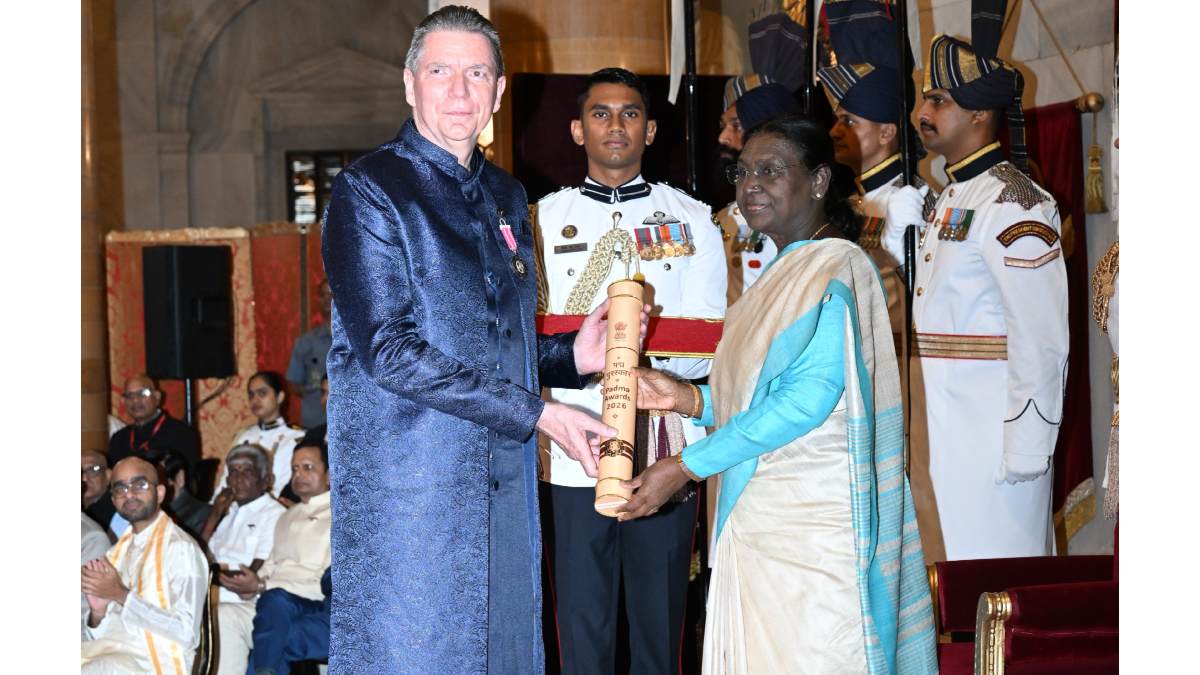
When President Droupadi Murmu presented the Padma Awards at the first civil investiture ceremony of 2026 at Rashtrapati Bhavan on May 25, one of the names that stood out was that of German ethnomusicologist Dr Lars-Christian Koch. The 66-year-old scholar received the Padma Shri for spending decades studying, documenting and interpreting Indian classical music and cultural traditions for audiences across the world.
Over the years, Koch has emerged as one of the most respected international scholars of Indian music, blending academic rigour with fieldwork, archival research and cultural interpretation. He highlighted lesser-known aspects of India’s artistic heritage within the country itself.
Who is Dr Lars-Christian Koch?
Born in 1959 in Peine, a town in Lower Saxony, Germany, Dr Lars-Christian Koch pursued studies in ethnology before earning a PhD in musicology in Bonn. He later combined both disciplines to specialise in ethnomusicology – the study of music in relation to culture and society.
His academic path eventually led him to some of Germany’s most prestigious cultural institutions. Koch served as Head of Media, Ethnomusicology and Visual Anthropology at Berlin’s Ethnologisches Museum and also headed the renowned Berlin Phonogram Archive, known for preserving historical sound recordings from across the world.
Key Role in Berlin’s Controversial Humboldt Forum
In 2018, Koch became director of both the Ethnologisches Museum and the Museum of Asian Art. He played a key role in integrating the museums into the Humboldt Forum, the cultural complex housed inside the reconstructed Berlin Palace.
The institution has frequently drawn international debate over colonial-era acquisitions and artefacts obtained during European imperial expansion. Despite the wider controversies surrounding museum collections in Europe, Koch’s own academic focus remained strongly tied to documentation, preservation and interpretation of Asian and Indian cultural traditions, according to a report by The Indian Express.
Koch’s Groundbreaking Thesis: Comparing Indian rasa to European music emotions
One of Koch’s most influential academic works came through his 1994 doctoral dissertation, where he examined the rasa doctrine in North Indian classical music and compared it with the “Doctrine of Affections” associated with Baroque Europe, the report mentioned.
The “Doctrine of Affections” was a European theory popular during the 16th and 17th centuries, particularly in royal courts such as Versailles, where music was believed to evoke specific emotional states in listeners. Koch drew parallels between this idea and India’s own long-standing aesthetic traditions rooted in performance and emotion.
Koch’s India connection
Koch’s deep engagement with India became central to his academic career. Through extensive fieldwork, repeated visits to India and years of studying Hindustani classical traditions, he developed a specialised interest in the rasa doctrine described in the ancient Sanskrit text Natyashastra.
Drawing from the ancient Indian text Natyashastra, Koch explored how emotions and aesthetic experience are communicated through performance traditions. He analysed the concept of navarasa – the nine emotional states central to Indian aesthetics – and compared it with European theories developed in the courts of Versailles during the 16th and 17th centuries, IE reported.
What made the work significant was that Koch avoided forcing Indian traditions into Western frameworks. Instead, he studied Indian aesthetic systems through their own philosophical vocabulary and artistic logic, a method that earned appreciation within ethnomusicology circles.
Koch’s deep fascination with Tagore’s Rabindra Sangeet
Koch’s repeated visits to India, especially West Bengal, shaped another important dimension of his work – the study of Rabindra Sangeet, the songs written and composed by Rabindranath Tagore.
His book My Heart Sings: The Songs of Rabindranath Tagore Between Tradition and Modernity explored how Tagore’s music balanced classical Indian traditions with modern thought and regional influences. Through an ethnomusicological lens, Koch attempted to explain why Rabindra Sangeet continues to remain emotionally and culturally relevant across generations.
His writings also helped Western readers better understand the philosophical and artistic depth embedded in Tagore’s musical compositions.
Documenting Kolkata’s legendary instrument makers
Another major contribution by Dr Lars-Christian Koch was his documentation of India’s traditional instrument-making heritage.
His 2011 publication, Sitar and Surbahar Manufacturing: The Tradition of Kanailal & Brother, focused on the iconic instrument makers of Kolkata’s Upper Chitpur Road in Burrabazar. Through photographs, interviews and technical documentation, Koch chronicled the craftsmanship behind sitars and surbahars made by the Kanailal family.
The work also highlighted how legendary musicians such as Pandit Ravi Shankar, Ustad Vilayat Khan, Enayet Khan and Waheed Khan preferred instruments crafted by the family-run workshop.
Kanailal & Brother eventually shut down in 1995 due to the absence of successors. By documenting their story, Koch preserved the legacy of a fading artisanal tradition that played a major role in shaping Hindustani classical music, the report mentioned.
A career spanning academia and cultural preservation
Beyond museums and fieldwork, Koch continues to remain active in academia. He currently serves as director of the State Ethnographic Collections of the Dresden State Art Collections in Germany. He is also Professor of Ethnomusicology at the University of Cologne and Honorary Professor at the Berlin University of the Arts.
Over the years, he has also held guest professorships at the University of Vienna and the University of Chicago, further strengthening his reputation as a leading global scholar of music and culture.
For decades, Dr Lars-Christian Koch has worked at the intersection of scholarship, preservation and cultural interpretation. His studies on Indian classical music, Rabindra Sangeet, Buddhist traditions and instrument-making practices have contributed to a wider global understanding of India’s artistic heritage.