



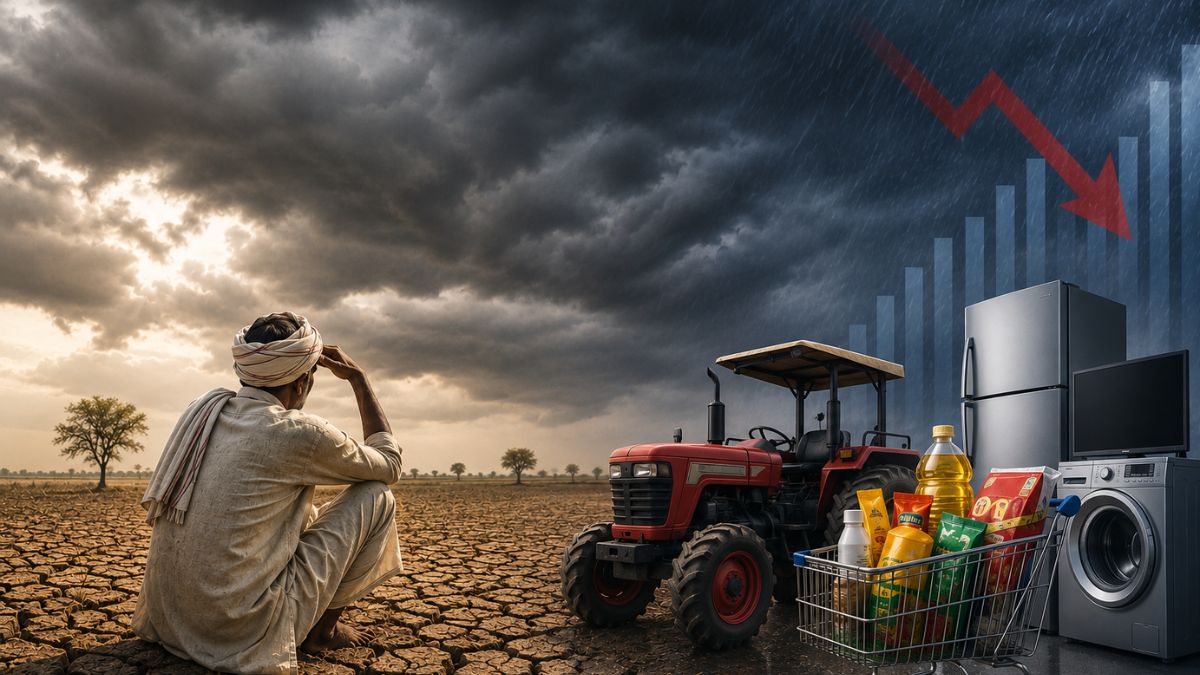
Consumer-facing businesses are bracing for turbulence. A weakening monsoon forecast—driven by El Niño conditions—threatens to erode rural demand, the one engine that has kept FMCG companies, automakers and appliance manufacturers moving even as urban recovery sputtered. With the festive season on the horizon, the stakes could not be higher.
The India Meteorological Department (IMD) last week trimmed its forecast to 90% of the long-period average (LPA), down from 92%, and put an 84% probability on rainfall landing in the “deficient to below normal” range. Brokerage estimates suggest that every 1% shortfall from the LPA can drag rural consumption growth down by 0.5–0.7 percentage points—a rule of thumb that is now flashing red.
The blow lands at an already difficult moment for India Inc. Commodity price volatility, elevated logistics costs and the ripple effects of the Iran war are already squeezing margins. Price hikes have been pushed through across FMCG and durables to absorb input cost pressures from the West Asia crisis, but a monsoon-driven demand slowdown would be a different beast: more diffused, longer-lasting and harder to price away.
“Rural demand was the only consistent factor in FMCG over the last few quarters as urban recovery was fragile,” said Mayank Shah, chief marketing officer at Parle Products. “A below-normal monsoon may hurt sentiment in rural areas as farm incomes take a hit.”
Rural sales account for over a third of total revenues for FMCG and durables companies, and have been a primary volume growth driver in recent quarters. Companies have been doubling down on direct rural distribution to ride the hinterland momentum—an expansion that may now need to be rethought as consumers in those markets grow cautious.
The split between mass-market and premium segments could widen sharply. “We expect mass-market and entry-level products to take a hit as farm incomes come under pressure,” said Kamal Nandi, business head and executive vice-president of the appliances business at Godrej Enterprises Group. “On the positive side, demand for premium products could hold up, driven largely by urban centres.”
Tractors tell a similarly sobering story. Ratings agency ICRA projects tractor sales growth will slow to 1–4% in FY27, a sharp deceleration from around 19% in FY26. Rohan Kanwar, vice-president and sector head for corporate ratings at ICRA, flagged that tractor demand is closely tied to agricultural cash flows, and that any moderation in farm incomes could weigh heavily on the segment. Non-agricultural demand—from haulage and infrastructure—may provide some support, but is unlikely to fill the gap: agricultural use still accounts for around 93% of total tractor sales.
Mahindra & Mahindra (M&M), the country’s largest tractor maker, is holding its ground. The company has maintained its mid-single-digit sales growth outlook, arguing that weather-related disruptions are already factored in. Veejay Nakra, president of M&M’s farm equipment business, pointed to recent government measures—including higher fertiliser subsidies, seed reserves and kharif crop support—as potential buffers against income pressure on farmers.
Companies are already exploring contingency plays: smaller pack sizes, targeted rural promotions and a deeper pivot to digital and direct-to-consumer channels. Whether those levers prove enough will depend on how the rains actually unfold—and how quickly farm sentiment follows.
Cloudy Outlook
- Rural sales account for over a third of total revenues for FMCG and durables companies
- Every 1% deviation in monsoon rainfall from LPA can affect rural consumption growth by 0.5–0.7 percentage points
- ICRA projects tractor sales growth will slow sharply to 1–4% in FY27
- Price hikes already initiated across FMCG and durables sectors