



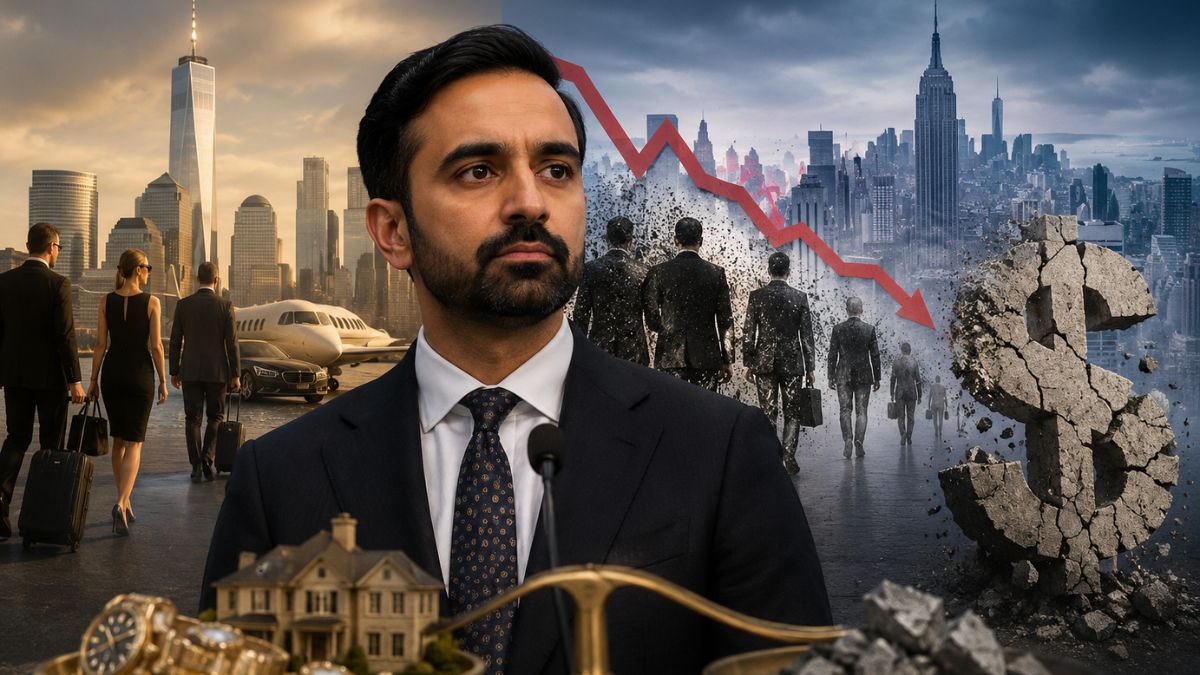
New York has seen a sharp decline in its share of America’s millionaires in recent years, costing the state nearly $11 billion in potential tax revenue in a single year, according to a new analysis. The study, released Monday by the Citizens Budget Commission (CBC), comes as concerns grow that New York City Mayor Zohran Mamdani’s push to increase taxes on the wealthy could drive more high-income taxpayers and businesses out of the city.
New York’s share of US millionaires fell from 12.7% in 2010 to 8.7% in 2022, the largest decline recorded by any state during the period, according to the CBC’s Competitive NYS: Value Proposition Tracker dashboard. “New York’s declining share of high-income taxpayers has meaningful consequences,” the analysis states.
“Had New York maintained its share of the nation’s millionaires over the past decade, personal income tax collections would have been substantially higher – roughly $10.7 billion more in tax year 2022.”
New York had more millionaires, but other states grew faster
The decline in New York’s national share does not mean the state lost millionaires in absolute numbers. New York had roughly 34,000 more millionaires by 2022 than it did in 2010.
However, the number of wealthy residents grew much faster in other states.
“New York’s number of millionaires doubled, but it tripled in California and Texas and quadrupled in Florida, leaving New York State with the fourth-most millionaires behind those states,” the study states.
The findings have added to concerns about New York’s ability to retain wealthy taxpayers, particularly as Mamdani pushes for higher taxes on the rich.
Mamdani’s tax plans raise new concerns
Mamdani has proposed an additional 2% tax on New Yorkers earning more than $1 million a year. If approved, the combined top New York City and state tax rate would rise to 16.776%, while the combined federal, state and city rate would reach 53.776%.
However, Mamdani cannot raise the city’s income tax on his own. New York City income tax rates are set by Albany, and Gov. Kathy Hochul has said she would block an income tax increase.
“I don’t want to lose any more people to Palm Beach,” Hochul told the New York Post.
Hochul, who is seeking re-election in November, has instead backed a so-called pied-à-terre tax on luxury second homes in New York City.
Mamdani promoted the tax in a social media video filmed outside billionaire Ken Griffin’s $238 million Manhattan penthouse. The move angered the hedge fund billionaire and reportedly prompted him to threaten to pull a $6 billion Park Avenue development. The dispute has added to fears of a wider exodus of wealthy residents and businesses from New York.
High earners account for a major share of tax revenue
New York’s finances are heavily dependent on a relatively small group of high-income taxpayers. “In New York, the top 1% of earners pay about 45% of all state income taxes in any given year, so New York’s revenue is very reliant on high earners to stay in New York, and that has been a challenge in recent years,” said Jared Walczak, an economist and senior fellow at the Tax Foundation think tank.
Critics fear that losing even a small number of high earners could significantly reduce tax revenue and put pressure on public services.
New York state recorded a net loss of $14 billion in adjusted gross income due to taxpayers leaving between 2021 and 2022, according to Tax Foundation and IRS data.
New York City’s personal income tax revenue also fell from $16.7 billion in 2022 to $14 billion in 2024. However, it remained above the pre-pandemic level of $13.4 billion in 2019, according to data from the New York City comptroller.
Wealthy residents do not have to move far to avoid city tax
Experts say high earners would not necessarily have to move to Florida or Texas to avoid a higher New York City income tax. They could simply relocate to Long Island, Westchester County or New Jersey while remaining close to the city.
“New York City can only tax its own residents,” said Jared Walczak, vice president of state projects at the Tax Foundation told New York Post. “A high earner doesn’t need to give up the convenience of the city, they just need to move outside the five boroughs. Migration across city lines is the easiest.”
Walczak said any major tax changes would ultimately require action from state lawmakers. “Gracie Mansion can’t do it on its own; it takes Albany,” he told The Post. “Pied-à-terre will have some impact, but there’s this feeling that New York isn’t done raising taxes, and with other places being more competitive, it won’t be surprising if high-earner taxpayers choose to relocate.”
Florida brokers report growing interest
Florida real estate brokers have reported a rise in inquiries from wealthy New Yorkers considering moves to Miami or Palm Beach. Some business owners have also threatened to leave the city or close their businesses.
New York developers concerned about Mamdani’s rent control platform have also joined efforts to fund his political opponents.
Critics say concerns over taxes, policing and public safety could become the final push for some wealthy residents and business owners who were already considering leaving.
However, there is so far little evidence of a major slowdown in New York’s high-end real estate market or a broad decline in the city’s overall wealth.
New York remains a major global wealth hub
New York City continues to have a large and growing wealthy population. The number of millionaires in the city has more than doubled over the past decade to more than 2.4 million, according to Altrata. More than 33,000 New Yorkers are worth at least $30 million, nearly twice the number in Miami.
The figures suggest that New York continues to create new wealthy residents even as some high earners leave. Whether measured by millionaires, multimillionaires or billionaires, New York City remains one of the world’s dominant wealth hubs.
Critics say New York is becoming less competitive
Abir Mandel, senior state policy analyst with the Tax Foundation, said New York currently ranks last in the country for competitiveness.
“Without reforming the tax structure New York won’t be competitive for attracting population and business,” he told New York Post.
Mandel pointed to Elon Musk’s decision to move his companies from California to Texas as an example of businesses relocating to states with more favorable policies.
Critics have also blamed years of state policies for New York’s economic challenges.
Former Gov. Andrew Cuomo increased income taxes on high earners during the coronavirus pandemic, while Medicaid spending under Hochul is expected to reach $58 billion by the end of the decade.
Ken Girardin, a research fellow at the conservative Manhattan Institute, pointed to New York’s tighter rent control law approved in 2019 and its green energy mandate, arguing that the policies reduced housing supply and increased energy costs. “Albany is directly responsible for the stagnation,” he said.
Study explains population challenges
The CBC analysis also showed demographic and economic challenges across New York.
The state has lost more residents to every other state than it has gained from them, with Florida and Texas among the biggest destinations for former New Yorkers.
After a major population exodus during the coronavirus pandemic, New York City’s population rebounded in 2023 and 2024, largely because of international immigration.
The state’s economy is also heavily concentrated in a corridor stretching from New York City and Long Island to Albany, while upstate and rural regions continue to lose workers and residents.
New York leads the country in state and local taxes collected per person, with per capita collections of $12,495 — 78% above the US average.New York City has generally performed better than areas such as the North Country and Southern Tier, which have experienced continued population declines.
Mamdani says fears are overblown
Mamdani has rejected concerns that his policies will lead to a major exodus of wealthy residents, pointing to the continued growth in New York’s millionaire population following previous tax increases.
“I’ve been very clear about the fact that we live in the wealthiest city in the wealthiest country in the history of the world, and it’s unacceptable that one in four New Yorkers are living in poverty, and I believe that the wealthiest can do a little bit more to ensure that everyone can afford to live here,” he told reporters.
However, business leaders warn that losing more high-income taxpayers could ultimately hurt lower-income New Yorkers because wealthy residents contribute such a large share of the tax revenue used to fund public programs.
“If we don’t course-correct and get laser-focused on keeping the city and state attractive to the people and businesses that drive our economy, the affordability crisis will only deepen because the people leaving are the ones paying the largest share of a budget that funds the social programs meant to help our most vulnerable,” said Steve Fulop, CEO of the Partnership for New York City.