



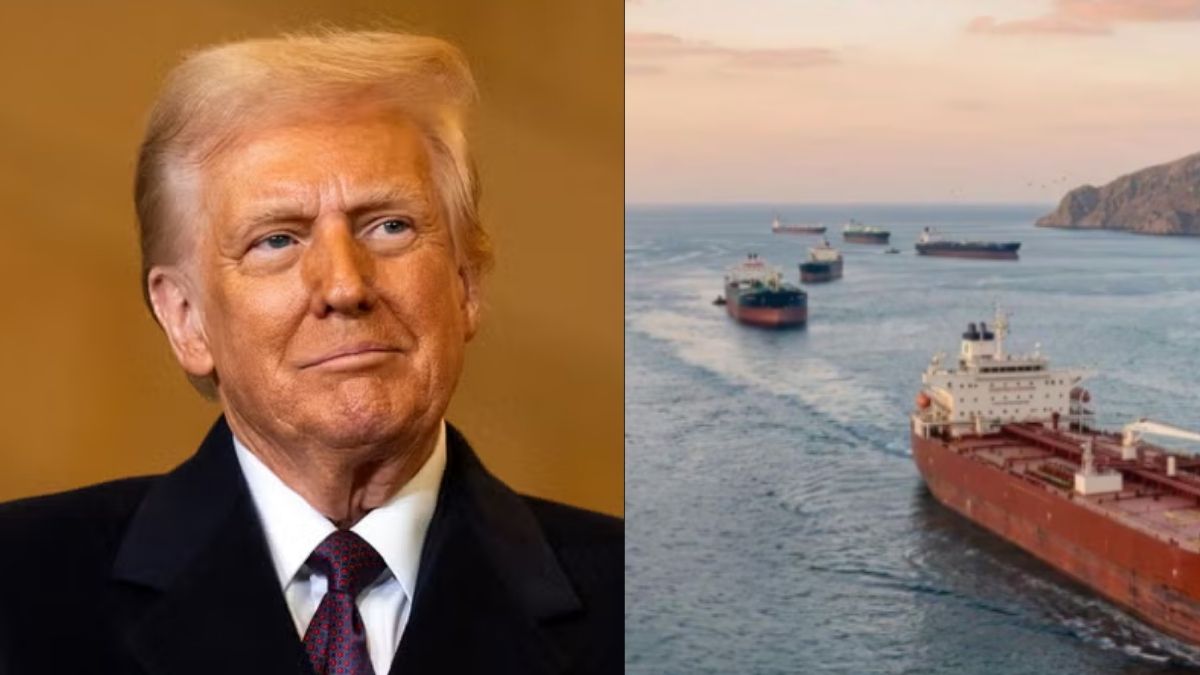
US President Donald Trump’s proposal to impose a 20% toll on commercial cargo passing through the Strait of Hormuz could generate between $176 billion and $194 billion in annual revenue, reported New York Post citing estimates quoted by supply chain experts. The proposal marks a major shift from Trump’s earlier position that commercial shipping through the strategic waterway should remain toll-free after the conflict with Iran.
Brandon Daniels, chief executive of supply chain AI company Exiger, told the New York Post that annual international trade moving through the strait was worth between $880 billion and $970 billion before the conflict. Based on those figures, a 20% levy could generate between $176 billion and $194 billion every year.
Daniels said such revenue could cover the salaries and compensation of roughly one million federal civilian employees. However, he questioned how such a policy could actually be implemented. “I don’t think that there is a real mechanism for us to charge that toll at this moment, and how we would charge that toll is still an open question of both economic policy and international law,” Daniels said, according to New York Post.
So far, US government has not announced any formal mechanism or timeline for imposing the proposed fee.
Why Trump proposed Strait of Hormuz toll?
Trump announced the proposal after previously opposing similar toll plans suggested by Iran. People familiar with the discussions told the New York Post that the latest announcement could form part of a broader negotiating strategy rather than an immediate policy decision.
“It’s a negotiation. It’s real until there’s an alternative arrangement,” a source told New York Post.
The proposal came after fresh tensions in the Strait of Hormuz following disputes over shipping routes. According to the report, Iran’s military attacked three commercial vessels after they used a US-backed navigation route instead of a path closer to the Iranian coastline.
Trump later announced the reimposition of a US blockade targeting Iranian shipping and linked the proposed toll to Washington’s role in protecting commercial vessels using the waterway.
In a statement, Trump said, “We are reinstating the THE IRANIAN BLOCKADE… All other countries will have fair and open use of the Strait.”
He added, “The USA will be, from this point forward, known as ‘THE GUARDIAN OF THE HORMUZ STRAIT,’ but as such, and as a matter of FAIRNESS, will be reimbursed, at the rate of 20% on all cargo shipped, for any and all costs necessary to do the job of providing safety and security to this very volatile section of the World.”
Despite the announcement, officials have not released details about how the toll would be collected, when it could take effect or whether any countries would receive exemptions.
What impact could the proposal have on global trade?
The Strait of Hormuz remains one of the most important energy corridors in the world. Exiger estimates that around $600 billion worth of crude oil shipments move through the route every year. Another $80 billion to $120 billion in liquefied natural gas exports also pass through the strait annually, reported New York Post.
In addition to energy supplies, goods worth roughly $200 billion to $250 billion, including fertilisers, helium and industrial polymers, also transit the waterway, according to New York Post.
Experts say the actual revenue from any future toll would depend on several factors, including global oil and gas prices, total cargo volumes and whether the United States offers exemptions or reduced rates to friendly countries such as Saudi Arabia, Qatar and the United Arab Emirates, reported New York Post.