



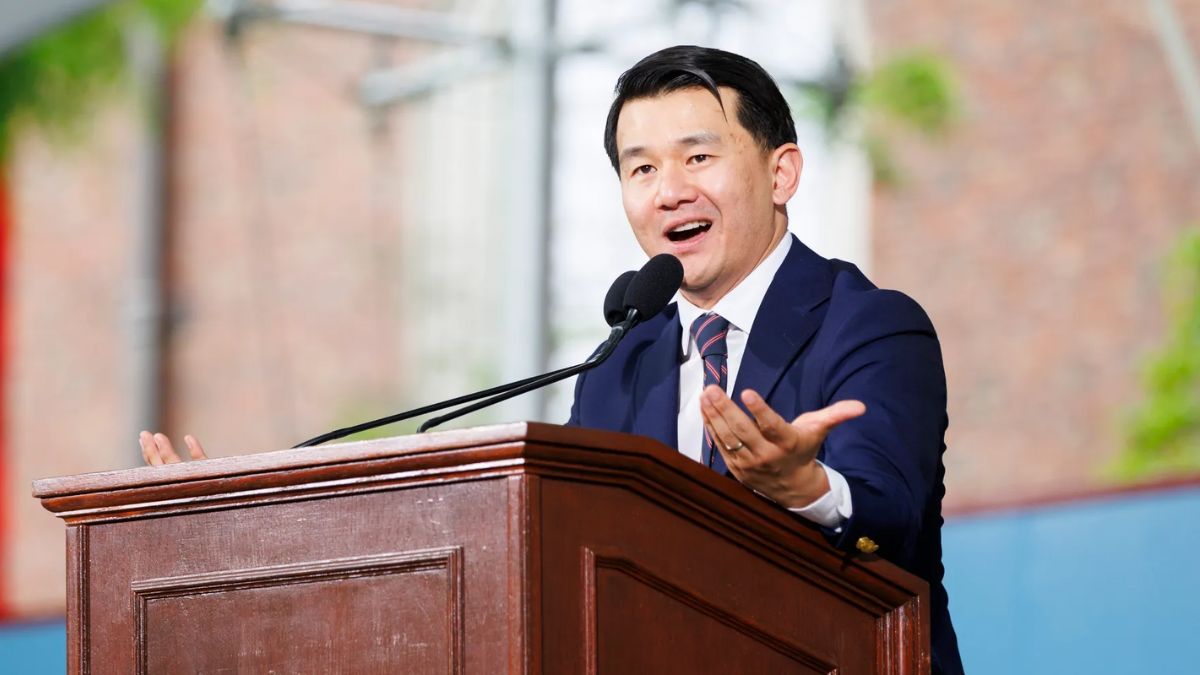
For most commencement-style speeches, the script is all about telling embrace technology, adapt to change, and prepare for an AI-driven future. But comedian and actor Ronny Chieng had a very different message for Harvard’s Class of 2026. Standing before graduating students during Harvard Class Day, Chieng launched into a humorous critique of artificial intelligence, arguing that the technology threatens creativity, learning and genuine human mastery.
“F*** AI. F*** AI! F*** it to death, all right?” he declared to loud applause from the audience. “I’m so glad you agree. I prepared a completely different speech in case you guys turned on me.” In his speech he came out strongly with a message, he believes overreliance on AI risks making people intellectually lazier and less capable.
A different message from the AI evangelists
Chieng acknowledged that many graduation speakers across the United States have been encouraging students to master AI and integrate it into their futures. His advice was the opposite. “I’m here to tell you the mission of your generation is to destroy AI, kill it,” he said.
“To accomplish this, you will have to capture and reprogram an AI to be on the side of humanity, then commandeer its own time-traveling technology, send it back to the past to defeat the current AI before it gains sentience. This isn’t just graduation day, this is ‘Terminator 2: Judgment Day.’” The audience laughed, but Chieng repeatedly returned to a concern that AI may be replacing thinking rather than enhancing it.
‘AI is stupid’
Part of Chieng’s frustration stems from what he sees as AI’s limitations. “It’s stupid. It’s so stupid. Have you tried using it? It’s always wrong,” he said. “Like, I asked AI what’s the fastest way to get from New York City to Harvard, and it told me to take FlixBus. I’m a movie star. Hello, I don’t take the bus, Acela only.”
He then mocked AI-generated information about Harvard itself. “Do you even know what AI is saying about Harvard? The garbage that AI is spouting about you guys?” he asked before sarcastically citing facts about Harvard’s endowment and graduate student wage demands. “There’s no way that’s true. I mean, that’s ridiculous. How bad are these AI hallucinations getting?”
The real danger: Cognitive debt
Regardless of his repeated calls to “destroy” AI, Chieng clarified that he was not attacking scientific breakthroughs enabled by the technology.
“I know that someone’s sitting out here right now who’s just saying, ‘Well, you know, what about the use of AI to pioneer breakthroughs in medicine and physics?’” he said. “First of all, shut up, nerd. I’m not talking about that. Obviously, if you’re using it for that purpose, you are not the problem.”
Instead, he pointed to what he called “the accumulation of cognitive debt due to excessive use of large language models,” referencing a 2025 study from MIT.
The comedian argued that excessive dependence on AI tools could weaken people’s ability to think independently and solve problems on their own.
One of the loudest laughs came when Chieng mocked common AI use cases that automate everyday tasks. “Have you heard how dumb people brag about how they use AI?” he asked.
“They’re always like, ‘Hey, did you know that AI can now read my email, summarize it, and draft a response?’ Yeah, you know who else can do that? Me. I can do that. You can’t do that? How useless are you?”
According to Chieng, AI will not necessarily make talented people obsolete. Instead, he suggested it could increase the gap between people who possess genuine expertise and those who rely on shortcuts. “I think AI is just gonna end up making mediocre people dumber,” he said.
Mastery versus faking it
Perhaps the strongest theme running through Chieng’s speech was the importance of mastering a craft rather than outsourcing it. “AI can be the fuel, but fuel is useless if you can’t kindle the fire,” he said.
He argued that the future battle would not be “humans against AI” but rather a struggle between substance and superficiality. “It’s gonna be people with substance versus people with shallow knowledge,” Chieng said. “It’s gonna be mastery versus faking it. It’s gonna be people with good taste versus tacky.”
The comedian also lamented how AI is increasingly being used to generate speeches, scripts and creative work. “Untalented people love bragging about using AI to help them draft their speeches, and their scripts, and their podcast,” he said. “But what they’re missing is this: the creating is the fun part.”
“The best part of comedy writing is figuring out the puzzle pieces of a joke, and getting the self-regard from having accomplished a difficult thing.” One of Chieng’s most memorable examples involved a friend who tried to learn Buddhism using AI. “I recently tried to introduce my friend to Buddhism through a book called ‘Buddhism Made Simple,’” he recalled. “Instead of reading it, he used AI to summarize it in 10 seconds. Believe it or not, he didn’t reach enlightenment. Turns out, speedrunning Buddhism is completely missing the point.”