



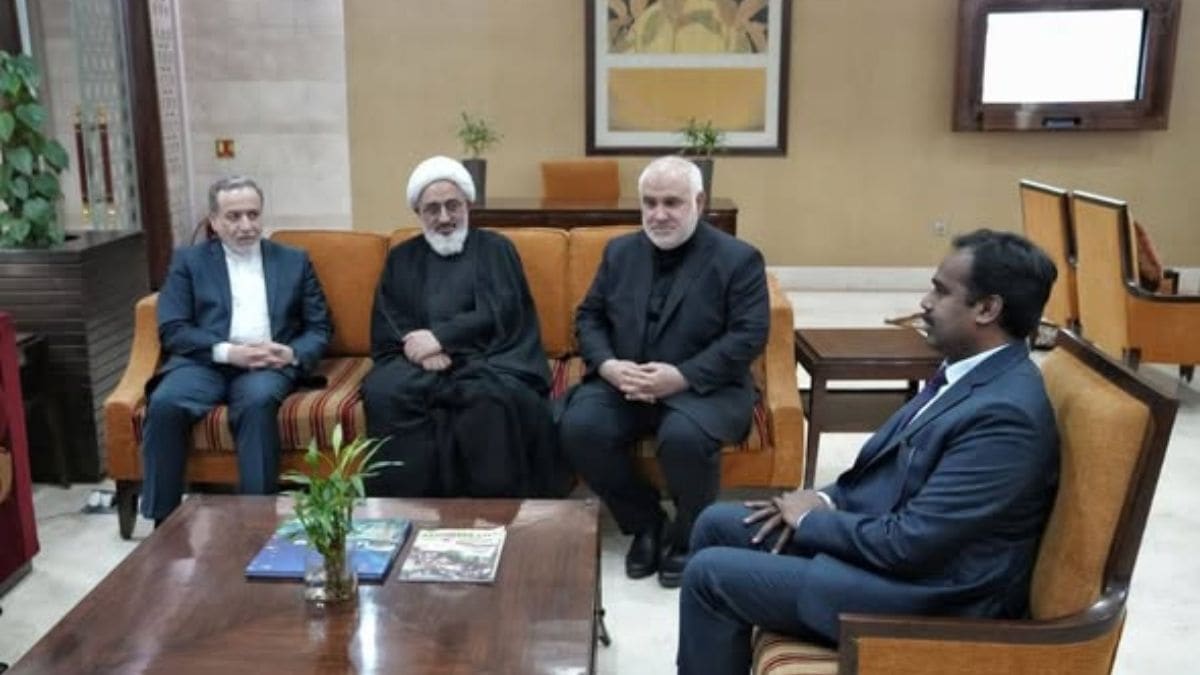
Iranian Foreign Minister Abbas Araghchi arrived in New Delhi on Wednesday for a three-day official visit, marking Tehran’s first major diplomatic outreach to India since the US-Israel war with Iran broke out more than two months ago.
His visit comes at a tense moment for West Asia, with fears growing over oil supplies, regional security, and the future of global trade routes. The two-day meeting of BRICS foreign ministers begins on Thursday under India’s chairmanship.
Soon after landing in Delhi, he received a warm welcome from Indian officials. External Affairs Ministry spokesperson Randhir Jaiswal posted on X, “A very warm welcome to Foreign Minister of Iran, Seyed Abbas Araghchi, on his arrival in New Delhi for the BRICS Foreign Ministers’ Meeting.”
Aragachi arrives in Delhi for key FMs BRICS Meet, likely to meet PM Modi
Araghchi, along with foreign ministers from other BRICS nations, is also expected to meet Prime Minister Narendra Modi on Thursday. The BRICS meeting itself is expected to revolve heavily around the growing instability in West Asia and the effect it is having on the global energy supply chain.
India, which currently chairs BRICS, is hosting the meeting ahead of the grouping’s annual summit scheduled for September.
Big focus on Hormuz safe passage and West Asia Crisis
During his stay, Araghchi is expected to hold detailed bilateral talks with Indian External Affairs Minister S. Jaishankar. The worsening situation in West Asia is likely to dominate those discussions.
One of the key concerns for India is the Strait of Hormuz, one of the world’s most important shipping routes for oil and gas supplies. According to people familiar with the matter, India is expected to raise concerns over the safe movement of merchant ships still passing through the narrow waterway.
The Strait of Hormuz connects the Persian Gulf with the Gulf of Oman and handles nearly 20 percent of global oil and liquefied natural gas shipments. Tensions in the region have already pushed global oil and gas prices higher after Iran effectively blocked parts of the route.
Chabahar project still moving ahead, says Iran
Amid worries that sanctions and the ongoing war could hurt regional projects, Iran’s Ambassador to India, Mohammad Fathali, said the Chabahar Port project remains on track.
Speaking to News18, Ambassador Dr. Mohammad Fathali said the project would continue despite international sanctions and the intense conflict that has lasted for the past two months.
While discussing the war, the envoy said Iran wants a “durable and lasting peace” instead of a never-ending cycle of conflict and temporary ceasefires.
The Chabahar Port project is strategically important for India because it gives New Delhi direct access to Afghanistan and Central Asia while bypassing Pakistan.
India has invested heavily in the port over the years, seeing it as a key trade and connectivity project in the region.
Can BRICS agree on a common stand?
One big question hanging over the summit is whether the foreign ministers will be able to release a joint statement on the West Asia conflict.
Last month, India tried to help BRICS members reach a common position during a meeting of deputy foreign ministers and special envoys dealing with Middle East and North America issues. However, those efforts reportedly failed because member countries could not agree on the language regarding the Iran conflict.
The main disagreement was between the United Arab Emirates and Iran. Relations between the two neighbours have turned tense in recent weeks over allegations that Iran targeted energy infrastructure inside the UAE. The earlier BRICS meeting ended without a consensus statement on the conflict.
Iran pushes for ‘Genuine Multilateralism’
Iranian Deputy Foreign Minister Kazem Gharibabadi, who is also in New Delhi for the BRICS meeting, strongly defended Iran’s growing role within the bloc.
In a post on X, he said, “The active presence of the Islamic Republic of Iran in mechanisms such as BRICS represents a strategic choice to strengthen genuine multilateralism, expand equitable cooperation, and participate in shaping a more just order in international relations.”
He also described the BRICS foreign ministers’ meeting in Delhi as “an important opportunity” to discuss the future of cooperation among Global South countries.
According to him, discussions could include reforming global economic governance, developing independent trade systems, boosting banking and financial ties, and reducing dependence on “discriminatory and unilateral mechanisms.”
BRICS growing bigger
BRICS originally began with five countries — Brazil, Russia, India, China and South Africa. The grouping expanded in 2024 with the addition of Egypt, Ethiopia, Iran and the United Arab Emirates. Indonesia joined in 2025.
Today, BRICS represents nearly half of the world’s population, around 40 percent of the global GDP, and roughly 26 percent of global trade, making it one of the most influential international groupings among emerging economies.