



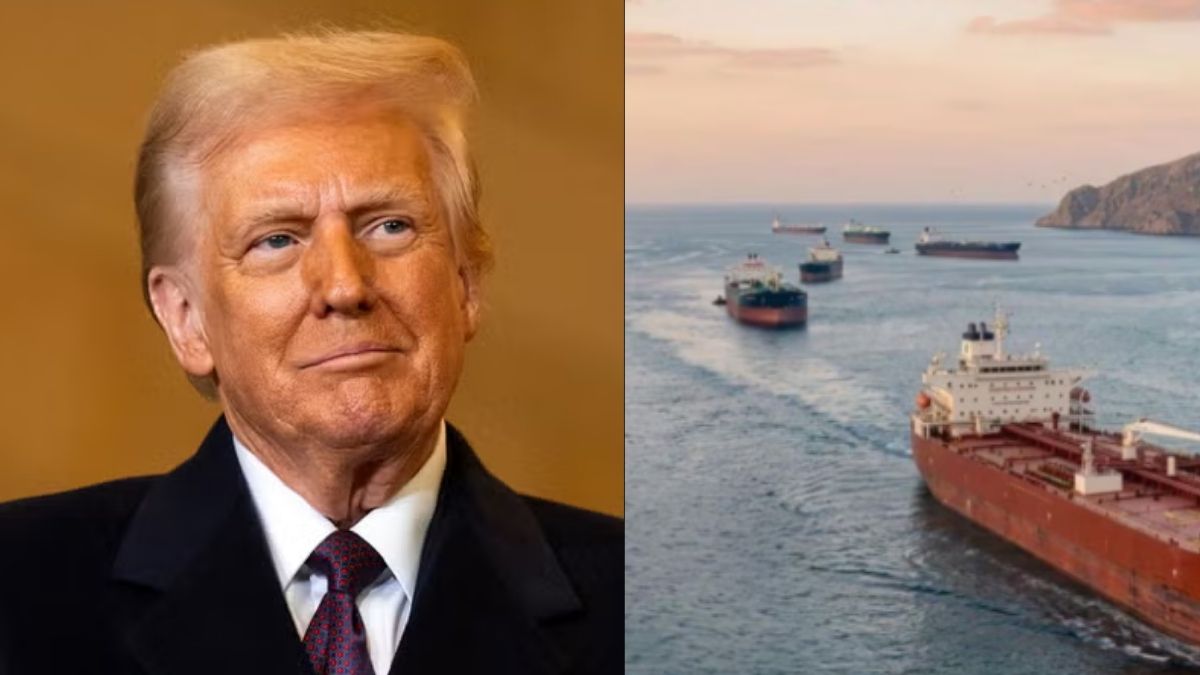
US President Donald Trump surprised both America’s Gulf allies and many of his own advisers when he announced a plan to charge a 20% toll on ships passing through the Strait of Hormuz. The proposal triggered confusion inside the White House and concern across the Middle East before Trump abandoned the idea just a day later.
The announcement came even though Trump’s own advisers had spent months warning him against such a move. They feared it would hurt the US during the ongoing conflict with Iran and also strengthen Iran’s long-standing argument that countries protecting the waterway should be allowed to collect fees.
Hormuz tariff effect- White House scrambled to work out the details
Soon after Trump announced, “The U.S.A. will be, from this point forward, known as ‘THE GUARDIAN OF THE HORMUZ STRAIT,'” and added that the United States would charge a 20% toll on all cargo passing through the strait, White House officials rushed to figure out how such a toll system would actually work.
According to CNN, officials tried to answer basic questions such as who would pay the fees and how the money would be collected. At first, many inside and outside the administration believed shipping companies would have to pay. But the situation became even more confusing later that day when Trump said America’s Gulf allies would be the ones paying instead.
At the same time, reports suggest, leaders from Gulf countries were urgently trying to reach Trump by phone in hopes of convincing him to abandon the proposal.
Gulf nations stepped in
By Tuesday morning, those efforts had paid off. Leaders from Saudi Arabia, the United Arab Emirates, Bahrain and Qatar persuaded Trump to drop the toll plan. Instead of collecting fees from ships or Gulf countries, Trump announced that these nations had agreed to make new investments in the United States.
The exact amount of these fresh investments was not disclosed.
The Gulf countries have already promised to invest trillions of dollars in the US over the coming years, although it is still unclear how much money will actually be invested.
Explaining his decision, Trump said, “I put it out yesterday, I thought it was good.”
He added, “I was called by different people, different countries, kings and emirs, and all of the people that we all know and we all love. And they’ve been, frankly, they’ve been very strong partners. And they said we’d love to do it a different way.”
White House says investments were better option
Speaking to CNN, a White House official defended Trump’s thinking. The official said that because Iran had violated its agreement to keep the Strait of Hormuz open, the president believed the United States deserved compensation for protecting ships using the waterway over many years.
The official said, “The president has always kept all options on the table, and he wisely determined that the United States should be reimbursed for our many years of protecting ships transiting this waterway. Ultimately, our Gulf allies offered to provide investments into the United States, which the President found preferable.”
Since sending the US back into active conflict with Iran last week, Trump has repeatedly said that America is close to victory. He has argued that another short but intense bombing campaign would be enough to force Iran to give in.
He has also insisted that the Strait of Hormuz remains open and ships can move through it freely. However, the situation on the ground tells a different story.
Iran still has the ability to threaten ships travelling through the strait. Because of these security concerns, shipping traffic through the important waterway has fallen sharply. That has pushed global oil prices to their highest levels since before last month’s peace agreement between the US and Iran.
Why the plan worried countries like India
The proposal could have increased shipping costs, which in turn might have pushed oil prices higher. That would have affected countries that depend heavily on energy imports, including India.
According to an Indian Express report, nearly 40% of India’s crude oil imports, about 60% of its liquefied natural gas (LNG) imports and almost 90% of its liquefied petroleum gas (LPG) imports come from West Asia through the Strait of Hormuz.
Any disruption or extra cost on this route could have had a major impact on India’s energy bills.
The International Maritime Organisation (IMO), the United Nations agency responsible for global shipping, opposed the proposal as well.
An IMO spokesperson said, “We have always been consistent on our stance on fees – IMO stands firmly against charging fees for passage through straits used for international navigation. There is no legal basis through which to introduce mandatory tolls simply to transit through a strait.”
Shipping companies also opposed the plan
German container shipping company Hapag-Lloyd described the idea as “fundamentally wrong.” According to Reuters, the company argued that commercial shipping should not have to pay the cost of geopolitical conflicts.
The proposal also surprised Gulf governments.
Many Gulf countries are close security partners of the United States and rely heavily on free movement of ships through the Strait of Hormuz. Charging every vessel could have damaged relations at a time when Washington was trying to strengthen regional cooperation against Iran.
The proposal also contradicted statements made by senior officials in Trump’s own administration.
In June, US Secretary of State Marco Rubio had clearly said that countries cannot charge tolls on international waterways.
He said, “No country is allowed to charge tolls or fees on an international waterway. That’s existing international law. That’s the way it is in international waterways all over the world, and that’s the way we expect it’ll be here.”
Soon afterwards, the United States signed a joint statement saying the participating countries “rejected any tolls, fees or attempts to assert control over the strait.”
Vice President JD Vance also expressed a similar view on June 18 while discussing the US-Iran ceasefire.
Trump had raised the idea before
This was not the first time Trump suggested charging ships to pass through the Strait of Hormuz.
Earlier during the conflict, he argued that the United States was carrying most of the burden of protecting the waterway even though America itself does not depend on it for oil.
In April, Trump suggested the US should collect fees because, as he put it, “we’re the winner” in the war. He later floated the idea of a “joint venture” with Iran to manage the strait. More recently, he warned that tolls could be introduced if Iran failed to agree to a permanent peace deal, describing the charges as “reimbursement” for the cost of the war.
However, the report suggests that Trump was warned by his closest advisers, who consistently opposed the proposal. They warned that charging ships to use the strait would likely increase oil and gas prices even further. That, they argued, could create political problems for Republicans before November’s midterm elections, when voters are already worried about the rising cost of living.
Iran Says It Has Always Protected the Strait
Iranian Foreign Minister Seyed Abbas Araghchi reacted to Trump’s proposal by saying the United States had acknowledged an argument Iran had made for years.
He wrote on X, “POTUS is absolutely right. Whoever provides secure and safe passage of commercial vessels through the Strait of Hormuz should be compensated for this service. Iran has always been the GUARDIAN of the Strait and will remain so FOREVER. 20% is of course too much. We will be fair.”
Although Trump has withdrawn the 20% fee proposal, the bigger US strategy has not changed.
The US president said America will continue its naval blockade targeting Iranian-linked shipping while allowing most commercial vessels to pass through the Strait of Hormuz.