



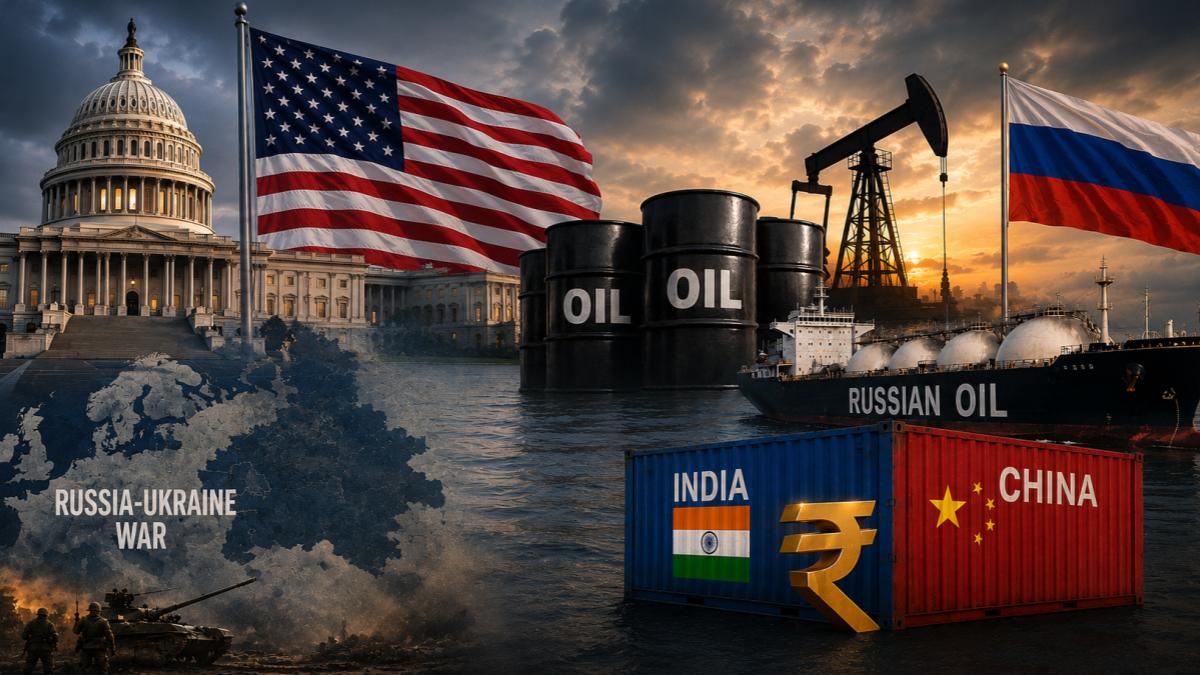
Strategic affairs expert Brahma Chellaney on Friday accused Washington of forcing India to bear the economic costs of a European conflict (Russia-Ukraine war). His remarks come days after US senators introduced a revised Russia sanctions bill on July 16. The bill allows the US president to levy tariffs of up to 100% on imports from the five largest buyers of Russian energy, including India and China.
“Put simply, Washington is seeking to make India and other countries bear the economic costs of a European conflict while the U.S. and its allies continue to buy from Russia whatever they deem essential,” Chellaney wrote in a social media post.
The revised Sanctioning Russia Act of 2026 names India, China, Slovakia, Hungary and Azerbaijan as the five largest buyers of Russian crude, according to a Reuters report. The earlier version, introduced in April 2025, had proposed blanket tariffs of 500%.
More than 60 US senators have rallied behind the legislation, which has been negotiated with the White House, and President Donald Trump has indicated he would sign the bill into law pending Congressional approval. Late Senator Lindsey Graham was originally spearheading the bill.
Chellaney said the bill follows a familiar template of shielding Washington’s treaty allies. “It exempts America’s treaty allies while seeking to target India, China (which has long sidestepped or circumvented US sanctions), Slovakia, Hungary and Azerbaijan,” he wrote. “It also exempts the US, which continues to rely on Russia for enriched uranium to fuel its domestic nuclear reactors,” Chelaney added.
The strategist noted that India bore the brunt of the oil sanctions Trump previously imposed on Russia, “even though New Delhi has never been the largest or second-largest buyer of Russian energy (China ranks first and Europe second)”.
He said that Washington’s aim was “to compel India to shift from Russian energy to American supplies”. That strategy has largely worked as the US became India’s largest supplier of LNG and LPG within months, Chellaney noted.
The bill comes at a sensitive time as India’s Russian crude imports hit a record 2.58 million barrels per day in June, data from maritime intelligence firm Kpler showed. Russia supplied nearly 50% of India’s total crude imports that month, Business Standard reported citing the Kpler data.
Indian officials, however, have played down the friction. Russian oil has not been a sticking point in bilateral trade talks, a government source told Outlook Business. The additional 25 per cent tariffs tied to Russian oil were removed after a framework trade deal in February, the source said.
Chellaney also targeted Western double standards in his social media post. “Even as the Western bloc wages a proxy war against Russia in Ukraine, it continues to pour far more money into Russia’s coffers than India ever has through its own purchases of Russian resources — from LNG and piped gas to enriched uranium, fertilizers, and precious metals such as palladium and platinum,” he posted.