



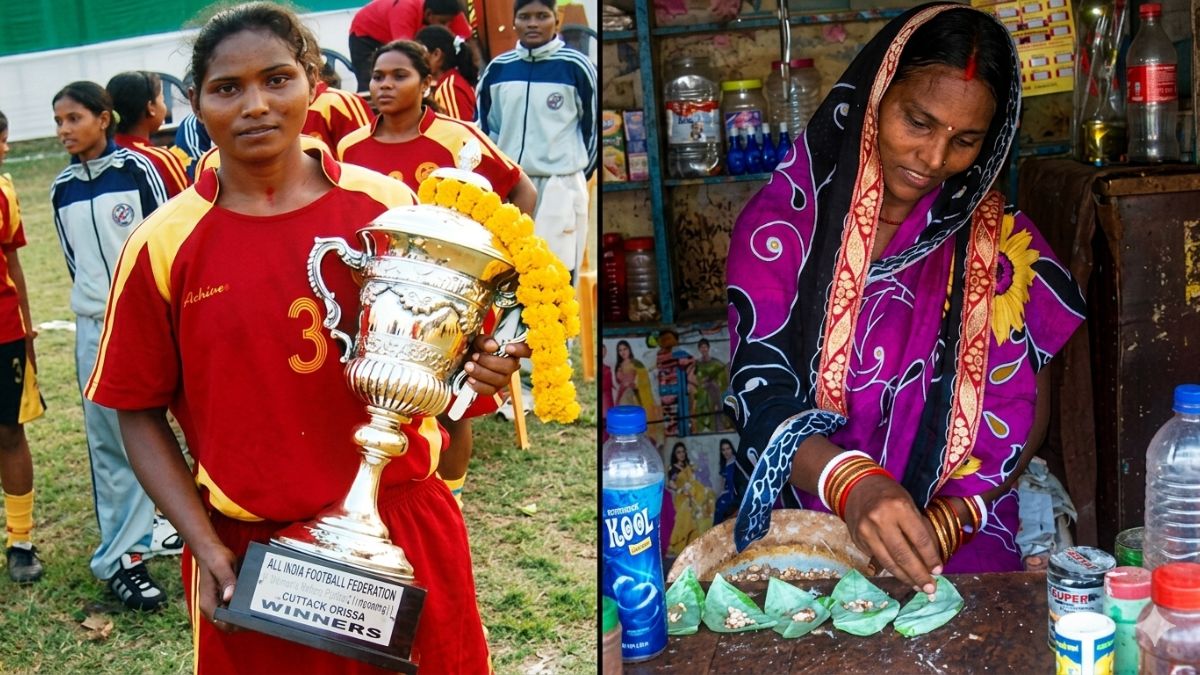
In India, sporting success can sometimes look glamorous from a distance. Packed stadiums, celebrity endorsements, crores in sponsorship deals, viral social media fame- for a select few athletes, sport becomes a gateway to wealth and recognition. But that version of Indian sport exists only for a tiny minority.
Far away from the spotlight, there are former international athletes who once represented the country with pride but now struggle simply to survive. Their medals faded, their careers forgotten, and the promises made to them quietly disappeared with time.
One such story begins in a small market in Odisha. Behind the counter of a modest paan shop in Aul, Kendrapara district, sits a woman who once wore the India jersey.
Customers stopping by for betel leaves may not immediately recognise her but years ago, Rashmita Patra was considered one of Odisha’s brightest football prospects. Today, she runs a small shop to support her family.
From Odisha’s football fields to the India team
Rashmita’s football journey began at the age of 12.
Born into a financially struggling family, the daughter of a daily-wage labourer, she found escape and identity through football. What started as passion quickly turned into promise. A natural defender with discipline and grit, she rose rapidly through the ranks.
At just 15 years old, she represented India in the AFC Under-16 Women’s Championship qualifiers in Kuala Lumpur in 2008. Two years later, she helped Odisha win the Senior Women’s National Football Championship in Bhilai.
By 2011, she had progressed to the senior national team setup and travelled to Dhaka for AFC qualifiers, becoming part of the Indian side that secured a 2-1 invitational series victory over Bahrain. For years, football was her life.
Like many athletes from smaller towns, Rashmita sacrificed education, financial stability and personal comfort chasing the dream of representing India.
The sacrifice that later trapped her
One decision would eventually change everything. In 2008, Rashmita missed her Class 10 board examinations because the dates clashed with India’s national football camp ahead of international competition.
At the time, prioritising the national team felt obvious. Representing India seemed bigger than an exam. But years later, that sacrifice returned to haunt her.
As form dipped and opportunities dried up, Rashmita slowly slipped out of the national setup. Without educational qualifications, she found herself ineligible for many government jobs under the sports quota system.
The same system that had once asked her to choose football over exams now had little place for her. By 2014, married to a fisherman with an unstable income and raising a young child, survival became more important than sport. She borrowed money and opened a small paan shop in her village market. Her football career quietly ended there.
The story that briefly shocked India
Rashmita’s story first gained wider national attention during the 2014 FIFA World Cup. Reports revealed that despite her financial struggles, she had sold her gold chain just to buy a television and watch the World Cup, proof that her love for football had never disappeared.
In interviews at the time, she spoke openly about how forgotten athletes often become once their playing days end. She said football had given her recognition but not security.
For a few days, outrage followed. Local officials promised support. Politicians assured intervention. Discussions about women’s football and athlete welfare resurfaced again. Then the attention moved elsewhere. More than a decade later, little has fundamentally changed. An individual who represented India internationally, is now perhaps living in obscurity, with no media reports.
A story bigger than one player
Rashmita Patra’s story is profoundly uncomfortable because it exposes structural fractures that the Indian sports ecosystem rarely acknowledges in full view.
The Astronomical Wealth Gap: Cricket vs the Field
The first reality is the sheer financial asymmetry between cricket and almost every other sport in India.
At the elite end, cricket operates as a full-fledged commercial industry. An uncapped player picked up at the IPL auction is guaranteed a base contract of around Rs 20 lakh for just a two-month season, while top Indian cricketers earn central contracts worth up to Rs 7 crore annually, excluding match fees and significant endorsement income from brands, leagues and lucrative IPL contracts.
By contrast, success in other sports rarely translates into long-term financial security. India has repeatedly seen athletes with international or national success fall into economic hardship once their careers end.
Sita Sahu, a two-time Special Olympics bronze medallist, was reported to be selling pani puri in Madhya Pradesh to make a living. Boxer Kamal Kumar Valmiki, a multiple-time state gold medallist, was later found working as a garbage collector in Uttar Pradesh. Their trajectories underline a harsh reality- sporting achievement outside cricket does not guarantee economic mobility or institutional protection.
The institutional neglect of women’s sports
The second layer of this divide lies within women’s sport, where structural underinvestment compounds existing inequalities.
Despite growing visibility, women’s football in India continues to operate with limited infrastructure, inconsistent domestic structures, and comparatively weak commercial backing.
Globally, women’s sport accounts for less than 2% of total sports media and commercial valuation, according to industry benchmarking studies frequently cited by organisations such as McKinsey, a gap that is even more pronounced in developing sporting economies like India.
At the domestic level, leagues such as the Indian Women’s League operate on budgets that are a fraction of their male counterparts. This disparity affects everything from player salaries to travel logistics and medical support. For many athletes, representing India brings prestige but not stability; salaries, where they exist, are often insufficient to sustain long-term livelihoods, forcing players into parallel careers or early retirement.
The broken life after sport blueprint
The final structural gap emerges after retirement when institutional attention fades almost completely.
India’s official Scheme of Sports Fund for Pension to Meritorious Sportspersons provides monthly pensions ranging from ₹12,000 to ₹20,000 but eligibility is narrowly defined. It is restricted to medal winners at select multi-sport events such as the Olympics, Asian Games and Commonwealth Games.
This leaves out a large pool of athletes who have represented India at international federations and qualifiers but have not won podium finishes at those specific events. Athletes like Rashmita Patra, who competed in AFC-level football qualifiers, fall outside this safety net entirely.
Compounding this gap is the absence of structured transition pathways. There is no consistent national framework that links sporting careers with education completion, skill development, or corporate placements for athletes whose careers end early or without major medals. As a result, retirement for many non-elite athletes becomes a sudden economic and social reset, often without institutional cushioning.
That is why Rashmita’s story still deeply resonates across the country. Not because it is rare, but because it is an ongoing reality. And perhaps that remains the most damning indictment of Indian sports governance: the system celebrates its heroes loudly while they are useful on the podium but too often leaves them financially invisible the moment the applause fades.