



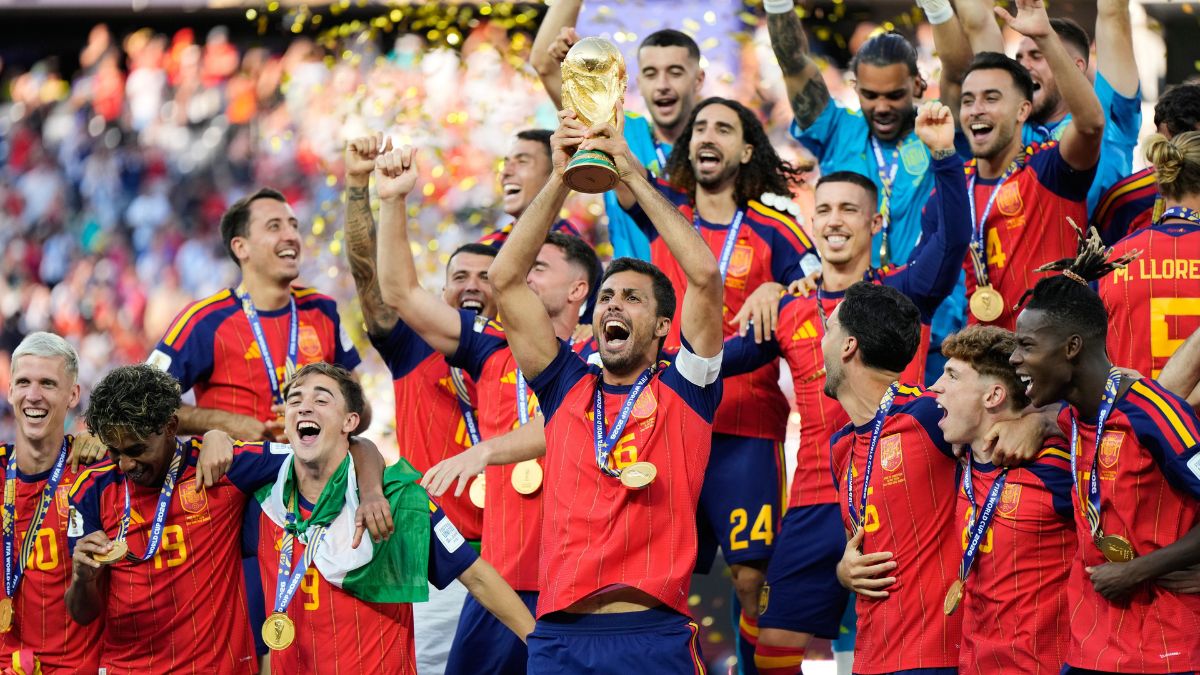
With the 2026 edition of the Fifa World Cup now over, it’s time to count the winnings. Banasree Purkayastha looks at how football’s biggest tournament ensured its greatest commercial success
How much money did Fifa make?
The 2026 World Cup is expected to have added $8.9 billion to Fifa’s kitty, taking the total money generated in the 2023-26 cycle to $13 billion. This is 72% more than that from the previous cycle that concluded with the last World Cup in Qatar and more than double the $6.4 billion from the 2015-18 period.
The final figure could be even more. Broadcasting rights remain the foundation of its business model. Close to $4 billion came from television rights from the World Cup and about $1.8 billion from sponsorships, including Fifa’s deal with oil company Saudi Aramco.
The biggest increase comes from ticket sales and hospitality, mainly due to its smart decision to expand the tournament from 64 games to 104. Far higher ticket prices and fees from ticket trading — Fifa launched its own official ticket resale platform for this World Cup charging 15% from the buyer and the seller on all transactions — also helped.
Fox Sports reportedly paid $485 million for the broadcasting rights. A 30-second commercial during the matches sold for $200,000-300,000, as per industry estimates.
How Fifa puts that money back into the game
FIFA says revenue generated by the World Cup are reinvested into global football through programmes such as Fifa Forward “to support the development of men’s, women’s and youth football across all 211 member associations, every day of the year”. That accounts for the bulk of Fifa’s budgeted spending — about $3.9 billion.
However, according to Financial Times, critics say giving flat annual fees regardless of size does little to develop the game in larger countries, such as India or Indonesia. “For the tiny Atlantic island of Montserrat, for example, Fifa’s payments equate to about $2,000 per cycle per inhabitant, while for India, it is half of one US cent per person,” it said.
Earnings from the tournament are also used to fund Fifa’s global operations for the rest of the cycle, and some of it is used to replenish Fifa’s reserves. A huge portion goes to the World Cup prize pools and the Club Benefits Programme, which compensates clubs for releasing their players for the World Cup.
Americanisation of the tournament
This world cup, FIFA introduced dynamic ticket pricing, expensive memorabilia and a half-time show at the finals. While tickets for Sunday’s final started at $4,185, premium category seats were officially offered at $32,970, and some resale tickets were listed for more than $2 million, thanks to dynamic pricing.
On the lines of the Super Bowl, Sunday’s final featured a half-time show led by Shakira, Madonna, Justin Bieber and K-pop band BTS, breaking with tradition by forcing a longer half-time stoppage than the standard 15 minutes. FIFA itself acknowledged that American sporting traditions were the inspiration behind these celebrations.
“In a momentous first for a FIFA competition, the tournament winners will also receive bespoke championship rings, bringing one of the most recognisable American sporting traditions to the global game,” it said.
Almost 2,000 lucky fans also could buy these luxury mementos. Then there were the hydration breaks ostensibly to protect players from the heat, but with matches played in air-conditioned stadiums there was speculation it was implemented to allow broadcasters to insert commercial breaks and push football towards the model of American sports that are built around TV advertisements.
Did the host countries benefit?
Any major tournament is supposed to give a short-term boost to the local economy, especially in infrastructure and tourism. However, studies of previous World Cups reveal that the benefits are unevenly distributed and difficult to measure over the long term; host cities and national governments have to bear the cost of additional security, transportation and infrastructure facilities.
The tourney’s contribution to the North American economy is estimated at $20 billion, though its positive impact was mitigated by economic weakness seen elsewhere. Bank of America consumer spending data revealed that card-based purchases across the 16 host cities in the US, Canada and Mexico rose 6.3% year-on-year, with the strongest growth coming from international visitors whose spending surged by 16.7% over the previous year.
Will 2026 set a new bar for future World Cups?
While distractors may say the 2026 World Cup was “too commercialised”, this year’s tournament has only set a new benchmark. The next cycle should generate $14 billion thanks to further increases in sponsorship and media rights, as per Fifa estimates.
There are proposals to expand the 2030 World Cup to 64 teams, and with matches to be played across six countries in three continent — there is certainly room for more matches and more moolah. Boston Consulting Group has identified three trends shaping global football: where value is created, how the game is governed, and how the calendar is structured. These trends—and how leagues, clubs, players, investors, and regulators respond to them—will define the future of football for decades to come.