



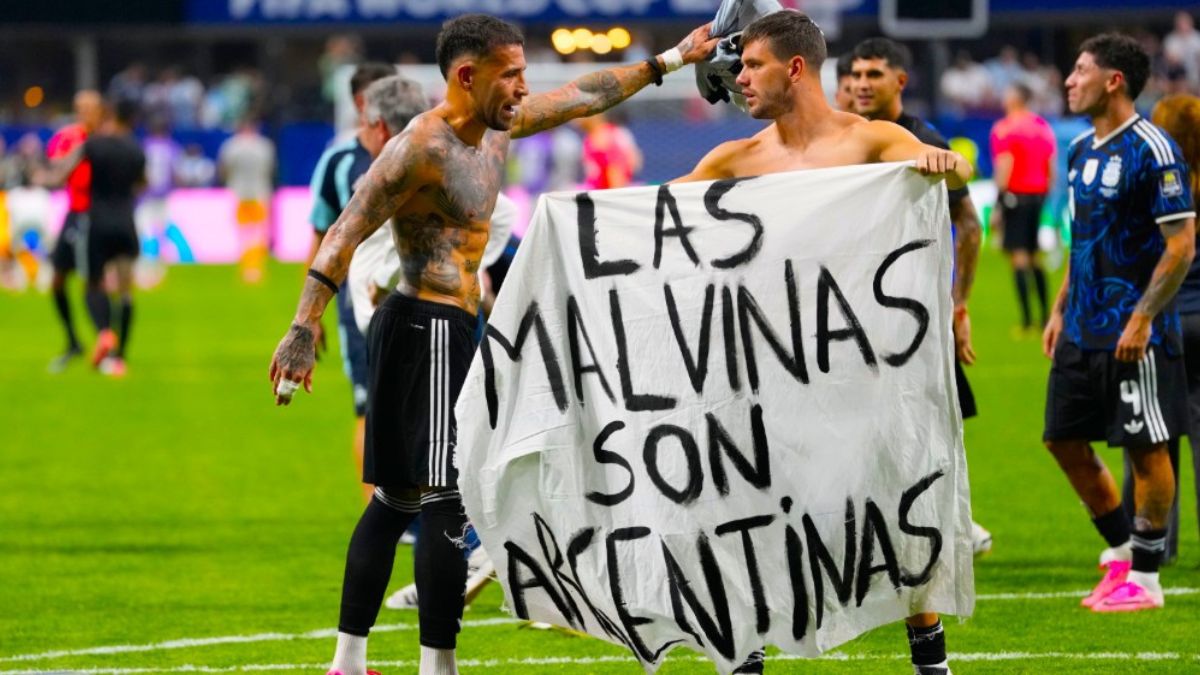
Argentina’s celebrations after reaching the FIFA World Cup 2026 final have come under scrutiny after several players were seen holding a politically charged banner following their 2-1 semi-final victory over England, prompting questions over whether FIFA could take disciplinary action before Sunday’s title clash against Spain.
The controversy erupted moments after Lionel Scaloni’s side secured their place in a second consecutive World Cup final in Atlanta. Television footage showed a group of Argentina players holding a banner that read “Las Malvinas son Argentinas” (“The Falkland Islands are Argentine”), a slogan linked to the long-running sovereignty dispute between Argentina and the United Kingdom.
With FIFA now reviewing the incident, attention has shifted from Argentina’s victory to whether any of the players involved could face sanctions, including a possible suspension.
What happened after Argentina beat England?
Following the final whistle, several Argentina players joined supporters during the on-pitch celebrations. Among them were reportedly defenders Lisandro Martinez and Cristian Romero, along with midfielder Giovani Lo Celso, who were seen posing behind the banner.
When asked by reporters about the banner the Argentine team held up reading “Las Malvinas son Argentinas” after their semi-final match against England, midfielder Leandro Paredes responded: “Yes, and it will always and forever be Argentine”.
The slogan refers to Argentina’s claim over the Falkland Islands, known domestically as the Malvinas. The dispute led to the 1982 Falklands War, a 74-day conflict between Argentina and the United Kingdom in which 255 British servicemen and 649 Argentine military personnel were killed.
Although political messaging has occasionally surfaced in football celebrations, the incident has attracted significant attention because it occurred during an official FIFA competition and just days before the World Cup final.
FIFA confirms disciplinary review
FIFA has confirmed that its independent disciplinary committee is assessing the incident.
“As is standard procedure, FIFA’s independent disciplinary committee is currently assessing the match reports and considering the relevant circumstances before deciding on potential further steps based on the FIFA Disciplinary Code,” the governing body said in a statement.
The review centres on Article 34.3 of the FIFA World Cup Match Protocol, which prohibits players and team officials from displaying political, religious or personal messages before, during or after matches.
FIFA’s Disciplinary Code also allows sanctions where football events are used to stage political demonstrations.
Could Argentina players miss the World Cup final?
At this stage, there is no indication that any Argentina player has been suspended. British politicians have nevertheless urged FIFA to impose sporting sanctions.
Liberal Democrat leader Ed Davey called on FIFA to suspend every player involved in displaying the banner. In a letter to FIFA president Gianni Infantino, he referenced UEFA’s decision to suspend Spain internationals Álvaro Morata and Rodri for one match after they chanted “Gibraltar is Spanish” during Euro 2024 celebrations.
UK cabinet minister Peter Kyle also criticised the incident, telling the BBC that politics should have no place in football and calling for a thorough FIFA investigation.
Despite those demands, reports from Spanish broadcaster COPE and Argentine newspaper Clarín suggest sporting suspensions before the final are considered unlikely.
Both outlets reported that any punishment, if imposed, is more likely to take the form of warnings or financial penalties against either the players involved or the Argentine Football Association (AFA). Neither report has been officially confirmed by FIFA.
What do previous FIFA cases suggest?
Football has seen several similar disciplinary cases involving political messages, though punishments have varied. At the 2018 FIFA World Cup, Switzerland internationals Granit Xhaka and Xherdan Shaqiri were fined after making political gestures during a match against Serbia but were not suspended.
UEFA imposed one-match bans on Spain captain Álvaro Morata and midfielder Rodri following Euro 2024 celebrations involving chants about Gibraltar.
South Korea’s Park Jong-woo also received a suspension after displaying a political banner during the London Olympics. Argentina have previously faced FIFA sanctions over Falklands-related political messaging. Following a 2014 friendly, the Argentine federation received a financial penalty after players displayed a banner supporting Argentina’s claim over the islands.
Those precedents suggest FIFA has often opted for fines or warnings rather than immediate sporting sanctions, particularly where incidents occurred after matches.
Uncertainty remains before Spain final
For now, Argentina continue preparations for Sunday’s World Cup final against Spain without any confirmed disciplinary action affecting player availability.
FIFA has not indicated when its disciplinary committee is expected to reach a decision. Multiple reports suggest the process could extend until after the tournament concludes, although the governing body has not publicly confirmed any timeline.
Unless FIFA announces otherwise before kick-off, Argentina are expected to have their full squad available as they attempt to defend the FIFA World Cup title.